-
Pre-clinical
 If you have purchased a pre-clinical question bank for the 2025/26 academic year, login to your account here: app.medibuddy.co.uk
- Exams
- Interviews
- Crash Courses
- Professional Development
- Exams


 Close
Close
Prepare for the 2026 Paediatric Cardiology ST4 Interview with Structured, Specialty-Specific Practice Questions
£135.00
Expires: 26 August, 2027

Question bank includes:
- Clinical Scenarios
- Portfolio and Commitment to Specialty
- Ethics and Professionalism
- Reflective Practice
- Dual-Route Preparation
The Paediatric Cardiology ST4 Interview Questions bank is built for doctors preparing for the Wessex-coordinated interview, delivered virtually via Qpercom. It covers both assessed areas of the panel, your clinical acumen and experience in paediatric cardiology and your suitability for appointment, and is written by high-scoring paediatric cardiology trainees who recently sat the interview.

“I was successful at interview and the scenarios were very similar to those on the Medibuddy website. The information on Medibuddy was really useful for interview preparation.”
“I wanted to say thank you for your wonderful site. I got my top ranked post and I scored highly in all stations.”
Updated for 2026
This question bank reflects the current 2026 Paediatric Cardiology ST4 interview format, with content reviewed against the latest published guidance and recent candidate feedback.
What to Expect from the Paediatric Cardiology ST4 Interview
Paediatric Cardiology ST4 is a small, competitive national round. NHS England’s 2025 figures show 63 applications for 10 posts (a ratio of 6.3:1), up from approximately 4.0:1 in 2019 based on available historical data. Post numbers have held roughly steady at around ten nationally, so the squeeze reflects a growing applicant pool rather than fewer training slots.
Recruitment is coordinated by the NHS England Wessex Recruitment Office (Paediatric Cardiology sits outside both the PSRO and the standard RCPCH GRID process), with applications and offers handled via Oriel. The interview is built around two assessed areas: your clinical acumen and experience in paediatric cardiology, and your suitability for appointment. Always confirm specifics against the current Wessex Applicant Guide.
Clinical Acumen and Experience in Paediatric Cardiology
This area assesses your clinical acumen and experience in paediatric cardiology through clinical scenarios. Each scenario opens with a stem question and is then developed by the panel through a series of subsidiary questions, so you are reasoning aloud and responding to follow-ups rather than delivering one rehearsed answer. Expect scenarios spanning cyanotic and acyanotic congenital heart disease across fetal, neonatal, paediatric and adult congenital settings, alongside acutely unwell children needing prioritisation and escalation. The panel is looking for structured clinical reasoning, safe escalation, MDT working and recognition of the ethical and legal issues these cases raise.
Suitability for Appointment
This area assesses your suitability for appointment through a series of structured questions put to all candidates. The questions may take into account your career history and training, your personal qualities, and how you deal with the specific challenges seen in paediatric cardiology. Because every candidate answers the same structured questions, strong preparation is about evidencing your motivation, insight and resilience with specific examples rather than trying to predict the exact wording. Be ready to draw on relevant clinical exposure, taster experience, audit, QI, research and teaching, and to show genuine insight into the realities of sub-specialty training, from antenatal diagnosis and post-operative deterioration to difficult parental conversations, safeguarding and end-of-life discussions.
What the Panel Is Looking For
Across both areas the panel is assessing the same underlying capabilities, drawn from the Paediatric Cardiology curriculum and the GMC Generic Professional Capabilities: clear clinical thinking under pressure, safe prioritisation, structured communication with families and colleagues, awareness of ethical and legal issues, and credible commitment to the sub-specialty. RCPCH guidance notes that a strong shortlisting score does not guarantee appointment if interview performance raises concerns, so interview delivery is decisive. Candidates who score well combine accurate paediatric cardiology knowledge with a calm, organised way of presenting it.
The Medibuddy 2026 Paediatric Cardiology ST4 Interview Question Bank
We’ve built the question bank around the actual format you’ll face: a remote interview delivered via Qpercom Recruit, two assessed areas covering your clinical acumen and experience and your suitability for appointment, and assessment anchored in the RCPCH curriculum and GMC Good Medical Practice. Coverage is comprehensive across both areas, including clinical scenarios with stem and subsidiary questions, reflective practice prompts, ethics and safeguarding in children and young people, consent and Gillick competence, and the motivation and commitment-to-specialty themes the Wessex panel works through.
The bank is written by high-scoring trainees and registrars who recently sat the Paediatric Cardiology ST4 interview, and it’s updated each year from fresh candidate feedback so the questions track what panels are actually asking.
What’s Included in the Paediatric Cardiology ST4 Interview Question Bank
The bank covers every capability assessed across the two areas of the Wessex-coordinated remote interview, your clinical acumen and experience and your suitability for appointment.
Clinical Scenarios
Structured questions across the Paediatric Cardiology curriculum, including congenital heart disease, fetal cardiology, arrhythmias, imaging and ACHD, with prompts designed to test reasoning under time pressure rather than recall alone.
Portfolio and Commitment to Specialty
Practice questions on tertiary-centre exposure, taster posts, EACVI congenital echo interest, audit cycles and QI projects, framed so you can rehearse mapping your evidence to the suitability questions.
Ethics and Professionalism
Scenarios drawing on GMC Good Medical Practice and GMC 0–18 guidance, covering consent, Gillick competence, safeguarding, end-of-life decisions and conflict with families.
Reflective Practice
Prompts built around the person specification’s reflective practice criterion, with worked structures for talking through a clinical incident, your role, the learning and the change in practice.
Dual-Route Preparation
Tailored material for MRCPCH and MRCP(UK) applicants, including ST1 paediatric capability questions for physician-route candidates.
How to Prepare for the Paediatric Cardiology ST4 Interview
Paediatric Cardiology ST4 sits outside the main physician specialty recruitment process: it’s run nationally by NHS England Wessex, delivered remotely via Qpercom Recruit, and for 2026 entry interviews fall on 12–13 March. The way you prepare should reflect that format, not a generic ST4 interview template.
Understand the format before you start practising
The Wessex interview is a panel-style virtual assessment built around two assessed areas: your clinical acumen and experience in paediatric cardiology, explored through clinical scenarios with a stem question and subsidiary follow-ups, and your suitability for appointment, tested through structured questions put to every candidate. It is not the 22-minute multi-station OSCE circuit used by adult Cardiology ST4, and confusing the two is a common early mistake. Within those two areas the panel draws on the RCPCH sub-specialty capabilities: clinical thinking, leadership and governance, motivation and commitment to the specialty, communication, and reflective practice. Read the current Wessex Applicant Guide before you write a single answer, and watch the RCPCH recruitment webinar so you know what the panel are scoring against on the day.
Focus on knowledge and delivery equally
Strong candidates are caught out at either end. Some have lived and breathed paediatric cardiology for years but answer questions as a stream of consciousness, missing the structure the panel are scoring. Others have a polished delivery but reach for generic paediatric examples when asked about a duct-dependent neonate, a post-operative arrhythmia, or a complex consent conversation in a tertiary cardiac unit. You need both: the specialty knowledge to be credible, and a structured delivery that lets the panel mark you on what you actually know.
Build preparation around both areas
Treat each area as a separate piece of work. For clinical acumen and experience, rehearse structured approaches to common scenarios: the cyanosed neonate, the collapsed infant with suspected duct-dependent lesion, the child with a new murmur, post-operative complications and arrhythmia management, and practise handling the subsidiary questions the panel layer on top of each stem. For suitability for appointment, prepare specific, evidenced examples that speak to your career history and training, your personal qualities, and how you deal with the specific challenges of the specialty: be ready to articulate why paediatric cardiology rather than general paediatrics or adult cardiology, to draw on audit, QI and serious incident work and link it back to learning, and to talk through breaking bad news to parents and discussing surgical risk in plain language.
Practise under timed conditions
Qpercom gives you a defined window per question with no second chances. Reading at your own pace from notes is a poor proxy for delivering an answer to camera with a clock running. Practise out loud, on video, to a strict time limit, ideally with a partner playing the panel. Review the recordings: most candidates speak too fast, bury the answer in preamble, or run out of time before the worked example lands.
Start earlier than you think
We typically recommend beginning structured interview preparation around eight to twelve weeks before the March interview window. That gives time to work through both areas, gather and rehearse personal examples, and run several rounds of timed mock practice. Candidates who start in February tend to know the content but haven’t drilled the delivery, and it shows.
Tie the principles back to deliberate practice
Reading about the format is the easy part. The lift in scores comes from rehearsing answers, hearing yourself, and rebuilding them. The question bank is designed for that loop: questions mapped to both assessed areas in the Wessex panel format, with model answers to benchmark against until the structure becomes automatic on the day.
Frequently Asked Questions
What does the Paediatric Cardiology ST4 interview involve?
The interview is a remote panel-style assessment coordinated by the NHS England Wessex Recruitment Office, scheduled for 12–13 March 2026 and delivered via Qpercom Recruit. It is built around two assessed areas: your clinical acumen and experience in paediatric cardiology, explored through clinical scenarios with a stem question and subsidiary follow-ups, and your suitability for appointment, tested through structured questions put to all candidates. Within those areas the panel draws on the RCPCH sub-specialty capabilities: clinical thinking, leadership and governance, motivation and commitment to specialty, communication, and reflective practice.
How competitive is Paediatric Cardiology ST4?
Very competitive, and the trend is upward. NHS England’s official competition ratios show 63 applications for 10 posts in 2025, a ratio of 6.3:1, up from around 4.0:1 in 2019. National post numbers have stayed roughly stable at around 10, so the rise reflects growing applicant volume rather than reduced training capacity.
What topics come up at the Paediatric Cardiology ST4 interview?
Questions are built around the two assessed areas. For clinical acumen and experience, expect paediatric cardiology scenarios that open with a stem question and develop through subsidiary follow-ups. For suitability for appointment, expect structured questions on your career history and training, personal qualities, motivation and commitment to the specialty, communication with families and colleagues, and reflective practice, which is an explicit essential criterion in the 2026 person specification.
Does the question bank cover every part of the interview?
Yes. The bank is organised around the actual structure of the Wessex-run ST4 interview, with practice material for both assessed areas: clinical acumen and experience, through scenario questions with stem and subsidiary prompts, and suitability for appointment, through the structured questions every candidate answers. It’s designed to mirror the virtual, panel-style format rather than the multi-station circuit used for adult Cardiology ST4.
When should I start preparing for the Paediatric Cardiology ST4 interview?
We recommend starting at least eight to twelve weeks before the March interview dates, alongside your written application. The panel format rewards rehearsed structure and specific examples drawn from paediatric cardiology exposure, and reflective answers in particular take time to refine. Starting early gives you room to practise delivery, get feedback, and tighten responses across both areas.
Start Preparing for the Paediatric Cardiology ST4 Interview
Most candidates prepare by reading broadly across congenital cardiology and hoping it shows on the day. Strong candidates prepare differently: they rehearse against the actual interview, refine delivery under time pressure, and align their answers to how the Paediatric Cardiology ST4 interview is genuinely assessed.
[CTA BUTTON: Start Practising Now]
£135.00
Expires: 26 August, 2027
Question bank includes:
- Clinical Scenarios
- Portfolio and Commitment to Specialty
- Ethics and Professionalism
- Reflective Practice
- Dual-Route Preparation
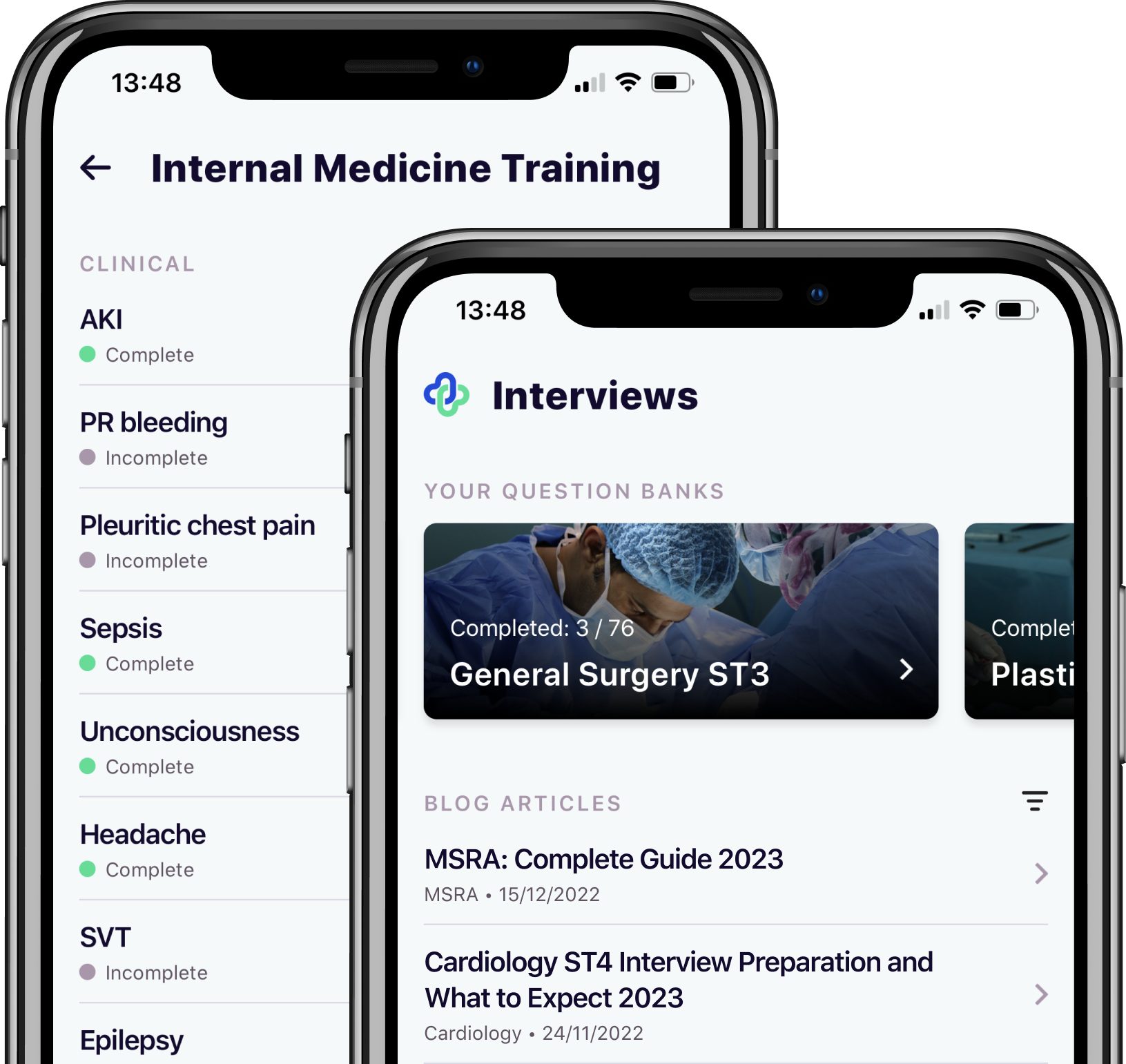
Take your subscriptions with you
Our mobile app allows you to access your interview and exam question banks wherever you are.