Close
Close

 6th August 2026
Complete Guide to Paediatric Cardiology ST4 Application and Recruitment (2026)
This guide covers everything you need to know about the Paediatric Cardiology ST4 Application for 2026 entry, walking you through the recruitment side from eligibility and the five-application cap through to self-assessment scoring and portfolio evidence. Your Paediatric Cardiology ST4 Application sits within a UK higher specialty training programme entered at ST4, running an indicative five years (ST4–ST8) under the RCPCH and JRCPTB, with National Selection coordinated by the NHS England Wessex office via Oriel. Entry is open via both the paediatrics (MRCPCH) and Internal Medicine Stage 1 (MRCP(UK)) routes, which shapes much of what follows. We’ve kept the interview itself brief here and covered it in depth on the Paediatric Cardiology ST4 Interview Question Bank page. Here’s the quick overview first.
Key Facts at a Glance
- Competition ratio (2025): 6.3:1 (63 applications, 10 posts)
- Training length: Five years (ST4–ST8), leading to CCT
- Entry requirement: MRCPCH or MRCP(UK) full diploma, plus GMC registration
- Recruitment lead: NHS England Wessex Recruitment Office, national process
- Application window (2026): 20 November – 11 December 2025 via Oriel
- Interview dates (2026): 12–13 March 2026, held remotely
Table of Contents
- What Is Paediatric Cardiology ST4 Higher Specialty Training?
- Is Paediatric Cardiology ST4 Competitive and What Is the Lifestyle Like?
- Paediatric Cardiology ST4 Eligibility Criteria and Entry Requirements
- How to Apply for Paediatric Cardiology ST4 National Recruitment
- Paediatric Cardiology ST4 Recruitment Timeline and Key Dates (2026)
- Paediatric Cardiology ST4 Competition Ratios and Application Trends
- How Paediatric Cardiology ST4 Applications Are Scored (2026)
- Paediatric Cardiology ST4 Self-Assessment and Portfolio: How to Maximise Your Score
- The Paediatric Cardiology ST4 Interview: A Brief Overview
- Paediatric Cardiology ST4 Offers, Preferencing and What Happens Next
- Frequently Asked Questions About Paediatric Cardiology ST4 Application
- Paediatric Cardiology ST4 Useful Resources
What Is Paediatric Cardiology ST4 Higher Specialty Training?
Paediatric Cardiology is a recognised UK higher specialty training programme entered at ST4, after you’ve completed core training and the relevant membership exam. It’s an uncoupled, run-through programme leading to a Certificate of Completion of Training (CCT) in Paediatric Cardiology, which entitles you to entry on the GMC Specialist Register and to take up a substantive NHS consultant post. Throughout the programme you train as a Specialty Registrar (StR) holding a National Training Number, with the CCT awarded at the end.
The programme has a dual-entry feel that’s unusual among paediatric subspecialties. Most trainees come in from paediatrics with MRCPCH, but you can also enter from Internal Medicine Stage 1 with MRCP(UK), provided you complete additional core paediatric and neonatal capabilities arranged by your employing deanery after appointment.
Oversight is shared between the Royal College of Paediatrics and Child Health (RCPCH) and the Joint Royal Colleges of Physicians Training Board (JRCPTB), with the curriculum hosted by the Federation. National Selection is run separately from the Physician Specialty Recruitment Office. It’s coordinated by the NHS England Wessex Recruitment Office via Oriel, on behalf of all four UK nations.
Structurally, the programme runs an indicative five years (ST4–ST8), typically split into roughly three years of core paediatric cardiology followed by two years in a chosen area of subspecialty interest. Sub-specialty options include fetal cardiology, interventional catheterisation, electrophysiology, advanced imaging, ACHD and cardiac intensive care. The curriculum is the 2021 JRCPTB/Federation Paediatric Cardiology Curriculum, built around Generic Professional Capabilities and specialty-specific Capabilities in Practice.
Programme structures evolve, so check the current applicant handbook for your recruitment year, particularly given the recent move to RCPCH Progress+ affecting feeder paediatric training.
Is Paediatric Cardiology ST4 Competitive and What Is the Lifestyle Like?
Paediatric Cardiology is one of the smaller, more specialised ST4 entry points, and competition reflects that. Only a handful of national posts are filled each year, and the field tends to attract candidates who’ve actively shaped their CV towards congenital cardiac work. If you’re drawn to long-term relationships with patients and families, a wide clinical canvas (fetal cardiology, paediatric inpatients, PICU and adult congenital heart disease), and technical work like echocardiography and catheter procedures, this specialty rewards that interest in a way few others can.
Lifestyle and on-call: Training runs ST4–ST8 in tertiary congenital cardiac centres, and you’ll join a specialty-specific middle-grade rota. Intensity varies a lot by host unit: official NHS job adverts show rotas ranging from 1 in 5 or 1 in 6 (banded 2B) at busier centres to roughly 1 in 9 or 1 in 10 elsewhere. A 2024 BJCA training survey analysis (Jenner et al.) flagged meaningful burnout across UK cardiology trainees, so it’s worth asking current registrars about the specific centre you’re considering. Less-than-full-time training is available with a well-founded reason; programme length extends pro rata.
Pay: ST4 sits at nodal point 4 on the national resident doctor scale (basic ~£65,048 in 2024/25), moving to nodal point 5 (~£73,992) from ST6. Take-home is higher once on-call, weekend and London weighting supplements are added.
Career trajectory: CCT leads to consultant posts in tertiary congenital cardiac centres, with subspecialty interests in fetal cardiology, interventional cardiology, electrophysiology, imaging or ACHD. Many trainees build a research or fellowship year into the pathway.
Paediatric Cardiology ST4 Eligibility Criteria and Entry Requirements
Eligibility for Paediatric Cardiology ST4 is set out in the NHS England person specification, published annually and applying across England, Northern Ireland, Scotland and Wales. The 2026 specification is the document to work from. If you’re applying in this round, treat it as the single source of truth, since exact wording can shift year on year.
What makes Paediatric Cardiology distinctive is its dual-route entry. You can come in via paediatrics or via adult medicine, and the requirements differ slightly depending on your background.
Core requirements for every applicant:
- Primary medical qualification: MBBS or equivalent.
- Registration: full GMC registration with a licence to practise by the post start date.
- Membership exam: either full MRCPCH (paediatric route) or full MRCP(UK) (physician route), achieved by the offer date. The MRCPCH is administered by the RCPCH.
- Right to work: a valid UK immigration status; most international applicants will need a Health and Care Worker visa sponsored by the employing trust.
- English language: evidenced at the GMC registration stage (typically IELTS Academic 7.5 overall with 7.0 in each domain, or OET grade B in each domain).
Route-specific competence sign-off:
- Paediatric route: completion of Core Paediatric Level 1 training (or equivalent), with capabilities signed off in your RCPCH ePortfolio.
- Physician route: completion of Internal Medicine Stage 1 (typically two years) with MRCP(UK), plus around 12 months of additional core paediatric and neonatal experience to evidence Level 1 paediatric capabilities before starting the ST4–8 curriculum.
There’s no upper cap on post-foundation experience, and no specialty aptitude test. Entry is governed by competence rather than time served.
For international medical graduates, the same person specification applies, but you’ll need to secure GMC registration first (via MRCPCH/MRCP(UK), PLAB, or a sponsorship route such as the RCPCH International Paediatric Sponsorship Scheme). The British Congenital Cardiac Association and RCPCH both recommend getting in touch early if you’re routing in from overseas, since evidencing equivalence to UK Level 1 paediatric capabilities can take planning.
How to Apply for Paediatric Cardiology ST4 National Recruitment
Paediatric Cardiology ST4 sits outside the Physician Specialty Recruitment Office (PSRO) process and is run as a single national annual cycle by the NHS England Wessex Recruitment Office. All steps below are drawn from the Wessex Applicant Guide and 2026 Person Specification. Always cross-check the live versions on the Wessex recruitment page before you submit.
Here’s the mechanical walkthrough for the 2026 round:
- Confirm your route and eligibility. You can enter from the paediatric route (MRCPCH full diploma) or the physician route (MRCP(UK) plus core paediatric/neonatal capabilities). Your exam must be passed by the offer date, so factor that into your timeline well before applications open.
- Plan your five Round 1 choices. For 2026 Round 1, NHS England has capped applications at five specialties per applicant. Paediatric Cardiology ST4 is a Round 1 specialty, so it has to fit inside that five. Round 2 (if posts remain) has no cap.
- Register and apply on Oriel. Applications opened at 10:00 on Thursday 20 November 2025 and closed at 16:00 on Thursday 11 December 2025. Everything (the form, evidence upload, preference ranking) runs through Oriel.
- Complete the form sections. The Oriel application covers personal details, qualifications, GMC registration, employment history, fitness to practise declarations, and the supporting information / self-assessment section that drives shortlisting. You’ll also rank your preferred deanery locations.
- Upload supporting documents. Expect to provide proof of primary medical qualification, MRCPCH or MRCP(UK), GMC registration, English language evidence where applicable, and the “alternative certificates” relevant to your route. Paediatric trainees usually need a Confirmation of Eligibility form signed by their educational supervisor or TPD via RCPCH ePortfolio/RISR. There is no application fee.
- Reapplicants, extra paperwork. If you’ve previously held (and relinquished) a specialty training programme, you must upload a “Support for Reapplication to a Specialty Training Programme” form signed by your Training Programme Director. Without it, your application won’t be considered.
- Longlisting, shortlisting, interview. Wessex longlists for eligibility, then shortlists against the published scoring framework. Only candidates who hit the cut-off are invited to the remote interview on 12–13 March 2026, with posts starting August 2026. Appointees join the programme as Specialty Registrars with a National Training Number (NTN).
- If unsuccessful. You can reapply in the next annual cycle. There’s no cap on attempts. Feedback is released after shortlisting and interview, and the Wessex Recruitment Team handles appeals where you can evidence a process breach.
If you’ve come through the Foundation Programme and paediatric training, most of this paperwork lives in your ePortfolio already. Pulling it together early is the quickest win.
Paediatric Cardiology ST4 Recruitment Timeline and Key Dates (2026)
Paediatric Cardiology ST4 sits outside the Physician Specialty Recruitment Office (PSRO) process and is coordinated nationally by the NHS England Wessex Recruitment Office. That’s worth flagging early, because Wessex (not the RCPCH sub-specialty portal or PSRO) is the authoritative source for dates. The 2026 cycle runs to a tight three-week application window in late November, with remote interviews in March.
Here’s how the 2026 round breaks down:
| Stage | Date (2025/26) |
|---|---|
| Advert published | 19 November 2025 |
| Applications open (Oriel) | 10am, 20 November 2025 |
| Applications close (Oriel) | 4pm, 11 December 2025 |
| Shortlisting outcomes / interview invitations | Issued via Oriel between application close and interview (exact date not published) |
| Interviews (remote) | 12–13 March 2026 |
| Initial offers (Round 2)* | By 14 April 2026 |
| Offer-holding deadline* | 1pm, 22 April 2026 |
| Offer upgrade deadline* | 4pm, 23 April 2026 |
*Offer, hold and upgrade dates are drawn from the wider NHS England Round 2 Higher Specialty Training timeline. It is not yet confirmed whether Wessex publishes its own specialty-specific offer-window dates for Paediatric Cardiology. Check the Wessex page for the definitive figures closer to the time.
A few practical notes. Supporting evidence is uploaded inside the main Oriel application window. There’s no separate portfolio upload portal with its own deadline for the Wessex-coordinated ST4 route. Wessex may publish specialty-specific offer dates closer to the time, so check the Wessex page once you’ve submitted. Dates shift each cycle, so confirm yearly against the current applicant guide.
Paediatric Cardiology ST4 Competition Ratios and Application Trends
Paediatric Cardiology ST4 is a small, nationally coordinated round, so even modest swings in applicant numbers shift the ratio sharply. The most recent published cycle (2025) saw the competition ratio climb to 6.30:1, up from 4.42:1 in 2024 and around 4.0:1 back in 2019. Post numbers have stayed roughly stable at 10 nationally, so the rise reflects more applicants chasing the same handful of training places.
| Year | Applications | Posts | Ratio |
|---|---|---|---|
| 2019 | 40 | 10 | 4.0:1 |
| 2024 | 53 | 12 | 4.42:1 |
| 2025 | 63 | 10 | 6.30:1 |
Figures are from NHS England’s official competition ratios pages, with the 2019 baseline from a historical compilation.
A couple of things are worth knowing. First, fill rates run high: in 2025, England filled all 8 advertised posts (100% fill), and 2024 sat at 80%. So while the headline ratio looks tougher each year, posts very rarely go unfilled. Strong applicants are appointed. Second, recruitment is run as a single National Selection process by the NHS England Wessex Recruitment Office, and posts cluster in a small number of specialist congenital cardiac centres. That means location preference, rather than geography of application, is where competitiveness really bites.
The 2026 round opened in November 2025 with interviews in March 2026, so this year’s ratio isn’t published yet, but the trend is clearly upward.
How Paediatric Cardiology ST4 Applications Are Scored (2026)
Paediatric Cardiology ST4 sits outside the main Physician Specialty Recruitment Office (PSRO) process. It’s coordinated nationally by the NHS England Wessex Recruitment Office, which means the scoring framework is different from adult Cardiology and most physician specialties. There’s no PSRO-style points grid. Instead, you’re assessed in two scored stages anchored in the published Person Specification and Shortlisting Criteria. Always cross-check the current year’s Wessex Applicant Guide and Shortlisting Criteria before you finalise your form, as exact weightings are reviewed annually.
The two scored stages
Stage 1: Application form shortlisting. Each application is independently scored by three paediatric cardiology consultants against Wessex’s published scoring guide, then quality-assured by the recruitment team. Points are awarded across structured domains drawn from your self-assessment answers and supporting evidence (covered in detail in the next section).
Stage 2: Remote interview. Shortlisted candidates are invited to a remote interview, which for 2026 entry is fully online. RCPCH sub-specialty guidance indicates that shortlisting scores are used to determine who’s invited to interview and don’t carry forward into the final ranking, meaning the interview itself effectively decides offers. This is an important quirk worth knowing: a strong portfolio gets you through the door, but it won’t compensate for a weaker interview performance.
Indicative domain weightings at shortlisting
Important caveat. The figures below are based on the most recently available 2024–25 Wessex scoring guide; the 2026 document may differ. Confirm at the Wessex recruitment page before submitting.
| Domain | Indicative points |
|---|---|
| Postgraduate degrees & qualifications | 0–5 (Masters/Bachelor 2; MD/PhD 3) |
| Research (design and lead original work) | 0–4 |
| Publications (only published or accepted work counts) | Tiered by author position |
| Presentations | Tiered by level (local/national/international) and format |
| Clinical audit / QI | 0–2 (1 for conducting, 1 for closing the loop) |
| Teaching experience and qualifications | 0–4 |
| Courses relevant to paediatric cardiology | 1–3 |
The headline message: domain maxima are modest and closely matched, so a single weak area can be offset by strong performance elsewhere, but the converse is also true. A missing closed audit loop or an absent teaching qualification can cost you the marginal points that decide an interview invitation. We unpack exactly how to evidence each domain in the next section.
Paediatric Cardiology ST4 Self-Assessment and Portfolio: How to Maximise Your Score
The Paediatric Cardiology ST4 self-assessment is structured around six domains on the Oriel form, with each application independently scored by three consultants against the Wessex Shortlisting Criteria.
Where the points actually sit
In recent years, the scored domains have covered:
- Commitment to specialty: evidenced through dedicated cardiology placements, taster weeks, OOPE, BCCA membership, conferences and an echocardiography course logbook. There’s no minimum duration prescribed; assessors look for depth of engagement.
- Clinical experience and skills: paediatric cardiology exposure, personal echo logbook entries and supervisor sign-off. This replaces a surgical-style logbook score.
- Research: graded 0–4, with descriptors moving from local involvement up to leading original research (PhD/MD-level work scores at the top).
- Publications and presentations: peer-reviewed papers are tiered above abstracts; first-author and higher-impact outputs score better.
- Quality improvement / audit: recent years’ criteria explicitly reward closing the loop with a re-audit, not a single-cycle project.
- Teaching, leadership and management: scored 0–4. Note that the exact Paediatric Cardiology tariff for formal teaching qualifications isn’t published in the snippets we’ve reviewed, so check the current shortlisting matrix. That said, formal teaching qualifications (PGCert/PGDip in Medical Education) are likely to attract points in line with related physician specialties.
How evidence is verified
Every self-assessment claim needs documentary backing from the moment you submit: supervisor letters, certificates, conference programmes, acceptance emails, audit reports and ePortfolio entries. The recruitment team scrutinises evidence at shortlisting, and assessors can adjust your scores. The RCPCH also requires a separate Confirmation of Eligibility form via RISR before the Oriel deadline.
Where candidates lose easy points
- Do close the audit loop and have a signed report ready.
- Do keep a dated, supervisor-signed echo logbook from your first cardiology block onwards.
- Don’t claim “leading” research for a project where you were a contributor. Assessors downgrade overclaims.
- Don’t rely on a teaching role without certificates of feedback or a formal qualification.
- Don’t leave QI as a single cycle; the descriptors reward demonstrable impact.
If you’re 12 months out, prioritise an accredited echo course, a re-audited QI project and a first-author publication or national presentation. These three moves shift you across the most scoring bands at once. The Medibuddy blog has further worked examples of portfolio-building strategies across ST3/ST4 specialties.
The Paediatric Cardiology ST4 Interview: A Brief Overview
Paediatric Cardiology ST4 recruitment is coordinated nationally by NHS England Wessex, and for the 2026 round interviews are being held virtually via the Qpercom Recruit platform on 12–13 March 2026. Unlike the multi-station OSCE circuit used for adult Cardiology ST4, the paediatric pathway uses a panel-style virtual interview, broken into themed sections, starting with a Suitability component and progressing through further clinical, academic, and leadership-focused domains, based on the Wessex Applicant Guide. The exact station count and total duration are not officially published in the retrieved guidance, so confirm in the live Wessex Applicant Guide once it’s released for the round.
Because the format, themes and scoring deserve a proper walkthrough (with worked examples rather than a quick summary), we’ve kept the deep dive separate.
Preparing for the interview? Head to the Paediatric Cardiology ST4 Interview Question Bank for a full station-by-station breakdown, scenario questions and model answers written by recently appointed trainees.
Paediatric Cardiology ST4 Offers, Preferencing and What Happens Next
Once interviews close, the Wessex Recruitment Office ranks all candidates nationally and sends offers through Oriel. Because Paediatric Cardiology ST4 sits outside the Physician Specialty Recruitment Office process, everything, from preferencing to upgrades, runs through the Wessex national recruitment Oriel pipeline. Here’s roughly how it unfolds:
- Preferencing. Before or shortly after interview (check the round’s published dates), you rank every available post by deanery on Oriel. With only around 10 posts nationally in recent rounds, geographic flexibility matters. Rank honestly, but rank all of them if you’d accept them.
- Initial offer. Offers are released in rank order against your preferences. You can decline, accept outright, or accept with upgrades (sometimes called the hold-down period). Successful candidates take up an NTN-holding Specialty Registrar post from August.
- Hold and upgrades. If you accept with upgrades, Oriel automatically moves you to a higher-preferenced post if one becomes available. You won’t be contacted first. Upgrades continue until the published upgrade deadline, after which allocations are final.
- Pre-employment checks and start. Once allocated, your employing trust handles occupational health, DBS and right-to-work checks ahead of the August start.
A quick caveat: small post numbers mean the reserve list moves slowly, so don’t bank on late upgrades. Always cross-check the current round’s timeline in the Wessex applicant guide.
When you’re ready to prepare for the interview stage that feeds into all of this, the Paediatric Cardiology ST4 Interview Question Bank has scenario questions with model answers from recent appointees.
Frequently Asked Questions About Paediatric Cardiology ST4 Application
How competitive is Paediatric Cardiology ST4?
Competition has tightened over recent cycles. NHS England figures show the 2025 round had 63 applications for 10 posts (a ratio of 6.3:1), compared with around 4.0:1 in 2019. Post numbers have stayed roughly stable, so the rise reflects growing applicant interest rather than shrinking training capacity. Expect 2026 to remain competitive.
Who is eligible to apply for Paediatric Cardiology ST4?
You need MBBS or equivalent, GMC registration, and either the full MRCPCH diploma (paediatric route) or full MRCP(UK) diploma (physician route). Physician-route entrants must also evidence around 12 months of paediatric and neonatal capabilities before starting the ST4–8 programme. The official 2026 person specification is published by NHS England and applies across all four UK nations.
How do I apply for Paediatric Cardiology ST4?
Applications go through the Oriel national portal. Recruitment is coordinated by the NHS England Wessex Recruitment Office on behalf of all four UK nations. It sits outside the PSRO process used by most adult medical specialties. For the 2026 intake, applications opened on 20 November 2025 and closed on 11 December 2025, with interviews held remotely on 12–13 March 2026.
How does shortlisting work for Paediatric Cardiology ST4?
After applications close, Wessex carries out a longlisting eligibility check followed by shortlisting against published criteria. Your self-assessment and supporting evidence are scored against the Wessex shortlisting framework, and only candidates reaching the required standard are invited to interview. There’s a formal shortlisting appeals stage if you believe a domain has been mis-scored.
How long is Paediatric Cardiology training in the UK?
Higher specialty training is an indicative five-year programme running ST4 to ST8, leading to a Certificate of Completion of Training (CCT). It’s typically structured as around three years of core paediatric cardiology followed by two years in a chosen area of subspecialty interest. Trainees entering from an internal medicine background may need an additional nominal year of paediatric and neonatal experience first.
How many Paediatric Cardiology ST4 posts are advertised each year?
National post numbers have been small and fairly stable, usually around 10 posts per round across the UK. NHS England published 12 advertised posts in the 2024 round (53 applications, 4.42:1), with the fill-rate page showing 10 posts ultimately accepted. Indicative post numbers for each cycle appear on the Wessex Paediatric Cardiology ST4 page once recruitment opens.
Can I reapply if I’m unsuccessful at Paediatric Cardiology ST4?
Yes. There’s no cap on the number of times you can apply for Paediatric Cardiology ST4. Many successful candidates apply more than once, using the intervening year to strengthen weaker self-assessment domains, typically publications, formal teaching qualifications, quality improvement and paediatric cardiology-specific experience. Feedback on your shortlisting score is available after each round and is the best place to start.
How do offers and upgrades work after the interview?
Offers are released through Oriel. You can accept outright, decline, or accept and hold with upgrades. If you opt in for upgrades and a higher-preferenced post later becomes available, Oriel upgrades you automatically without contacting you first. Upgrades continue until the published deadline, after which all allocations are finalised. Make sure your preference order genuinely reflects where you want to train.
Paediatric Cardiology ST4 Useful Resources
When you’re pulling your application together, go straight to the official sources first. They tell you exactly what’s being scored.
Official recruitment and person specification
- NHS England Paediatric Cardiology ST4 2026 person specification: essential entry criteria, including MRCPCH or MRCP(UK) routes.
- Wessex Recruitment Office: Paediatric Cardiology ST4 National Recruitment: the applicant guide, shortlisting criteria, alternative certificates and indicative post numbers. Recruitment is coordinated here, not via PSRO.
- Oriel: where you actually submit the application.
Curriculum and specialty context
- British Congenital Cardiac Association: Education and Training: ST4–8 programme structure and dual-entry routes.
- 2021 Paediatric Cardiology Curriculum (Federation/JRCPTB): the capabilities you’ll be expected to demonstrate.
- RCPCH sub-specialty shortlisting and scoring guidance
Medibuddy guides
- Paediatric Cardiology ST4 Interview Question Bank: scenario questions with model answers from high-scoring trainees.
Applying for Paediatric Cardiology ST4 is a big step, but it’s a manageable one when you break it down: meet the person specification, get your MRCPCH or MRCP(UK) evidence in order, build a portfolio that maps cleanly onto the Wessex shortlisting criteria, and submit through Oriel by the deadline. Get those foundations right and you’ve already done most of the hard work.
When you’re ready to turn your attention to the interview itself, the Paediatric Cardiology ST4 Interview Question Bank has scenario questions with model answers, put together by trainees who’ve been through National Selection recently. Good luck. You’ve got this.
Take your subscriptions with you
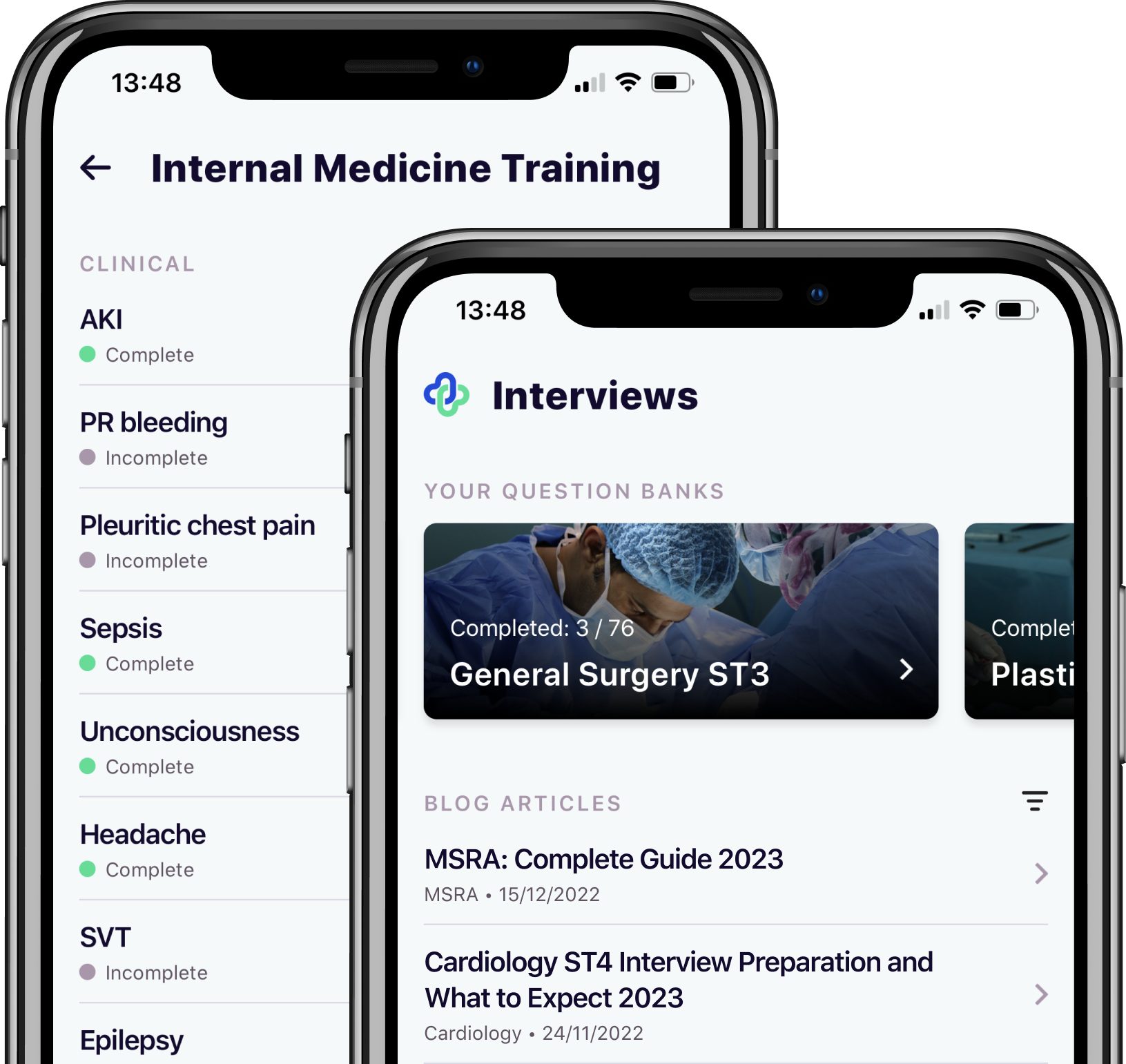
Our mobile app allows you to access your interview and exam question banks wherever you are.