-
Pre-clinical
 If you have purchased a pre-clinical question bank for the 2025/26 academic year, login to your account here: app.medibuddy.co.uk
- Exams
- Interviews
- Crash Courses
- Professional Development
- Exams


 Close
Close
Prepare for the 2026 Geriatric Medicine ST4 Interview with Structured, Specialty-Specific Practice Questions
£135.00
Expires: 03 September, 2027

Question bank includes:
- Clinical Scenario
- Suitability & Commitment
- Ethical Scenario
- Medical Registrar Suitability
Geriatric Medicine ST4 Interview Questions built for doctors preparing for the 2026 national selection interview. The question bank covers every station of the online panel, from clinical and ethical scenarios to suitability and commitment and the medical registrar role, and is written by high-scoring registrars with recent experience of the selection process.

“I was successful at interview and the scenarios were very similar to those on the Medibuddy website. The information on Medibuddy was really useful for interview preparation.”
“I wanted to say thank you for your wonderful site. I got my top ranked post and I scored highly in all stations.”
Updated for 2026
This question bank reflects the current 2026 Geriatric Medicine ST4 interview format, with content reviewed against the latest published guidance and recent candidate feedback.
What to Expect from the Geriatric Medicine ST4 Interview
Geriatric Medicine ST4 recruitment is coordinated nationally by the Physician Higher Specialty Training (PHST) office on behalf of JRCPTB, with applications submitted through Oriel. Competition sits at 2.06:1 for the 2025 round (323 applications for 157 posts, NHS England), up slightly from 1.75:1 in 2024. The specialty remains less oversubscribed than most physician routes, but with published appointability thresholds the interview itself is where posts are won or lost.
The interview is delivered online as a two-station structured panel lasting 40 minutes, with each station scored by its own pair of consultant interviewers and roughly four questions of 5–10 minutes each across the interview. A third clinician occasionally joins to share questioning, and communication is marked across the encounter as a whole. The four assessed areas below sit across the two stations; specifics can shift year on year.
Clinical Scenario
You’ll be given a hypothetical clinical scenario involving a complex older patient and asked to talk through your assessment, prioritisation and management. This tests clinical reasoning against the Comprehensive Geriatric Assessment framework: acute medical management, frailty, multimorbidity, functional and social context, and MDT decision-making. Scoring is on a 1-5 scale per assessment area, contributing to the Raw Interview Score.
Suitability and Commitment
Expect questions on why you have chosen geriatric medicine, the experiences that evidence that commitment (taster weeks, audits and QI in older people’s care, teaching, BGS involvement), and your plans within dual GIM and geriatrics training. Panels probe the claims in your portfolio and self-assessment, so have specific, credible examples ready. Each assessment area is again scored 1-5 by the paired interviewers.
Ethical Scenario
Scenarios built around the issues that dominate geriatric practice: mental capacity and best interests, consent, DNACPR and ceilings of care, end-of-life decisions and safeguarding, framed against GMC Good Medical Practice. Professionalism and governance material, such as managing a colleague’s behaviour or responding to a complaint, can also surface here.
Medical Registrar Suitability
Because Geriatric Medicine ST4 dual-trains with Internal Medicine, the panel tests your readiness for the medical registrar role: acute take decision-making, prioritisation, escalation, handover and leading the team out of hours.
What the Panel Is Looking For
Ten individual 1-5 scores across the two stations produce a Raw Interview Score out of 50, which is weighted to produce a Weighted Interview Score out of 80. This is combined with an Application Score (out of 40, halved to 20) to give a Total Score out of 100. To be appointable you need no 1/5 in any domain, no more than two 2/5 scores, and a minimum RIS of 30. Across every station the panel is assessing the same underlying attributes set out in the person specification: sound clinical judgement in older patients, empathy, MDT working, probity, and a credible, evidenced commitment to geriatric medicine. Communication is marked across the whole interview (clarity of thought, structure, and how you handle ethically loaded conversations with patients, families and colleagues), so it carries real weight in the final ranking.
The Medibuddy 2026 Geriatric Medicine ST4 Interview Question Bank
We’ve built the question bank around the actual shape of the Geriatric Medicine ST4 interview and the four areas it assesses: the Clinical Scenario, Suitability and Commitment, the Ethical Scenario, and Medical Registrar Suitability. Coverage is comprehensive across every station, from capacity and DNACPR ethics, end-of-life and ceiling-of-care decisions and safeguarding through to the clinical scenarios that come up repeatedly in older-patient care and the acute take material of the medical registrar role. Every question and model answer is written by high-scoring geriatric medicine registrars who recently sat the interview, and the question bank is updated each year using feedback from that year’s candidates.
What’s Included in the Geriatric Medicine ST4 Interview Question Bank
Clinical Scenario
Practice cases covering comprehensive geriatric assessment, frailty, falls, delirium, dementia, stroke and acute deterioration in older patients, structured to the 5–10 minute question format used at interview.
Suitability and Commitment
Prompts that mirror how panels probe motivation and self-assessment claims, from why geriatrics, taster experience and BGS involvement to postgraduate qualifications, publications, teaching, quality improvement and leadership.
Ethical Scenario
Scenarios built around the issues that dominate geriatric practice: mental capacity, consent, DNACPR, ceilings of care, end-of-life decisions and safeguarding, framed against GMC Good Medical Practice and the four principles.
Medical Registrar Suitability
Because ST4 Geriatric Medicine dual-trains with GIM, we include acute take, handover and prioritisation scenarios testing your readiness for the med reg role.
How to Prepare for the Geriatric Medicine ST4 Interview
Preparation for the Geriatric Medicine ST4 interview isn’t about learning stock answers. It’s about understanding what each of the two stations is scoring, then rehearsing your material until you can deliver it precisely within the time each interviewer pair gives you.
Understand the format before you start practising
The interview is delivered online as a two-station structured panel, with a separate pair of interviewers scoring each station. Total interview time is 40 minutes, split across roughly four questions of 5 to 10 minutes each with an overall communication mark layered across the whole encounter. Before you rehearse a single answer, read the current Geriatric Medicine guidance and the 2026 person specification so you know exactly which areas (the clinical scenario, suitability and commitment, the ethical scenario and medical registrar suitability) sit in front of which interviewer pair. Working through the question bank in parallel with the person specification is the most efficient way to translate those criteria into rehearsed answers; practising blind against a generic "med interview" format wastes time.
Focus on knowledge and delivery equally
Strong clinical content delivered as an unstructured monologue scores poorly, and a slick structure with thin geriatrics knowledge is caught immediately by consultant interviewers. We recommend treating knowledge and delivery as two separate workstreams. Build your underlying content (frailty syndromes, falls, delirium, dementia, continence, end-of-life decision making, capacity, and the acute general medical topics you’ll be expected to handle as a dual-accredited registrar) using the 2022 JRCPTB curriculum, BGS guidance (including the Silver Book), and relevant NICE guidelines. Then use timed question practice against the question bank to turn that knowledge into structured, spoken answers that fit the 5 to 10 minute window.
Build preparation around each station
Clinical Scenario: Rehearse acute geriatric scenarios out loud: the frail patient with delirium and sepsis, the falls admission with an atypical presentation, the polypharmacy review, the MDT decision on ceiling of care. Use a clear framework, work through assessment, differential, immediate management and MDT/discharge planning, and practise finishing inside the question window.
Suitability and Commitment: Prepare your "why geriatrics, why now" narrative and the evidence behind it: taster experience, QI work, teaching and BGS involvement, and what they tell the panel about your fit for a four-year dual GIM programme. Have specific examples ready; the panel will probe.
Ethical Scenario: Prepare for capacity and best-interests scenarios, DNACPR and ReSPECT conversations, safeguarding, complaints, colleague behaviour and clinical governance, structured around the four principles and GMC guidance.
Medical Registrar Suitability: Drill acute take prioritisation, escalation and handover scenarios, and be ready to talk through how you’d run a take list, manage a deteriorating patient and lead the team overnight as the on-call medical registrar.
Practise under timed conditions
The 5 to 10 minute question window is the constraint most candidates underestimate. In real interviews, strong answers get cut off mid-flow and weak ones sprawl. We recommend practising with a visible timer from your very first mock: 60 seconds to think, then a structured answer that lands its main points inside the window and closes cleanly. Record yourself, listen back, and cut filler.
Start earlier than you think
We recommend beginning focused interview preparation around eight to twelve weeks before your interview date, alongside continued portfolio and self-assessment work. That gives you time to build clinical content, run at least two full mock cycles across both stations, and refine your commitment-to-specialty narrative. Candidates who start in the final fortnight typically know the material but haven’t rehearsed delivery, and it shows in the communication mark that sits across the whole interview.
Practise deliberately with the question bank
Reading through model answers isn’t practice. The question bank is designed to be worked through out loud, timed, station by station, so that by interview day the format feels familiar and your answers land inside the window. Rotate between the clinical scenarios and the non-clinical areas rather than drilling one domain in isolation, and revisit weaker questions until the structure is automatic.
Frequently Asked Questions
What does the Geriatric Medicine ST4 interview involve?
The interview is delivered online through the national recruitment process as a structured two-station panel lasting 40 minutes, with two scoring interviewers per station. Across the stations you’ll face a clinical scenario, suitability and commitment questions, an ethical scenario and medical registrar suitability questions, with communication assessed throughout.
How competitive is Geriatric Medicine ST4?
Competition is moderate compared with most physician specialties. NHS England’s published figures show 323 applications for 157 posts in the 2025 round, a ratio of 2.06:1, up slightly from 1.75:1 in 2024. The specialty has historically been undersubscribed, but rising applicant numbers mean interview performance still decides who ranks where and who secures their preferred region.
What topics come up in the Geriatric Medicine ST4 interview?
Expect clinical scenarios rooted in older people’s medicine: delirium, falls, frailty, deteriorating patients, and ceiling-of-care decisions. Ethical scenarios cover consent, capacity, safeguarding and end-of-life discussions. You’ll also be asked about your commitment to the specialty and your readiness for the medical registrar role, with questions drawing on your portfolio, teaching, quality improvement and leadership experience.
Does the question bank cover every station?
Yes. The question bank is built around the two-station format used for Geriatric Medicine ST4, with practice questions across all four assessed areas: the clinical scenario, suitability and commitment, the ethical scenario and medical registrar suitability. Each question includes a model answer and marking guidance mapped to the domains interviewers actually score, so you can rehearse the full interview rather than isolated topics.
When should I start preparing for the Geriatric Medicine ST4 interview?
We recommend starting around eight to twelve weeks before your interview date. That gives you time to work through clinical scenarios covering the core geriatric syndromes, refine a structured approach to ethical scenarios, prepare suitability and commitment answers, and drill the acute scenarios of the medical registrar role. Candidates who begin only in the final fortnight rarely have time to move from knowing content to delivering it clearly under timed conditions.
Start Preparing for the Geriatric Medicine ST4 Interview
Most candidates prepare by reading broadly across geriatric syndromes and hoping it translates on the day. Strong candidates prepare differently. They practise the exact stations they’ll face, rehearse structured answers under time pressure, and align their preparation to how the ST4 interview is actually assessed.
£135.00
Expires: 03 September, 2027
Question bank includes:
- Clinical Scenario
- Suitability & Commitment
- Ethical Scenario
- Medical Registrar Suitability
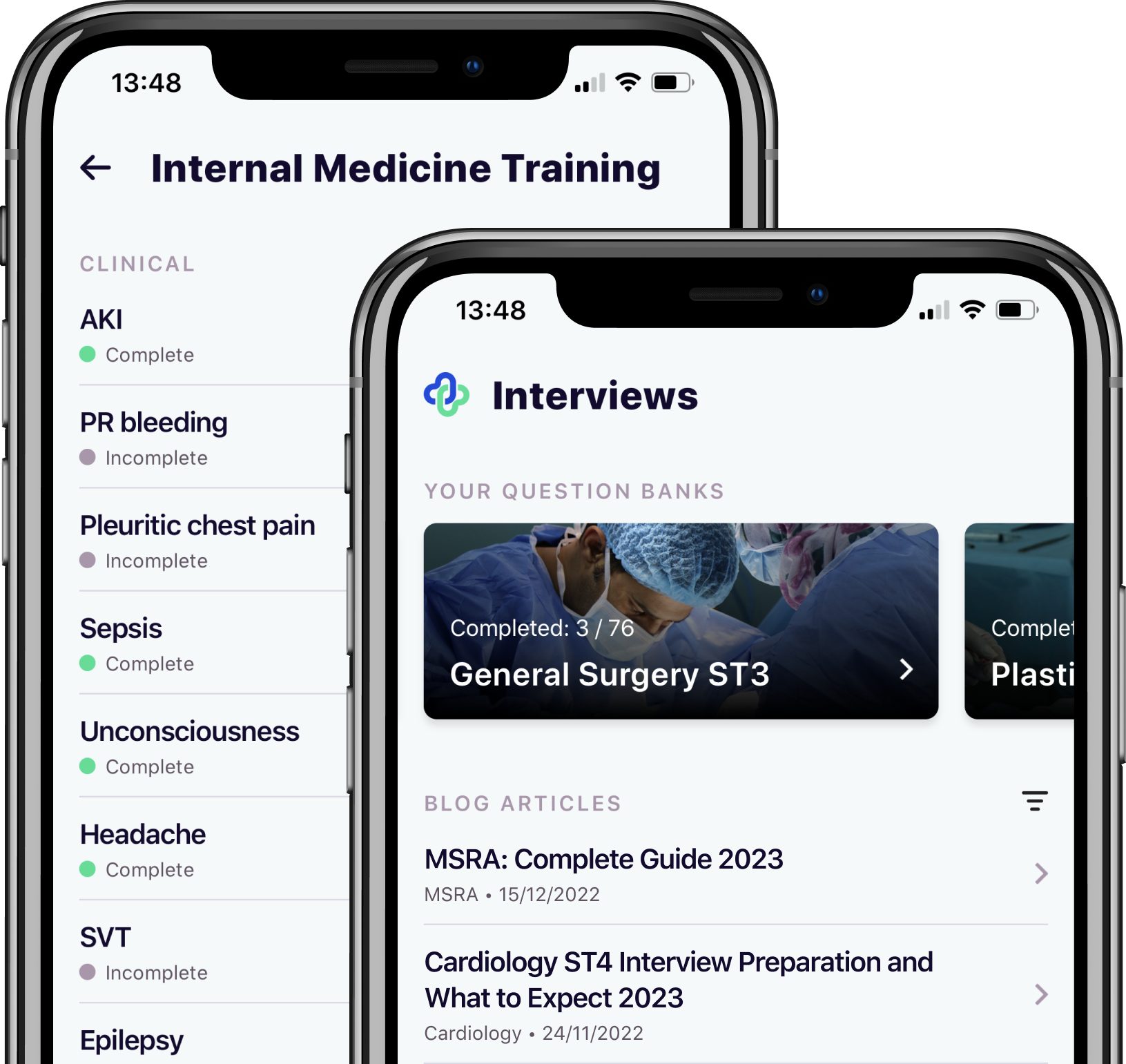
Take your subscriptions with you
Our mobile app allows you to access your interview and exam question banks wherever you are.