Close
Close

 7th July 2026
Complete Guide to Clinical Genetics ST3 Application and Recruitment (2026)
Applying for Clinical Genetics ST3 is a genuinely competitive step, and a well-planned Clinical Genetics Application makes all the difference. This guide is for UK doctors preparing to enter higher specialty training at ST3 after Internal Medicine Training, GP with MRCGP, ACCS or paediatric core training with MRCPCH: the uncoupled four-year Specialty Registrar programme overseen by JRCPTB, with national recruitment run through Oriel.
We’ll walk you through eligibility, the recruitment timeline, self-assessment domains, portfolio evidence and scoring: everything on the application side that earns you points before you’re shortlisted. The interview itself is summarised briefly here and covered in depth on the Clinical Genetics ST3 Interview Question Bank page. Let’s start with the headline facts.
Key Facts at a Glance
- Competition ratio (2025): 5.6:1 (84 applications, 15 posts)
- Training length: 4 years full-time from ST3 to CCT
- Entry exam: MRCP(UK), MRCPCH, MRCGP or equivalent Part 1
- Recruitment platform: Oriel, coordinated nationally via the Midlands region
- 2026 application window: 23 October 2025 – 20 November 2025; interviews 25 February 2026
- Posts start: August 2026, with full GMC registration required
Table of Contents
- What Is Clinical Genetics ST3 Higher Specialty Training?
- Is Clinical Genetics ST3 Competitive and What Is the Lifestyle Like?
- Clinical Genetics ST3 Eligibility Criteria and Entry Requirements
- How to Apply for Clinical Genetics ST3 National Recruitment
- Clinical Genetics ST3 Recruitment Timeline and Key Dates (2026)
- Clinical Genetics ST3 Competition Ratios and Application Trends
- How Clinical Genetics ST3 Applications Are Scored (2026)
- Clinical Genetics ST3 Self-Assessment and Portfolio: How to Maximise Your Score
- The Clinical Genetics ST3 Interview: A Brief Overview
- Clinical Genetics ST3 Offers, Preferencing and What Happens Next
- Frequently Asked Questions About Clinical Genetics ST3 Application
- Clinical Genetics ST3 Useful Resources
What Is Clinical Genetics ST3 Higher Specialty Training?
Clinical Genetics is a GMC-approved higher specialty training programme entered at ST3, after you’ve completed a recognised core stage. It’s an uncoupled, four-year run-through programme (ST3–ST6) that leads to a Certificate of Completion of Training (CCT) in Clinical Genetics and eligibility for the GMC Specialist Register. Recruitment is run nationally through Oriel, historically hosted by the Yorkshire and Humber Deanery on behalf of NHS England, and the curriculum is set by the Joint Royal Colleges of Physicians Training Board (JRCPTB, “the Federation”).
Entry is at ST3 only; there’s no ST4 entry point. You’ll normally arrive via Internal Medicine Training stage 1, ACCS-IM, paediatrics to ST3-level capabilities, or general practice with MRCGP, using the JRCPTB Alternative Certificate route if you’re a non-IMT applicant.
Training is largely outpatient and multidisciplinary: you’ll work alongside genetic counsellors, laboratory scientists and clinicians from almost every other specialty. There are no formal CCT sub-specialties, but most consultants develop a defined interest such as cancer, cardiac, prenatal or neurogenetics, and academic pathways are actively encouraged. Programme length and curriculum outcomes are uniform UK-wide, but rotational patterns and post numbers vary by deanery.
Is Clinical Genetics ST3 Competitive and What Is the Lifestyle Like?
Clinical Genetics is a small, national specialty with limited posts each year, so competition is genuinely tight even though the applicant pool isn’t huge. Because numbers are so small, competition ratios fluctuate year to year and aren’t as reliably published as for larger specialties, so we’d recommend checking the latest NHS England competition data before you apply. What’s consistent is that panels expect clear, sustained evidence of commitment to genetics; casual applicants tend not to make it through.
Lifestyle is one of the biggest draws. Training is almost entirely outpatient-based at a Regional Genetic Centre, with only occasional ward referrals and minimal acute on-call. The Clinical Genetics Society’s 2025 trainee workforce report found 58.3% of trainees cited work-life balance as a leading factor in choosing their centre. Clinics tend to run longer than in most medical specialties, giving you time for detailed family history-taking, counselling and MDT discussion with genetic counsellors and laboratory scientists.
Training runs for four years at ST3–ST6, usually based in a single regional centre, so geographic stability is a real feature. Less-than-full-time training is explicitly welcomed from the outset, extending calendar length pro rata but keeping ARCP standards identical.
On pay, you’ll join at Nodal 4 (around £65,048 basic in England for 2025–26 per BMA scales), rising to roughly £73,992 at ST6+, plus London weighting where applicable. Banding supplements are usually modest given the limited out-of-hours work.
After CCT, most trainees move into consultant roles within the NHS Genomic Medicine Service, often with strong academic links given the field’s expansion since the 100,000 Genomes Project.
Clinical Genetics ST3 Eligibility Criteria and Entry Requirements
Clinical Genetics is one of the more unusual ST3 entry points because it accepts applicants from a wide range of parent specialties. That said, the essential criteria are strict and published each year in the NHS England person specification for Clinical Genetics ST3 2026. If any single criterion isn’t met by the offer date, the application won’t progress, so it’s worth working through the list carefully before you commit time to the self-assessment.
Here’s what you’ll need in place:
- Primary medical qualification: MBBS or equivalent, with completion of the Foundation Programme competences (or evidence of equivalent competences if you trained outside the UK).
- GMC registration: full registration with a licence to practise by the post start date.
- A route-specific membership exam by the offer date. The accepted routes are broad:
- Physicians: MRCP(UK) Part 1 at application, full MRCP(UK) diploma by offer (or eligibility for the GIM specialist register, or Irish Basic Specialty Training plus MRCPI). If you’re coming through this route, our MRCP guide may help.
- Paediatrics: MRCPCH.
- General practice: full MRCGP.
- Other routes: MRCS, primary FRCA, MRCPsych, MRCOG Part 1 or FRCOphth Part 1 are also accepted per the curriculum.
- English language proficiency: IELTS Academic 7.5 overall (7.0 in each domain) or OET grade B (400) in each subtest, unless you meet an alternative GMC route.
- Right to work: UK right to work or eligibility for a Certificate of Sponsorship via the National Overseas Sponsorship Team for international applicants.
A couple of practical points worth flagging. First, unlike some ST1 entry points, Clinical Genetics ST3 doesn’t apply a documented cap on months of prior post-Foundation experience, so applicants coming in later in their careers aren’t disqualified on those grounds. Second, exact wording of essential and desirable criteria can shift year to year, so always cross-check against the current NHS England person specification before submitting through Oriel.
How to Apply for Clinical Genetics ST3 National Recruitment
Clinical Genetics is a small, nationally coordinated round (84 applicants for 15 posts in 2025, per NHS England competition data), run entirely through Oriel with the Midlands region managing longlisting and shortlisting on behalf of the UK. The steps below reflect the 2026 cycle, and we’d recommend cross-checking each stage against the current applicant handbook on the PHST recruitment site before you submit.
- Confirm you meet the person specification. The 2026 person spec sets out the dual entry route: MRCP(UK) Part 1 at the point of application (with full MRCP(UK) by the offer date), or MRCPCH, full MRCGP, or GIM specialist register eligibility by the offer date. Irish BST plus MRCPI is also accepted. If you’ve come through the Foundation Programme and internal medicine training, this is where you check your evidence lines up.
- Register on Oriel. All UK specialty applications, including Clinical Genetics ST3, go through oriel.nhs.uk. There’s no application fee. Set your account up well before the window opens so you’re not troubleshooting logins on deadline day.
- Submit within the Round 1 window. For 2026 entry, Round 1 opened at 10:00 on Thursday 23 October 2025 and closed at 16:00 on Thursday 20 November 2025. A Round 2 (20 November to 11 December 2025) fills any remaining posts for later start dates.
- Mind the five-application cap. Round 1 applicants are capped at five specialty applications per cycle under recent BMA-reported reforms, so choose deliberately. Clinical Genetics counts as one of those five.
- Complete the form sections. The Oriel form covers eligibility declarations, employment history, fitness to practise, equal opportunities, and, most importantly, the self-assessment domains (postgraduate qualifications, presentations, publications, teaching, QI and leadership). Traditional written references aren’t uploaded at this stage; employment references come in later via pre-employment checks after an offer.
- Line up your supporting documents. You declare achievements on the form and produce verifying evidence (certificates, publication proofs, teaching feedback) at interview. Keep a single folder with dated PDFs so nothing is missing when you’re asked to prove a claim.
- If shortlisted, book your interview slot via Oriel. Interviews for the 2026 cycle were scheduled 12–19 December 2025 on MS Teams.
Unsuccessful this year? There’s no cap on how many cycles you can apply across, provided you still meet the person spec. Scoring feedback is released through Oriel, and the PHST national complaints and appeals process is available where there’s evidence of a procedural error. It’s not a route to re-mark subjective scores, so use it accordingly.
Clinical Genetics ST3 Recruitment Timeline and Key Dates (2026)
Clinical Genetics ST3 is recruited nationally through Physician Higher Specialty Training (PHST), with applications submitted via Oriel. The 2026 Round 1 cycle follows the shared national ST3 timeline, but a few Clinical Genetics-specific quirks are worth knowing about, particularly the evidence upload window and the virtual interview format.
Here’s how the 2026 Round 1 cycle looks:
| Milestone | Date (2026 Round 1) |
|---|---|
| Applications open (Oriel) | 23 October 2025 |
| Applications close | 20 November 2025 |
| Evidence upload window | Mid-December 2025 to mid-January 2026 (region-specific, published on the PHST Clinical Genetics page) |
| Shortlisting outcomes issued | Late January to mid-February 2026 (via Oriel) |
| Interviews (virtual, MS Teams) | 25 February 2026 |
| Initial offers released | By 31 March 2026 |
| Upgrade deadline | 4pm on 23 April 2026 |
| Round 2 initial offers (if running) | By 14 April 2026 |
Dates above are drawn from NHS England’s national ST3 schedule and the Oriel vacancy record for Clinical Genetics. A specific Oriel vacancy for Clinical Genetics ST3 has also been listed with a shorter 2–30 October 2025 window; where you see divergent dates, the national Round 1 window above is the one to rely on for standard entry.
Two windows are worth planning around carefully. The evidence upload window typically runs from mid-December 2025 to mid-January 2026 for physician ST3 specialties, and Clinical Genetics dates are published per region on the PHST specialty page rather than as a single national date, so check yours as soon as it’s confirmed. Round 2 then runs for late-year start dates and has previously featured single-post advertisements in specific regions (for example, one ST3 post in NHS England West Midlands via NIMDTA), so if you miss Round 1 there may still be a route in.
A practical tip: because Clinical Genetics posts are few and geographically scattered, keep an eye on Oriel for academic variants (ACF posts run on separate timelines) alongside the main NTN round. When offers land, you’ll have a short window to accept, decline or hold via Oriel, so have your decision-making framework ready in advance.
Clinical Genetics ST3 Competition Ratios and Application Trends
Clinical Genetics is a small specialty, so even modest changes in applicant numbers move the ratio noticeably. In the most recent completed cycle (2025), NHS England reported 84 applications for 15 ST3 posts, giving a competition ratio of 5.60:1. That’s a sharp jump from 2024, when 59 applications chased the same 15 posts (3.93:1).
| Year | Applications | Posts | Ratio |
|---|---|---|---|
| 2019 | 27 | 14 | 1.93:1 |
| 2024 | 59 | 15 | 3.93:1 |
| 2025 | 84 | 15 | 5.60:1 |
Source: NHS England competition ratios (Medical Hub).
The trend is clear: applications have tripled since 2019 while post numbers have barely moved. Clinical Genetics has shifted from a quietly under-the-radar specialty to a reasonably competitive one, in line with the wider rise in specialty training competition across the UK.
A couple of things are worth knowing when you read these figures. NHS England counts applications rather than unique applicants, and candidates can apply to up to five specialties, so headline ratios slightly overstate the number of individuals in the pool. Fill rates for Clinical Genetics ST3 are also very high (essentially 100% in 2025), meaning almost every post ends up allocated. Recruitment is national through a single process, but posts are distributed across regional genetic centres, and popular locations such as London tend to be preferenced more heavily than others, something to factor in when you rank your choices.
How Clinical Genetics ST3 Applications Are Scored (2026)
Clinical Genetics ST3 recruitment is coordinated nationally through Physician Higher Specialty Training (PHST) Recruitment, with NHS England (Midlands) acting as the lead recruiter. Your final ranking comes from two stages: a self-assessment scored against your uploaded portfolio evidence, followed by a national interview for shortlisted candidates. There’s no separate written entrance exam at ST3; MRCP(UK), MRCPCH, MRCGP or an accepted equivalent is an eligibility gateway rather than something you score points for. Because the full 2026 rubric isn’t published openly in one place, always confirm the specifics against the current applicant handbook before submitting.
The scoring domains
The Oriel self-assessment form asks you to rate yourself against a set of standard PHST domains, then upload evidence to back up each claim. Assessors verify your evidence before shortlisting, and any unsupported claim is downgraded. The domains you’ll see are broadly:
| Domain | What it covers |
|---|---|
| Postgraduate qualifications | PhD, MD, Masters, additional degrees relevant to the specialty |
| Publications | Peer-reviewed vs non-peer-reviewed, first vs co-authorship |
| Presentations | International, national, regional or local; oral vs poster |
| Teaching experience | Sessions delivered, programmes designed, formal feedback, teaching qualifications |
| Quality improvement & audit | Completed cycles, leadership role, specialty relevance |
| Commitment to specialty (captured within supporting information rather than a standalone scored box; confirm against the current applicant handbook) | Genetics-specific experience, courses, taster weeks, prizes |
| Leadership & management | Committee roles, project leadership, formal training |
How the domains are weighted
PHST has confirmed that shortlisting is driven primarily by two self-assessment sections. According to Oriel vacancy text, a minimum threshold of at least 2 points per assessor appears to apply to the Academic Experience domain; confirm against the current applicant handbook. That said, an explicit percentage-by-percentage weighting of every domain for the 2026 round hasn’t been published openly by NHS England or PHST, so treat any specific point tariffs you see on third-party sites as indicative until you’ve cross-checked the official 2026 applicant handbook.
Two practical things follow. First, higher-tariff items (a completed PhD, first-author peer-reviewed publications, closed-loop audits with genetics relevance) move the needle far more than volume of low-tier evidence. Second, because assessors verify evidence line by line, a well-organised portfolio with clearly labelled documents can be the difference between claiming a point and keeping it. We unpack exactly how to build that evidence in the next section.
Clinical Genetics ST3 Self-Assessment and Portfolio: How to Maximise Your Score
Clinical Genetics ST3 is recruited through the Physician Higher Specialty Training (PHST) portal on Oriel, and your written application is scored primarily through the self-assessment section. Because the specialty accepts candidates from very different backgrounds (MRCP(UK), MRCGP, MRCPCH and equivalent routes), the self-assessment is where you translate a mixed CV into a comparable score. The exact weightings sit in the annual PHST applicant handbook and can shift year to year, so treat what follows as a guide to the domains that have recurred.
The domains that tend to score
Community-source summaries of recent Clinical Genetics ST3 rounds point to a familiar cluster of self-assessment domains: additional postgraduate qualifications (higher degrees, PGCerts), presentations, publications, teaching experience, quality improvement, and leadership/management. There is no operative logbook domain; this is an outpatient, MDT-based specialty. The person specification does not list a minimum taster duration as a scored requirement, though specialty commitment, including genetics-specific experience, is clearly valued, and is captured through the supporting information rather than a discrete points box.
How evidence is verified
PHST requires you to hold documentary evidence for every claim you score from the moment you submit. Verification typically happens at interview or on appointment rather than at shortlisting, but a self-score you can’t back up with a certificate, letter or PDF is one you’ll lose. Core competence is evidenced via ARCP outcomes or a Certificate of Readiness to Enter Specialty Training, and your MRCP, MRCGP or MRCPCH certificate must be in hand by the advertised post start date.
Where candidates lose easy points
Do:
- Claim a genetics-specific taster, Regional Genetics Centre visit or Clinical Genetics Society engagement in your commitment-to-specialty evidence
- Keep dated certificates for every teaching session, QI project and presentation
- Read the domain descriptors literally: a poster at a regional meeting doesn’t score as a national oral presentation
Don’t:
- Overclaim first-author on a group publication
- Rely on a supervisor “vouching” verbally: get it in writing, on headed paper
- Leave the genomics context (100,000 Genomes Project, Genomic Medicine Service) invisible in your evidence
Start building this file now, well before applications open, and cross-reference each entry against your Foundation Programme and core training portfolio so nothing sits unevidenced. Always confirm the current domain descriptors against the applicant handbook before you submit.
The Clinical Genetics ST3 Interview: A Brief Overview
Once you’re shortlisted through the Physician Higher Specialty Training (PHST) route on Oriel, you’ll be invited to a structured interview. According to the official PHST Clinical Genetics page, the interview is split across two stations of 15 minutes each, giving roughly 40 minutes in total including changeover. Each station is run by a separate pair of interviewers, and across the two stations you’ll face four question areas ranging from 5 to 10 minutes, with communication skills assessed throughout. Your interview score is then combined with your application score to produce the total ranking score used for offers.
The format is confirmed closer to the interview date, so treat the shape above as the current picture rather than a fixed rule.
Preparing for the interview? For the full station-by-station breakdown, scoring domains and scenario questions with model answers, head to the Clinical Genetics ST3 Interview Question Bank.
Clinical Genetics ST3 Offers, Preferencing and What Happens Next
Clinical Genetics is a small specialty with only a handful of Specialty Registrar posts nationally each round, so the offers stage can feel high-stakes. The good news is that the mechanics are standardised across UK physician higher specialty training, run centrally by the Physician Specialty Recruitment Office (PSRO) through Oriel.
Here’s how it generally works, from interview to start date:
- Rank your preferences in Oriel. Before interviews close, you order the Regional Genetic Centres you’d accept. Because Clinical Genetics posts sit within a limited number of centres (often just one post per deanery in a given round), preferencing carefully matters more than in larger specialties.
- Interview scores are combined with preferences. Offers are made in strict rank order against your preference list: highest-ranked candidate gets their first available choice, and so on down.
- Receive your offer with a hold-down period. You’ll get an email via Oriel with a fixed window (typically around 48 hours, though the exact window is confirmed per Oriel offer; check the current applicant handbook for the definitive deadline) to Hold, Accept or Decline. Holding lets you keep the offer live while waiting to see if a higher preference frees up.
- Opt in to upgrades. If you Hold or Accept, tick the upgrade option. If a higher-preferenced post becomes available before the upgrade deadline, Oriel automatically moves you, no further action needed.
- Final allocation and pre-employment checks. Once upgrades close, the allocation is final and your Regional Genetic Centre picks up onboarding for the standard August start.
Confirm exact dates against the current applicant handbook, as windows shift year on year.
Frequently Asked Questions About Clinical Genetics ST3 Application
How competitive is Clinical Genetics ST3?
Clinical Genetics ST3 has become reasonably competitive. NHS England’s official figures show 84 applications for 15 posts in 2025 (a ratio of 5.6:1), up sharply from 27 applications for 14 posts in 2019 (1.93:1). With such a small number of national training numbers each year, even modest rises in applicant volume push the ratio up noticeably.
Who is eligible to apply for Clinical Genetics ST3?
You need an MBBS (or equivalent) plus full GMC registration with a licence to practise, evidence of Foundation-level competences, and one of several accepted membership routes. Physicians need MRCP(UK) Part 1 at application and the full diploma by offer; paediatricians need MRCPCH; GPs need full MRCGP. MRCS, primary FRCA, MRCPsych, MRCOG Part 1 or FRCOphth Part 1 are also accepted routes.
Do I need MRCP to apply for Clinical Genetics ST3?
Not necessarily. MRCP(UK) is one of several accepted routes. If you’re applying via the physician pathway you’ll need MRCP(UK) Part 1 at the point of application and the full diploma by the offer date. But paediatricians can apply with MRCPCH, GPs with full MRCGP, and applicants from surgery, anaesthetics, psychiatry, O&G or ophthalmology via their equivalent Part 1/membership exam.
How do I apply for Clinical Genetics ST3?
Applications are made through the Oriel national portal in a single annual round coordinated by the Physician Higher Specialty Training (PHST) recruitment office on behalf of NHS England and the devolved nations. For the 2026 Round 1, applications opened on 23 October 2025 and closed on 20 November 2025, with posts starting from August 2026.
How does shortlisting work for Clinical Genetics ST3?
After the vacancy closes, eligible applications are longlisted against the person specification and then shortlisted using the self-assessment section of the Oriel form, with uploaded evidence supporting the scores you’ve declared. Candidates who score highly enough are invited via Oriel to book an interview. The Midlands region has coordinated the round in recent cycles.
When are Clinical Genetics ST3 interviews held?
For the 2026 recruitment round, NHS England’s national interview schedule lists Clinical Genetics ST3 interviews on 25 February 2026. Interviews are booked through Oriel once you’ve been shortlisted. For a full breakdown of the interview format, station types and practice questions with model answers, see the Clinical Genetics ST3 Interview Question Bank.
How many Clinical Genetics ST3 posts are there each year?
Post numbers are small and fairly stable. NHS England advertised 15 UK posts in both 2024 and 2025, with England-only fill-rate data listing 13 posts in 2025. Because the specialty is small, the exact number varies slightly year to year and is confirmed via the Oriel vacancy listing when the round opens.
Can I upgrade to a more preferred post after receiving an offer?
Yes. When you hold or accept an offer through Oriel, you can opt in to the upgrade process. If a post higher on your preference list becomes available before the published upgrade deadline, your offer is automatically upgraded and you’re notified, no further action needed. Once the deadline passes, the allocation is final.
Clinical Genetics ST3 Useful Resources
We’ve pulled together the most useful official and community sources below. Start with the official documents: they define what you’re actually being scored against.
Official recruitment and person specification
- NHS England Clinical Genetics ST3 2026 person specification: essential and desirable criteria.
- PHST Recruitment — Clinical Genetics: lead recruiter for the specialty.
- PHST application scoring guidance: how the self-assessment form is scored.
- Oriel: where you apply and upload evidence.
Curriculum and training standards
Professional bodies and specialty guidance
- Clinical Genetics Society — prospective applicants
- British Society for Genetic Medicine (BSGM)
- Health Education England’s Genomics Education Programme
Medibuddy resources
- Clinical Genetics ST3 Interview Question Bank: scenario questions with model answers.
- MRCP guide if you’re coming through the internal medicine route.
- Foundation Programme guide and the wider Medibuddy blog.
Clinical Genetics ST3 is a small, competitive specialty, and the candidates who do well tend to be the ones who start early: mapping their evidence against the NHS England person specification, getting genomics-specific experience on the CV, and treating the self-assessment form as seriously as the interview itself. If you’ve worked through this guide, you already know where the easy points sit and where applicants tend to lose them.
When you’re ready to prepare for the interview stage, the Clinical Genetics ST3 Interview Question Bank has scenario questions with model answers put together by high-scoring trainees. Good luck with your application.
Take your subscriptions with you
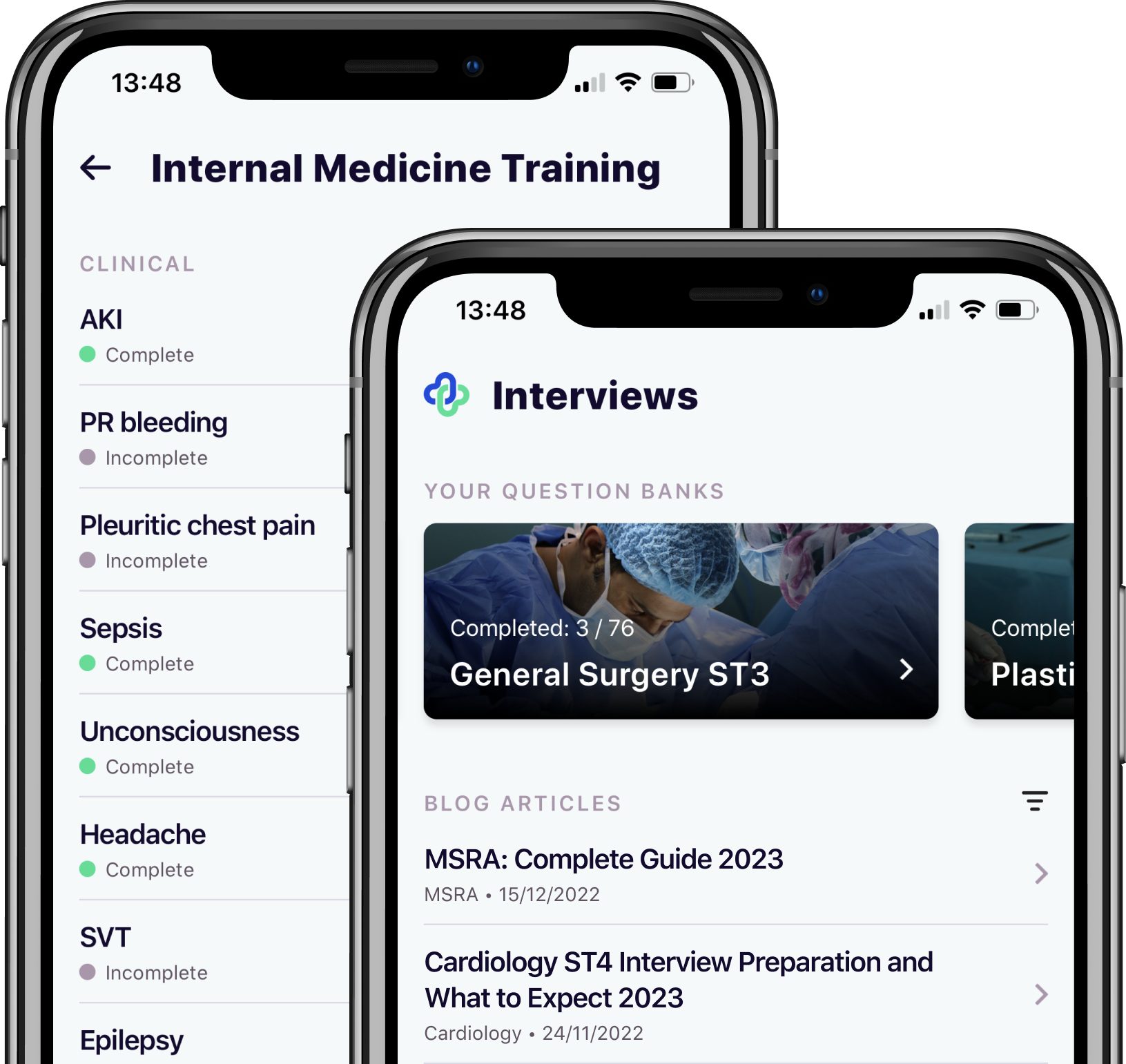
Our mobile app allows you to access your interview and exam question banks wherever you are.