


 Close
Close
 22nd June 2023
Distal Convoluted Tubule
The thick ascending limb of the loop of Henle flows into the distal convoluted tubule (DCT), which is subdivided into the early DCT and late DCT.
Early distal tubule
The early distal tubule forms the macula densa, a group of sensing epithelial cells which are part of the juxtaglomerular apparatus, a structure providing control of glomerular filtration rate and blood flow in the nephron.
Na⁺-K⁺-ATPase transporters on the basolateral membrane (as also seen in the PCT and TAL) generate an electrochemical gradient for the movement of sodium ions into the epithelial cells through Na⁺/Cl⁻ symporters (NCC). Chloride ion channels on the basolateral membrane then allow the diffusion of chloride into the extracellular fluid. Thiazide diuretics inhibit the NCC symporter.

Ion transport in the early distal tubule.
Late distal tubule
The late distal tubule is made up of principal cells and intercalated cells.
The principal cells again use Na⁺-K⁺-ATPase transporters on the basolateral membrane to generate an electrochemical gradient for the passage of sodium from the lumen to epithelial cells through epithelial Na⁺ channels (ENaC) and secretion of potassium ions into the lumen through K⁺ uniporter channels. Principal cells are the target of potassium-sparing diuretics (e.g. spironolactone, eplerenone, amiloride). The rate of sodium ion reabsorption and potassium ion secretion in the late DCT and cortical collecting duct is controlled largely by aldosterone (see RAAS below).
Intercalated cells secrete hydrogen ions and reabsorb bicarbonate and potassium. The hydrogen ions secreted are generated as a result of a reverse reaction to that seen in the PCT, i.e. CO₂ and H₂O absorbed into the cell combine to form carbonic acid, which subsequently splits into HCO₃- and H⁺ ions. Each hydrogen ion is secreted back into the lumen via hydrogen-ATPase and H⁺/K⁺-ATPase transporters to then combine with a bicarbonate ion to be reabsorbed, as per the reaction described in the PCT. Contrary to the PCT, the intercalated cells have the capability of secreting hydrogen ions against a large concentration gradient, allowing for H⁺ ion secretion in response to acidosis, and thus play an important role in acid-base balance.
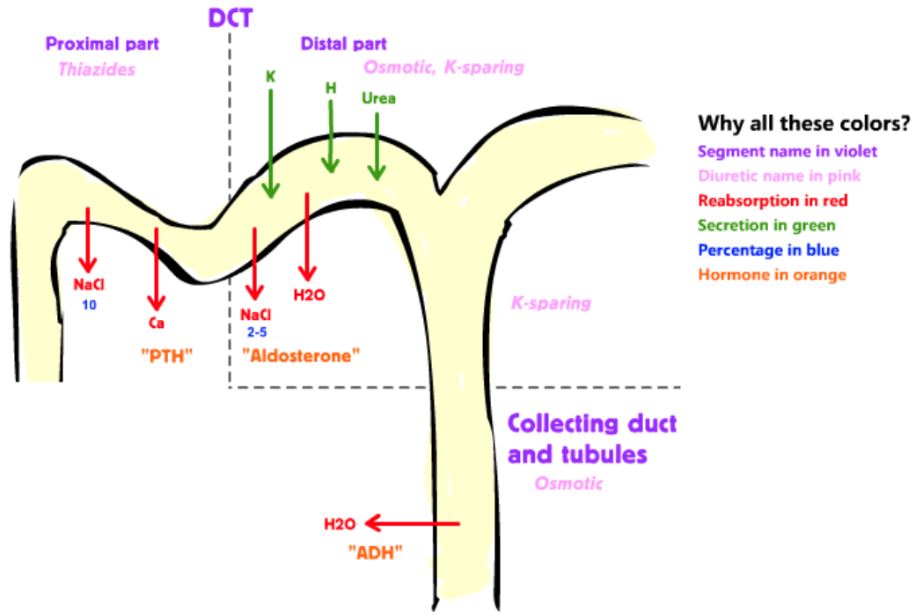
Sodium reabsorption and potassium secretion in the late distal tubule.
Image Source: Wikimedia Commons (2007). Renal Diuretics, Licensed under a creative commons licence. Available for free at: https://commons.wikimedia.org/wiki/File:Renal_Diuretics.gif (Accessed on: 13 February 2023).
Complete Guide to Clinical Genetics ST3 Application and Recruitment (2027)
Written by Medibuddy. Last updated: October 2026. Clinical Genetics is

Complete Guide to Clinical Radiology ST3 Application and Recruitment (2027)
Recruitment paused: NHS England is not running Clinical Radiology ST3+ recru

Complete Guide to Paediatric Surgery ST3 Application and Recruitment in United Kingdom (2026)
Written by Medibuddy. Last updated: October 2026. If you’re planning


Take your subscriptions with you
Our mobile app allows you to access your interview and exam question banks wherever you are.

