


 Close
Close
 27th June 2023
Post-coital and intermenstrual bleeding
Intermenstrual bleeding (IMB) is any bleeding (other than post-coital) happening outside the usual menstrual cycle. Post-coital bleeding (PCB) is non-menstrual bleeding happening immediately after intercourse. Both are symptoms rather than diagnoses and should be thoroughly investigated to rule out the most concerning cause: malignancy.
Post-coital bleeding
There are many causes of PCB, and 8% of women have at least one episode of bleeding after intercourse in any 2-year period. In 50% of women investigated for PCB, no identifiable cause will be found. Possible causes include a cervical ectropion which are small friable areas on the external cervix – these are the result of columnar epithelial cells usually found in the cervical canal being present on the external cervix within the vagina, typically cells here are squamous. Cervical ectropion is particularly common in women taking the combined oral contraceptive pill. Other causes include cervical polyps, infections, or cancers.
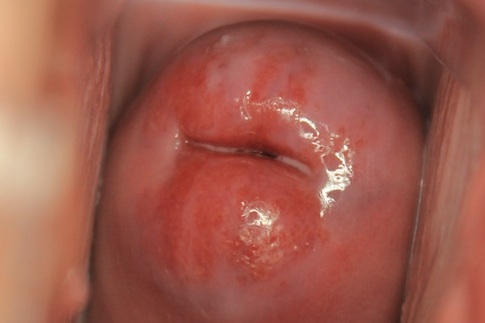
Cervical ectropion.
Image Source: Wikimedia Commons (2016). Licensed under a creative commons licence. Available for free at: https://commons.wikimedia.org/wiki/File:%D0%AD%D1%80%D0%BE%D0%B7%D0%B8%D1%8F_%D1%88%D0%B5%D0%B9%D0%BA%D0%B8_%D0%BC%D0%B0%D1%82%D0%BA%D0%B8.jpg (Accessed on: 13 February 2023).
Intermenstrual bleeding
The cause of IMB may become obvious from the history. One important cause to rule out is ectopic pregnancy or (less commonly) gestational trophoblastic disease – both would be associated with a positive pregnancy test. Causes can be grouped by the site of the reproductive tract involved, for example, polyps can be uterine or cervical. Fibroids are a common cause occurring in 25% of women of reproductive age.
Iatrogenic causes should be considered, including:
- Tamoxifen – an anti-oestrogen drug typically used in pre- and peri-menopausal women with oestrogen-receptor positive breast cancer
- Poor adherence to the taking of oral contraceptive pills
- Drugs affecting clotting, including serotonin selective reuptake inhibitors (SSRIs), anticoagulants and corticosteroids
Complete Guide to Clinical Genetics ST3 Application and Recruitment (2027)
Written by Medibuddy. Last updated: October 2026. Clinical Genetics is

Complete Guide to Clinical Radiology ST3 Application and Recruitment (2027)
Recruitment paused: NHS England is not running Clinical Radiology ST3+ recru

Complete Guide to Paediatric Surgery ST3 Application and Recruitment in United Kingdom (2026)
Written by Medibuddy. Last updated: October 2026. If you’re planning


Take your subscriptions with you
Our mobile app allows you to access your interview and exam question banks wherever you are.

