


 Close
Close
 1st July 2023
Allergic Skin Disorders
Background
Allergic skin disorders are very common in dermatology, and are important to understand as they have a huge global burden of disease. These conditions have a large impact on a patient’s quality of life and can affect the economy as they are a major cause of occupational disease.
The most common allergic skin disorders are allergic contact dermatitis and acute urticaria. Other differentials for allergic skin disorders include; angioedema, atopic dermatitis, drug hypersensitivity reactions and skin manifestation of food allergies. Urticaria and angioedema will be covered in the next section. Please refer to the dermatology topic ‘Inflammatory disorders’ where dermatitis (contact and atopic) will be covered in more detail.
Aetiology
Allergic skin disorders are triggered by exposure to an allergen which generates an immune response. They are normally caused by Type 1 (acute) or Type 4 (delayed) hypersensitivity reactions.
Clinical Features

Contact dermatitis due to poison ivy.
Image Source: Wikimedia Commons (2013). Poison ivy contact dermatitis, Licensed under a creative commons licence. Available for free at: https://commons.wikimedia.org/wiki/File:Poison_ivy_contact_dermatitis.jpg (Accessed on: 1 May 2022).

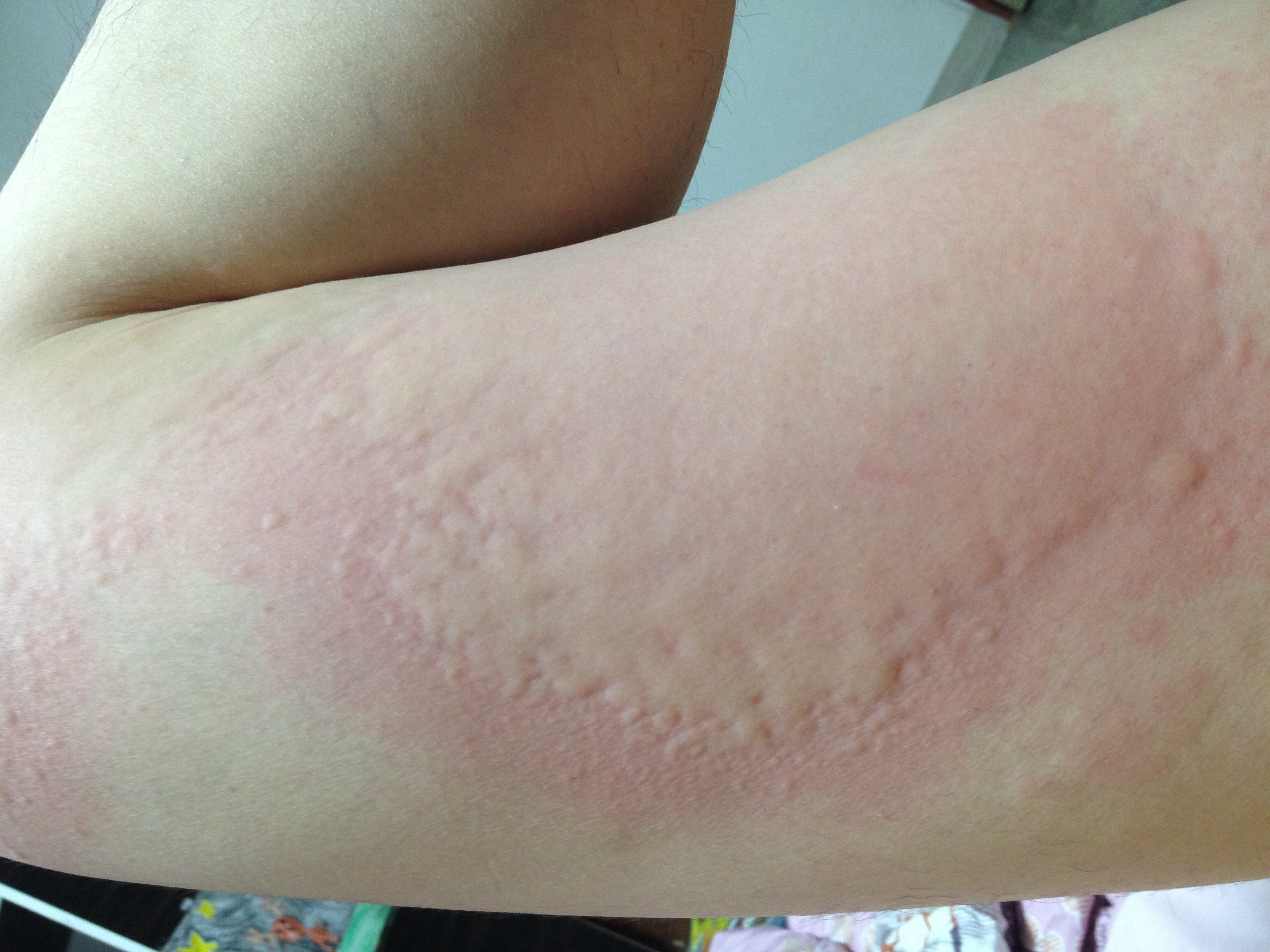
Urticaria
Image Source: Wikimedia Commons (2014). Have Urticaria 3, Licensed under a creative commons licence. Available for free at: https://commons.wikimedia.org/wiki/File:Have_Urticaria_3.jpg (Accessed on: 1 May 2022).

Clinical presentations of cutaneous allergic skin diseases vary, so a differential diagnosis will be determined by a thorough history and examination. Asking specifically about the symptoms, duration, and pattern of the eruption will assist with this.
Investigations
Patch testing is appropriate if you are considering contact dermatitis. Various allergens are placed on the patient’s back, usually for 48 hours. The dermatologist might assess the skin after a further 48 hours as some contact dermatitis reactions can take longer to develop.
Serum IgE or skin prick testing may be appropriate for urticaria.
Management
Identifying and removing the allergen is important to treat these conditions. Topical treatments, including steroids and calcineurin inhibitors, are helpful to relieve symptoms and inflammation.
Complete Guide to Clinical Genetics ST3 Application and Recruitment (2027)
Written by Medibuddy. Last updated: October 2026. Clinical Genetics is

Complete Guide to Clinical Radiology ST3 Application and Recruitment (2027)
Recruitment paused: NHS England is not running Clinical Radiology ST3+ recru

Complete Guide to Paediatric Surgery ST3 Application and Recruitment in United Kingdom (2026)
Written by Medibuddy. Last updated: October 2026. If you’re planning


Take your subscriptions with you
Our mobile app allows you to access your interview and exam question banks wherever you are.

