


 Close
Close
 2nd July 2023
Dermatitis/Eczema
The terms ‘eczema’ and ‘dermatitis’ are used synonymously. It describes an irritation of the skin because of abnormal epidermal barrier function. Eczema is typically characterised by itching and often visible excoriation marks. There are several classifications of eczema, the main ones of which will be discussed.
Atopic Eczema
The most common type of eczema which typically presents in childhood. It usually occurs from prolonged hypersensitivity to common environmental allergens, such as pollen or house dust mite. Individuals who suffer from atopy also have a predisposition to produce excess IgE causing the atopic response. Other atopic conditions include hay fever, asthma, or food allergies. Eczema is a clinical diagnosis based on history and examination. The main diagnostic criteria for atopic eczema include at least three of the following:
- Onset before 2 years of age
- History of itch in the skin creases (or cheeks if <4)
- History of asthma/hay fever (or in first degree relative if <4)
- Dry skin (xeroderma)
- Visible flexural dermatitis (cheeks, forehead, outer limbs if <4)
The distribution of the rash often varies with age. In babies and infants, it often presents on the face and trunk compared to the flexures in children. In adults, the rash can be widespread, affecting the face, trunk, and limbs (not restricted to flexures). An image of an eczematous rash can be seen below:

Image Source: Wikimedia Commons (2015). Dermatite o eczema atopico avambraccio 2015, Licensed under a creative commons licence. Available for free at: https://commons.wikimedia.org/wiki/File:Dermatite_o_eczema_atopico_avambraccio_2015.jpg (Accessed on: 14 March 2023).

Pompholyx Eczema
The most common variant of vesicular hand dermatitis which presents as multiple vesicles on the hands. It can similarly affect the feet.
It is most common in young adults, females, and those with a history of atopic eczema. The causes are usually multifactorial but can be related to sweating in hot, humid conditions, in response to stress, contact with certain irritants or allergens, as well as adverse reactions to drugs.

Pompholyx on the finger
Image Source: Wikimedia Commons (2011). Finger pompholyx view 2, Licensed under a creative commons licence. Available for free at: https://commons.wikimedia.org/wiki/File:Finger_pompholyx_view_2.tif (Accessed on: 14 March 2023).
Allergic Contact Eczema
Allergic contact eczema, or contact dermatitis, is an example of a delayed type IV hypersensitivity reaction. It occurs following contact with specific allergens. Repeated exposure to the allergen usually results in recurrence of the eczematous rash at the site of the allergen and can often spread beyond this. Typical sites include the earlobes from nickel jewellery or the wrists from rubber gloves.
Seborrhoeic Dermatitis
Chronic form of eczema that affects the sebaceous glands primarily on the scalp, face, and trunk. In adults, it results from the proliferation of the skin commensal yeast Malassezia. It typically presents with scale and erythema on the scalp and face, with oily skin affecting the latter. Treatment can be with various agents, which include keratolytics such as salicylic acid to remove scale, topical antifungal agents such as ketoconazole shampoo, and mild topical steroids to reduce inflammation.
Investigations and Management
This is dependent on the presenting features and likely type of eczema. Atopic eczema, as well as pompholyx, are primarily clinical diagnoses. However, patch tests can be performed if contact allergic dermatitis is suspected.
Eczema is managed with emollients and topical corticosteroids. Steroid creams are often used in more acute episodes of irritation as a short course of 5-15 days. The potency of corticosteroids prescribed will depend on the severity and site of the exacerbation. If topical therapies fail, phototherapy, usually with narrowband UVB, can have good results.
Complications
Eczema Herpeticum (EH)
An important and rare risk of atopic eczema. It results from a secondary infection of eczema with HSV. The presenting rash appears as small, punched-out lesions on a background of recently worsening eczema history from the patient. EH is a dermatological emergency and should be managed with urgent admission to hospital and intravenous antivirals (acyclovir). In any suspicious case, swabs should be taken from the skin for microscopy and culture.
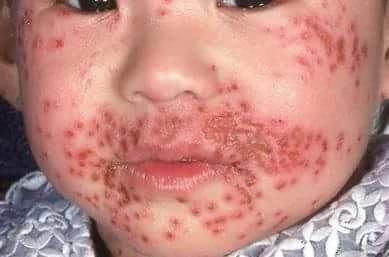
Eczema herpeticum showing the typical lesions of a secondary HSV infection in eczema.
Image Source: Wikimedia Commons (2018). Eczema herpitcum, Licensed under a creative commons licence. Available for free at: https://commons.wikimedia.org/wiki/File:Eczema_herpitcum.jpg (Accessed on: 14 March 2023).

Erythroderma
Erythroderma is a severe condition that presents with diffuse erythema and scaling. To be classified as erythroderma it must involve all or most of the skin surface area – over 90% as per the most common definitions. There are various causes, but two of the most common are exacerbation of pre-existing dermatitis or psoriasis, and hypersensitivity to drugs. It can develop acutely over a few hours, or it can evolve over days. It presents as skin that is red and warm to touch, often with severe pain or itching. Over time scaling of the skin can occur and crusted lesions can develop, and this is often more common in those who have underlying psoriasis.
Management involves hospitalisation requiring close monitoring of haemodynamic status as well as body temperature and treatment of any secondary cutaneous superinfections. Oral antihistamines can reduce itching, whereas inflammation and pruritus can be managed with topical corticosteroids.
Complete Guide to Clinical Genetics ST3 Application and Recruitment (2027)
Written by Medibuddy. Last updated: October 2026. Clinical Genetics is

Complete Guide to Clinical Radiology ST3 Application and Recruitment (2027)
Recruitment paused: NHS England is not running Clinical Radiology ST3+ recru

Complete Guide to Paediatric Surgery ST3 Application and Recruitment in United Kingdom (2026)
Written by Medibuddy. Last updated: October 2026. If you’re planning


Take your subscriptions with you
Our mobile app allows you to access your interview and exam question banks wherever you are.

