


 Close
Close
 3rd August 2023
Antimicrobials
Antibacterial Drugs
This section will focus on antibacterial drugs, or antibiotics, which form most of the curriculum for antimicrobials for MRCP examinations.
The most common and important classes of antibacterials are discussed in separate sections, with background information on their mechanism of action, the spectrum of activity, and important side effects, interactions and monitoring requirements about each class.
Each NHS trust will have individual local guidelines for antibiotic prescribing based on bacterial resistance patterns in the area. However, the questions in the MRCP exams are based on national guidance, which has been used to reference this text.
The following table demonstrates the spectrum of activity for commonly used antibiotics; an understanding of which can help guide prescribing and can be used as an overview for this section.

Table 1: Spectrum of activity of common antibiotics
Beta-lactams
Mechanism of action
Beta-lactams are bactericidal, meaning they directly kill bacteria, and work by disrupting bacterial cell wall synthesis. There are several different types of beta-lactam antibiotics, which are discussed in turn below.
Spectrum of activity
Penicillins
The first class of antibiotics first synthesised, which remain amongst the most commonly prescribed in healthcare today.
Benzylpenicillin (penicillin G)
- Narrow spectrum, with most activity against gram positive organisms, particularly Streptococci species
- Some activity against gram negative organisms, most importantly Neisseria and Leptospira species
- Also active against Treponema species
- Given IM or IV
Phenoxymethylpenicillin (penicillin V)
- Similar spectrum to benzylpenicillin, but given orally.
Amoxicillin
- A broader spectrum antibiotic that is commonly used to treat both gram positive and some gram negative organisms
Flucloxacillin
- Treats gram positive organisms and is the antibiotic of choice for Staphylococcus aureus.
- Especially used in skin and soft tissue infections
Co-amoxiclav (amoxicillin/clavulanic acid)
- Clavulanic acid is a beta lactamase inhibitor, which, when used in combination with amoxicillin, broadens the spectrum.
- Co-amoxiclav is used to treat a range of gram positive, gram negative, and anaerobic bacteria. It is a common first line antibiotic for many sources of infection, including sepsis of unknown origin.
Tazocin (piperacillin/tazobactam)
- Tazocin is a broad spectrum antibiotic that treats gram positive, gram negative, and anaerobic bacteria.
- Importantly, it has activity against Pseudomonas aeruginosa
- Generally first line for hospital-acquired infections and neutropenic sepsis
Cephalosporins
A category of beta-lactams, of which there exist several ‘generations’ with slightly different spectrums of actions.
Cross-react with penicillins (10%), and so therefore, should be avoided in severe penicillin allergy.
First generation:
- e.g. cefalexin
- Mainly active against Gram positive organisms
Second generation:
- e.g. cefuroxime
- Enhanced Gram negative activity compared to first generation
Third generation:
- e.g. ceftriaxone, cefotaxime
- Enhanced Gram negative activity compared to second generation, but not as good with Gram positive organisms, especially Staphylococcus aureus
- Ceftazidime in particular, has good activity against Pseudomonas species
- Reduced cross-reactivity with penicillin (2-3%) compared to first and second generation
Fourth generation:
- e.g. cefepime
- Broad spectrum –active against Gram positive and negative bacteria to a greater degree than cefotaxime (third generation)
- Active against Pseudomonas species
Fifth generation:
- e.g. ceftaroline
- Similar spectrum to cefotaxime (third generation) but has an extended activity against Gram positive organisms, including MRSA and multi-drug resistant Streptococcus pneumoniae, and hence reserved for these infections to decrease drug resistance
Carbapenems
Have a broad spectrum of activity against Gram positive, Gram negative and anaerobic bacteria. Less cross-reactivity with penicillin than cephalosporins (1% rather than 10%), so it may be safer to give in penicillin allergy.
Examples include imipenem, meropenem and ertapenem; the latter is not active against Pseudomonas aeruginosa, which separates it from other carbapenems.
Generally reserved for severe infections. Imipenem and meropenem are used for complicated hospital-acquired pneumonias, intra-abdominal, skin and soft tissue, and urinary tract infections. Ertapenem treats abdominal and gynaecological infections, community-acquired pneumonia, and skin and soft tissue infections in diabetics.
Carbapenems are not active against MRSA.
Important side effects, interactions and monitoring
Penicillins
Penicillin allergy is common and can range from mild skin reactions to life-threatening anaphylaxis. Side effects caused by penicillin are often mistakenly interpreted as an allergic reaction. It is important to establish the nature of symptoms to determine whether or not the reaction represents a true allergy. It is also crucial to clarify the severity of any allergic reactions, as this affects decision-making over whether cephalosporins would be safe to administer.
A common reaction with ampicillin and amoxicillin is a maculopapular rash, often mistaken for an allergic reaction. This rash generally manifests in patients with glandular fever or, more rarely, leukaemia or cytomegalovirus function. Broad spectrum penicillins are therefore contraindicated in patients presenting with sore throats, in case this is due to glandular fever, which triggers this reaction.
Caution should be taken when prescribing high doses in patients with renal failure, as accumulation may lead to encephalopathy. Interstitial nephritis may also be seen as a rare but important side effect of penicillins.
Penicillins do not require any special monitoring.
Cephalosporins
Hypersensitivity reactions are the most important side effect of cephalosporins. First and second generation cephalosporins have a cross-sensitivity with penicillin of 10% and 2-3% with third generation patients. Cephalosporins should therefore be avoided in penicillin-allergic patients, but if there are no suitable alternatives, then cefixime, cefotaxime, ceftazidime, ceftriaxone and cefuroxime may be used with caution. Caution should be taken when prescribing high doses in patients with renal failure, as accumulation may lead to encephalopathy.
Cephalosporins do not require any special monitoring.
Carbapenems
Common side effects of all meropenems include GI upset, headache, skin reactions and thrombophlebitis. Carbapenems are known to lower the seizure threshold (especially imipenem), so they should be used cautiously in people with seizure disorders and the elderly. Meropenem has less seizure-inducing potential and can be used to treat central nervous system infections.
Meropenem requires monitoring of LFTs, as it can cause hepatotoxicity. Dose reductions are necessary for all carbapenem antibiotics for renal impairment.
Imipenem is given in combination with the enzyme inhibitor cilastatin. This is because this enzyme can partially inactivate the kidney’s imipenem, reducing its effectiveness.
Glycopeptides
Mechanism of action
Bactericidal drugs work by inhibiting bacterial cell wall synthesis.
Spectrum of activity
Glycopeptides are active against aerobic and anaerobic Gram positive bacteria, including MRSA. Staphylococcus aureus and enterococci resistant to glycopeptides are increasingly emerging, making antibiotic stewardship of these drugs especially important. They are generally reserved for severe infections, especially useful in skin and soft tissue infections, joint and bone infections, endocarditis, and complicated infections where other antibiotics have failed. There are two key drugs in the class –vancomycin and teicoplanin. Teicoplanin has a longer duration, so following the loading dose can be given once daily.
Important side effects, interactions and monitoring
Fever and skin reactions are common side effects. In particular, intravenous vancomycin is commonly associated with ‘red man syndrome’, a hyperactivity reaction characterised by a diffuse erythematous rash, which may mimic an allergic reaction. Teicoplainin is associated with ototoxicity; if tinnitus or hearing impairment develops, it should be discontinued.
Vancomycin and teicoplanin require serum monitoring, including on the second day of treatment and pre-dose. Each hospital trust will have its own specific guidance, which should be referred to.
Both glycopeptides may cause nephrotoxicity, and monitoring renal function is a requirement.
Macrolides
Mechanism of action
Bacteriostatic drugs inhibit bacterial growth by binding to the 50s subunit of the bacterial ribosome, rather than directly killing the bacteria.
Spectrum of activity
Macrolides have a similar spectrum of activity to many penicillins, so they are a common alternative agent for patients allergic to penicillin.
Common indications include respiratory tract infections (including atypical pneumonia(, skin and soft tissue infections, and gastroenteritis caused by Campylobacter species.
The three most commonly used macrolides are erythromycin, clarithromycin and azithromycin. Claithromycin is derived from erythromycin and has a broader spectrum of activity. Azithromycin has not as good Gram positive activity but better Gram negative activity. It has a long half life, so it’s amenable to once daily dosing.
Important side effects, interactions and monitoring
GI upset is a common side effect, especially with erythromycin and clarithromycin; this is dose-dependent, so it may be avoided by giving lower doses when possible. This is also a therapeutic effect of erythromycin, which can treat vomiting caused by gastric stasis.
Macrolides are also known to be QT interval prolongers.
Tetracyclines
Mechanism of action
Bacteriostatic drugs inhibit bacterial growth by binding to the 30s subunit of the bacterial ribosome, preventing the translation of RNA into proteins. They are not bactericidal – like beta-lactams – and do not directly kill bacteria.
Spectrum of activity
A broad spectrum antibiotic, which covers both Gram positive and negative bacteria, can also be used to treat intracellular organisms. Due to increasing drug resistance, they are less popular than in previous years. They are still indicated in treating chlamydia, rickettsia brucella and Lyme disease. They are also used in genital infections, acne, and respiratory tract infections, especially exacerbations of chronic bronchitis, due to their activity against Haemophilus influenzae, a commonly associated pathogen.
Examples include doxycycline, minocycline, and tigecycline. They are all very similar, with doxycycline generally the macrolide of choice.
Important side effects, interactions and monitoring
Tetracyclines do not require routine monitoring. They should be used cautiously in those with hepatic and renal impairment but without precise contraindications.
A key side effect is photosensitivity; tetracycline use increases the risk of sunburn under exposure to UV light.
Tetracyclines are contraindicated in pregnant and breastfeeding women. This is because of the well-documented phenomenon of permanent discolouration of the teeth of foetuses and babies who are exposed. They are also contraindicated in children under the age of 8 for the same reason. This is known as “tetracycline teeth” – an example image below.
Tetracyclines are also associated with a risk of worsening muscle weakness in myasthenia gravis and exacerbating the symptoms of systemic lupus erythematosus. So they should be used with caution in these patients.
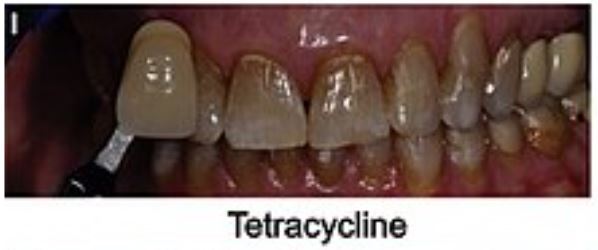
Examples of tooth staining – “tetracycline teeth”.
Image Source: Wikimedia Commons (2019). Examples of tooth staining, Licensed under a creative commons licence. Available for free at: https://commons.wikimedia.org/wiki/File:Examples_of_tooth_staining.jpg (Accessed: 25 September 2022).
Aminoglycosides
Mechanism of action
Like tetracyclines inhibit bacterial growth by binding to the 30s subunit of the bacterial ribosome, preventing the translation of RNA into proteins, but unlike tetracyclines, they are bactericidal, directly killing bacteria.
The mechanism of action is also concentration-dependent, meaning the higher doses of antibiotic given, the more effective against bacteria they are.
Spectrum of activity
Has some activity against Gram positive bacteria but is best known for its broad spectrum against Gram negative bacteria, and due to its effectiveness is generally used to treat severe infections. They are most effective against rapidly-multiplying bacteria, hence why they are effective in severe infections. However, they are not effective against anaerobes.
Examples include gentamicin (the most commonly used), tobramycin, amikacin, streptomycin and neomycin. Gentamicin, tobramycin, and amikacin also have activity against Pseudomonas aeruginosa. Aminoglycosides cannot be absorbed enterally and hence are generally given intravenously.
Important side effects, interactions and monitoring
Gentamicin generally has hospital-specific guidelines for administration and monitoring. It is increasingly given on a once-daily regime. Serum monitoring is essential to adjust the dose and avoid toxicity, especially in elderly patients or those with renal impairment.
The most important side effects of gentamicin to be aware of, is nephrotoxicity and ototoxicity, with the former necessitating regular monitoring of renal function.
Quinolones
Mechanism of action
Bactericidal antibiotics inhibit DNA topoisomerase and gyrase enzymes to prevent DNA replication. Nearly all quinolone antibiotics have a fluorine atom attached and hence are known as fluoroquinolones.
Spectrum of activity
The two most commonly used are ciprofloxacin and levofloxacin. Ciprofloxacin has activity against both Gram positive and negative bacteria; although not anaerobic organisms, and is limited in treating infection caused by Streptococcus pneumoniae and Enterococcus faecalis. It is also active against some mycobacteria. Ciprofloxacin is often used for GI tract infections (including typhoid fever), bone and joint infections, gonorrhoea, and sepsis caused by sensitive organisms. Levofloxacin has better Gram positive activity than ciprofloxacin and can treat atypical infections. Many Staphylococci are resistant to quinolones and therefore have no use in MRSA infections.
Important side effects, interactions and monitoring
QT interval prolongers, so best avoided if patients are taking other drugs, which may also prolong the QT interval. Not recommended for pregnant women. Dose reductions are required in patients with renal impairment, and local guidelines should be consulted.
Others
Other important antibiotics to be aware of are summarised in the table below.
| Antibiotic | Mechanism | Spectrum | Notes |
|---|---|---|---|
| Clindamycin | Similar to macrolides – bacteriostatic drugs, which inhibit bacterial growth by binding to the 50s subunit of the bacterial ribosome | Gram positive and anaerobic cover | Often used in skin and soft tissue infections |
| Trimethoprim | Bactericidal – inhibits dihydrofolate reductase. | Gram positive and gram negative – but best known for the cover of Gram negative anaerobes | Commonly used to treat UTIs
Contraindicated in pregnancy due to its effect on folate levels, and with the antifolate drug methotrexate |
| Co-trimoxazole (sulfamethoxazole/Trimethoprim | Sulfamethoxazole also acts on the folate metabolism pathway | Broad spectrum against Gram positive and negative bacteria | The addition of Sulfamethoxazole to Trimethoprim results in a synergistic effect
Used to treat Pneumocystis jirovecii pneumonia |
| Nitrofurantoin | Poorly understood – damages bacterial DNA | Concentrated in the urine, so highly useful against a variety of Gram positive and negative pathogens that cause UTI | Often first line for UTI
Contraindicated in people with renal impairment |
| Metronidazole | Nitroimidazole antibiotic, which inhibits nucleic acid synthesis | Effective against anaerobic bacteria and parasitic infections | Alcohol consumption is advised against whilst taking metronidazole.
Used to treat pelvic inflammatory disease, to provide Gram negative and anaerobic cover in intra-abdominal infections, and to treat bacterial vaginosis and Giardiasis |
Table 2: Miscellaneous antibacterial drugs
Special circumstances
When prescribing any medication, consideration should be given to individual patient factors that may influence the drug’s pharmacokinetics.
The most important of these situations are prescribing in renal impairment, hepatic impairment, and pregnant and breastfeeding women. Drugs may either be contradicted, or dose reductions may be required.
Detailed information on prescribing in these circumstances can be found in the British National Formulary (BNF) for each drug.
Antiviral Drugs
Antiviral drugs do not directly affect viruses but work by limiting the replication of a virus within a host organism. Not every viral infection necessitates treatment with antivirals. The most common indications are HIV infection (e.g. antiretrovirals), herpes virus infections (e.g. aciclovir), influenza viruses (e.g. oseltamivir) and hepatitis B and C (e.g. tenofovir, interferon-α).
As antivirals are not a topic which features heavily on the MRCP examination, this section focuses on the self-assessment questions – further information and references can be found in the explanations provided. The BNF treatment summaries cited below are also a useful resource. More background can also be found in the Viral Infections topic.
Antifungal Drugs
This topic is not a particular focus of the MRCP curriculum, so this section emphasises the self-assessment questions. Further information on the topic can be found in the explanations provided for these questions. More background can also be found in the Fungal Infections topic.
Antiparasitic Drugs
This topic is not a particular focus of the MRCP curriculum, so this section emphasises the self-assessment questions. Further information on the topic can be found in the explanations provided for these questions. More background can also be found in the Parasitic Infections topic.
Complete Guide to Clinical Genetics ST3 Application and Recruitment (2027)
Written by Medibuddy. Last updated: October 2026. Clinical Genetics is

Complete Guide to Clinical Radiology ST3 Application and Recruitment (2027)
Recruitment paused: NHS England is not running Clinical Radiology ST3+ recru

Complete Guide to Paediatric Surgery ST3 Application and Recruitment in United Kingdom (2026)
Written by Medibuddy. Last updated: October 2026. If you’re planning


Take your subscriptions with you
Our mobile app allows you to access your interview and exam question banks wherever you are.

