


 Close
Close
 23rd November 2023
Attachment
Attachment Theory
Melanie Klein
In order to fully understand John Bowlby’s work, we have to first look at Melanie Klein’s object relations theory.
To understand that, we need to revisit some of Freud’s work very briefly here.
Freud felt that people have innate drives as part of their id. He described two drives: the life instinct (aka as the libido to Freudian therapists – not necessarily sexual!) and the death instinct. The life instinct/libido is aimed at survival and propelling us through life. The death instinct is about self-destructive aggression. The exact difference here is not especially important. The key part is that it’s not conscious; it’s biological and innate. Freudian theory says that we infuse everything and everyone around us with this psychic energy or tension, especially those we consider emotionally important. The theory goes that it is uncomfortable when this tension accumulates, so much so that the discharge of this tension is felt to be pleasurable. We have an innate tendency to seek pleasure and avoid pain – so we seek to discharge this tension via an object.
However, Klein believed that we direct our drives at specific objects for specific reasons, rather than Freud’s more undifferentiated, chaotic view of this discharge of tension.
Melanie Klein believed that we are born with an internal world that is affected by our unconscious phantasy – that is, our mental representation of everything that happens around us. These phantasies will, in turn, affect our experience of the external world. She said that for an infant, objects are not recognisable as another human with an alternative internal world of their own – that’s much too complicated! The infant can only think as far as ‘this object is good’, aka when this thing/person/feeling is around, I like this, and I feel pleasure. Or, much more distressingly, ‘this object is bad,’ aka when this thing/person/feeling is around, I hate this, and I feel pain.
The example which is used, and you’ll probably have read about, is of breasts. The theory goes like this: to an infant, the mother is a pair of breasts who is sometimes there and sometimes not.
When the object, the mother, is there with her part-object, her breasts, and is feeding the hungry infant, the infant experiences a discharge of that unpleasant hungry feeling; they feel the love of their caregiver and the safety of being in their arms. In these times, the mother is seen as the owner of the good breast.
Now, say the hungry baby is crying, distressed by their experience of an empty stomach, and feeling neglected. They might be feeling frustrated and angry, and this is directed to the bad breast.
The infant can’t understand that the mother, the object, can be the owner of both the good breast and the bad breast, so they split them into these two part-objects. This is called the paranoid-schizoid position. This is the state of the infant for the first six months of life.
In the second six months of life, the infant starts to realise that the good and the bad objects are part of the same whole. The infant then feels guilt, sadness and regret for directing so much hate at the bad breast and internalises this. At the same time, the infant is experiencing a loss of the breast as weaning starts. The infant is described as being in a depressive position.
The infant has to work through the depressive position. Otherwise, they will interpret all future frustrations as some form of punishment for their past destructive aggression whilst in the paranoid-schizoid position.
Importantly, these are positions and not stages – we can switch between them throughout our lives.
John Bowlby
Whereas Freud and Klein talked about attachment in terms of these chaotic biological drives which must be satisfied and complex phantasies which seem advanced for an infant… John Bowlby focussed on the real experiences of children, observing them during WWII as part of his research. He emphasised the importance of a healthy relationship for both the primary caregiver and the child and how this supports a child to explore and develop.
‘The infant and young child should experience a warm, intimate, and continuous relationship with his mother (or permanent mother substitute) in which both find satisfaction and enjoyment… If a community values its children, it must cherish their parents.’ – John Bowlby
Ultimately, he formed the basis of attachment theory as we think of it today, and this was further expanded by some of his colleagues, as we’ll talk about later.
Attachment behaviours
For lots of animals, the young need their caregivers to provide them with food and comfort. They will survive by following the mother around, calling out to her, or just clinging on to her. Harry Harlow noted this ‘clinging’ in rhesus monkeys – demonstrating experimentally that they preferred to cling to something comfortable and not necessarily the thing that feeds them. So it isn’t just about survival but also their social and emotional development.
Bowlby felt that young human children do the same. Whilst they aren’t physically capable of following the caregiver around, they display behaviours that maintain proximity to a parent. These are called attachment behaviours.
Bowlby’s stages of attachment
Over the development of an infant, the attachment behaviours that predominate will change.
| Phase 1: Social gestures with limited selectivity | Birth to 3 months | The infant tracks faces and, from this, learns to social smile (from 6 weeks). The child shows a preference for their primary caregiver but is still okay with unfamiliar people. Both smiling and crying result in the proximity of the caregiver – it makes them want to stay with the child! They also have two ‘holding on’ reflexes – the grasp reflex and the Moro reflex. Bowlby suggested that rooting and sucking reflexes also bring the child in contact with the mother. |
| Phase 2: Focusing on familiar people | 3 to 6 months | Primitive reflexes drop out. Social smiles and babbling are more limited to people they know, and they are less well soothed by strangers. However, they start actively reaching out and grasping people they know. Monotropy begins to form – preference for one adult caregiver (usually Mum). |
Phase 3: Intense attachment and active proximity-seeking |
6 months to 3 years | Infants cry out when the mother figure leaves the room – separation anxiety. Both mother and child express joy at the reunion. Stranger anxiety also develops to varying degrees of intensity. The child can now crawl and will follow the caregiver if they leave. Equally, they can start to use the mother as a secure base from which to explore, checking their proximity periodically and still requiring significant comfort if something scares/hurts them. Bowlby described this as the ‘critical period’ for developing an ability to relate to others, and a disruption in attachment at this period can have consequences for attachment throughout life (covered in more detail later in the chapter!) |
| Phase 4: Partnership behaviour | 3 years to end of childhood | The child begins to understand that the caregiver will leave and still return, so separation anxiety lessens. They are also more able to consider the caregiver’s needs. |
Just to note, these aren’t clear-cut stages to memorise, but the general themes and key terms, which are in bold, are important!
References
- Bretherton, I. (1992). ‘The origins of attachment theory: John Bowlby and Mary Ainsworth’. Developmental Psychology. 28:5. 759-775.
- Crain, W. (2016). Theories of Development: Concepts and Applications 6e. Routledge.
- Gomez, L. (1997). An Introduction to Object Relations. Free Association Books.
- Johnstone, E et al. (2010). Companion to psychiatric studies 8e. Elsevier.
- Lemma, A. (2016). Introduction to the practice of psychoanalytic psychotherapy. Wiley Blackwell.
- Van der Horst, F.C.P., LeRoy, H.A., Van der Veer, R. (2008). ‘“When Strangers Meet”: John Bowlby and Harry Harlow on Attachment Behavior’. Integr Psych Behav. 42:370–388.
Types of Attachment – Secure and Insecure
Whilst Bowlby is often considered the father of attachment theory, Mary Ainsworth is often said to be the co-founder. Her work provided empirical evidence for Bowlby’s theories about attachment.
The strange situation test
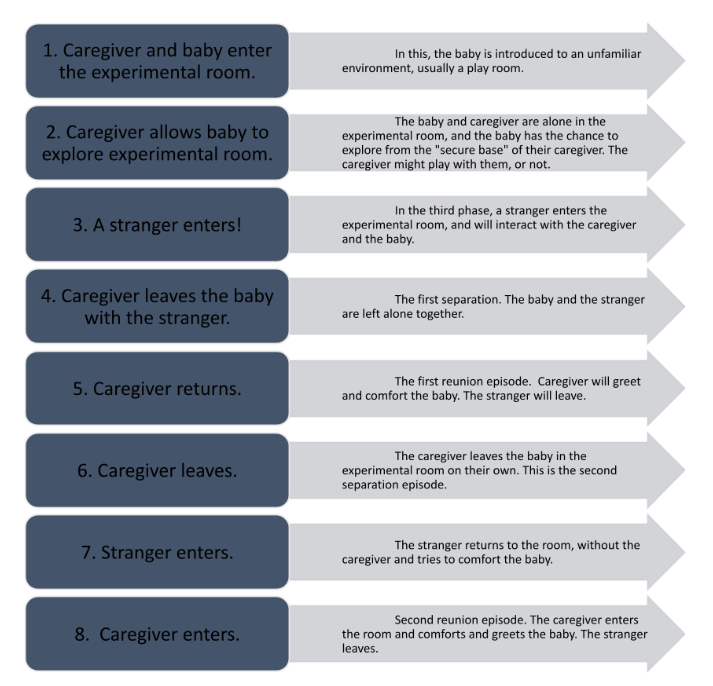
This experiment of Ainsworth’s was an observational study of the behaviours of infants when exposed to various ‘strange situations’, which are stressful for the infant and, therefore, induce attachment behaviours. The observers scored various aspects of these behaviours and used those to categorise them into types of attachment, with particular reference to a ‘secure’ attachment or an ‘insecure’ attachment. The experiment is applicable to infants between 9 and 18 months old.
It was done in an experimental room, with an observer watching through one-way glass. There are eight phases/episodes to the experiment, consisting of two separations and two reunions. These episodes are described below:
Types of attachment
From the strange situation test, they formulated different types of attachment in these infants. Overall, they noted lots of types but categorised these into three broad groups. Types A, B and C were identified by Ainsworth in the original experiments, Type D was added later.
| Type A: Anxious avoidant | Insecure | This group don’t appear too upset when the caregiver leaves and doesn’t show much of a reaction when they return either. However, the child is also not exploring freely. They are equally comforted by the stranger and the caregiver. |
| Type B: Secure | Secure | The child is upset by the separation but demands and receives comfort from the caregiver on their return. They could then continue with their explorative play. They use their caregiver as a safe base to explore. |
| Type C: Anxious resistant / Ambivalent | Insecure | The child is excessively upset by the separation, and when the caregiver returns, it may push them away and resist contact and comfort from them. They struggle to return to their activity on the return of the caregiver. They show fear about the stranger. |
| Type D: Disorganised | Insecure | These are the most bizarre presentations, where the child seems chaotic and confused. Videos will show a distressing picture of a frozen paralysis, with a dazed expression or repetitive movements. |
Note from the author: I would really recommend searching for videos on the Strange Situation Test – Whilst I hope I have described the procedure and attachment behaviours adequately, nothing can replace seeing it for yourself!
Development into adulthood
Bowlby and Ainsworth predicted that the attachment shown by an adult is a continuation of their attachment in infancy. In other words, our ability to relate to others is something we learn early in life, and we take this forward into our adult relationships.
Dr Mary Main developed a semi-structured interview for adults, called the Adult attachment interview, which classified attachment styles in adults based on the attachment styles defined in Ainsworth’s experiments. It’s an interview with 15 questions, and the responses are analysed based on the content of their speech, but also their language, grammar and flow of speech.
| Secure-autonomous (coherent-collaborative) | Same as Type B: Secure in infants.
The adult values attachment whilst also being able to be objective about their previous relationships and events. They are generally coherent and collaborative during the interview process. |
| Dismissing | Same as Type A: Anxious-avoidant.
They are not coherent during the interview. They are dismissing of previous relationships and make generalisations about the normality of their experiences that are not consistent with the examples they give. |
| Preoccupied/entangled | Same as Type C: Anxious-resistant.
Also, he was not coherent during the interview. They are often preoccupied by past experiences and express intense emotions about these. Sentences are long and vague. |
| Unresolved/disorganised | Same as Type D: Disorganised.
During discussions of loss or abuse, the adult loses their sense of logical speech and may lapse into ‘micro-dissociative episodes’. |
References
- Ainsworth, M. et al. (1978/2015). ‘Patterns of attachment: A psychological study of the strange situation: Psychology Press Classic Edition.’. Routledge.
- George, C. Kaplan, N. & Main, M. (1996). Adult Attachment Interview. Unpublished manuscript, Department of Psychology, University of California.
- Gomez, L. (1997). An Introduction to Object Relations. Free Association Books.
- Van Rosmalen, L. et al. (2015). ‘Ainsworth’s Strange Situation Procedure: The origin of an instrument’. Journal of the History of the Behavioral Sciences. 51:3. 261–284.
Conditions for Secure Attachment
We’ve now talked about the different types of attachment – but how is it that children can develop a secure attachment? What is the importance of this for later life?
Donald Winnicott
Donald Winnicott was yet another psychoanalyst, although with a background as a paediatrician, who theorised about the importance of early childhood and the attachments in these. There are two main concepts you need to know from him:
The holding environment
Winnicott described the importance of a ‘holding environment’ for infants – where they are physically held with that same tactile comfort that Harlow’s monkeys demonstrated, but also psychologically held. This means they need an environment where they are thought about and responded to. When they cry, and they need a parent, there is a responsive parent there for them. The holding environment is an important part of psychological therapy – the therapist needs to be able to create a psychologically safe space for the client to be supported and responded to.
Good-enough mothering
Within the holding environment, you need a ‘good enough mother’ to respond to the child. A neglectful caregiver leads to a child who is anxious and finds life unmanageable. An over-responsive caregiver will mean the child doesn’t develop their own abilities and skills to manage life on their own. The mother needs to be ‘just right’ or simply ‘good enough’.
Maternal sensitivity
‘The infant and young child should experience a warm, intimate, and continuous relationship with his mother (or permanent mother substitute) in which both find satisfaction and enjoyment.’ – John Bowlby
Whilst we’re talking about attachment styles in infants, it’s important to remember that how an infant relates to others is not actually about the temperament of the child. Attachment behaviours are innate and are needed to make a caregiver respond. It is the caregiver’s response to these and their sensitivity to the child’s needs that causes these behaviours to change and develop.
Ainsworth assessed children during the strange situation test but also in their home environments. Part of this was assessing the caregivers. She noted that children who were securely attached were correlated with sensitive mothers who enjoyed their caregiving responsibilities, especially breastfeeding. In contrast, mothers of babies with avoidant attachment tended to be ‘more rejecting, more often angry, and yet more restricted in the expression of affect’. Along with Mary Main, she theorised that this develops as the child calls out for their mother and is constantly rebuffed, leading to the formation of avoidance as a defence to the anger and anxiety in the child.
The parent needs to behave as the ‘secure base’ we’ve talked about several times in this chapter. Bowlby recognised the importance of the quality and consistency of the relationship in this.
References
- Ainsworth, M. (1979). ‘Infant-Mother Attachment’. American Psychologist. 34:10. 932-937.
- Bretherton, I. (1992). ‘The origins of attachment theory: John Bowlby and Mary Ainsworth’. Developmental Psychology. 28:5. 759-775.
- Johnstone, E et al. (2010). Companion to psychiatric studies 8e. Elsevier.
When Attachment Goes Wrong
So, we need responsive caregivers who are physically and emotionally present for good attachment to develop. What happens when we don’t ever have a secure attachment figure? What happens when we are separated from our caregivers or we lose our primary attachment figure?
Bowlby did a lot of work about the physical separation of children from their caregivers during early childhood, particularly in relation to children admitted to the hospital due to physical illness. Films by Bowlby, Robertson and Spitz highlighted the importance of parents being allowed into children’s hospital wards (which they previously hadn’t been allowed to attend!) and hugely improved their wellbeing moving forward.
Rutter described the terms privation and deprivation to describe two broad ways that attachment can be disrupted:
Privation – The child never has the chance to develop a secure attachment, for example, to an emotionally unavailable parent, abuse or neglect.
Deprivation – When the child has had the opportunity to develop a secure attachment, but this is lost through separation.
Privation
In Harlow’s experiments with monkeys, discussed briefly earlier in the chapter, the monkeys often had no contact with their own mothers from early in life. They were then bred from a young age and found to be incapable of being mothers themselves. They bit and hit their own babies and neglected them, so the researchers had sole responsibility for feeding and nurturing them. Despite this maltreatment, the babies still clung to their mothers.
Bowlby recognised a similar phenomenon in human parenthood – mothers who had suffered in their early lives themselves were more likely to develop as less-responsive parents. He showed that family therapy was an effective intervention for children showing challenging attachment behaviours. In his early work, he also studied ‘Forty-four Juvenile Thieves’ who were adolescent delinquents who had spent their lives institutionalised. He described an ‘affectionless psychopathy’ in these boys and theorised that it had been the lack of any significant attachment in early life that had led to this. Studies by Rutter into privation have replicated this finding, although termed this as ‘attachment difficulties’ or ‘quasi-autistic features’.
Deprivation
Bowlby’s work on the separation of securely attached children from their parents was made possible by the myriad of ways this could happen at the time: by children separated from parents during admissions to the hospital (as parents were not allowed to visit!), by World War Two and the evacuation of children, as well as the loss of parents and resultant institutionalisation of their children. He studied the effect of this and identified stages a child separated from their attachment figure will go through, which may be sequential, as shown here, or intermingled.

The impact of repeated separations can be to develop this ‘affectionless character’ that Bowlby described, as well as being ‘exploitative’, ‘heartless’ or ‘destructive’. In more recent years, we would term these as conduct disorders or attachment disorders. Bowlby also noted higher rates of emotional disorders and personality disorders.
References
- Bretherton, I. (1992). ‘The origins of attachment theory: John Bowlby and Mary Ainsworth’. Developmental Psychology. 28:5. 759-775.
- Gomez, L. (1997). An Introduction to Object Relations. Free Association Books.
- Rutter, M. (2001). ‘Specificity and heterogeneity in children’s responses to profound institutional privation’. British Journal of Psychiatry. 179. 97-103.
Complete Guide to Clinical Genetics ST3 Application and Recruitment (2027)
Written by Medibuddy. Last updated: October 2026. Clinical Genetics is

Complete Guide to Clinical Radiology ST3 Application and Recruitment (2027)
Recruitment paused: NHS England is not running Clinical Radiology ST3+ recru

Complete Guide to Paediatric Surgery ST3 Application and Recruitment in United Kingdom (2026)
Written by Medibuddy. Last updated: October 2026. If you’re planning


Take your subscriptions with you
Our mobile app allows you to access your interview and exam question banks wherever you are.

