


 Close
Close
 28th November 2023
Psychiatric History
Introduction
This chapter will explore the tools required to carry out a comprehensive psychiatric assessment. The psychiatric history builds upon the standard medical history taking framework that you will be familiar with from medical school. The psychiatric assessment should include a mental state exam (MSE), a full physical examination, and investigations to ensure organic causes are accounted for.
This section will focus principally on the framework and contents to enable you to carry out a thorough psychiatry history.
Structure of a psychiatric history
This table provides an outline for areas to cover in a psychiatry history. The approach and technique can be tailored to suit your individual interviewing style, as well as tailoring your approach accordingly to each patient.
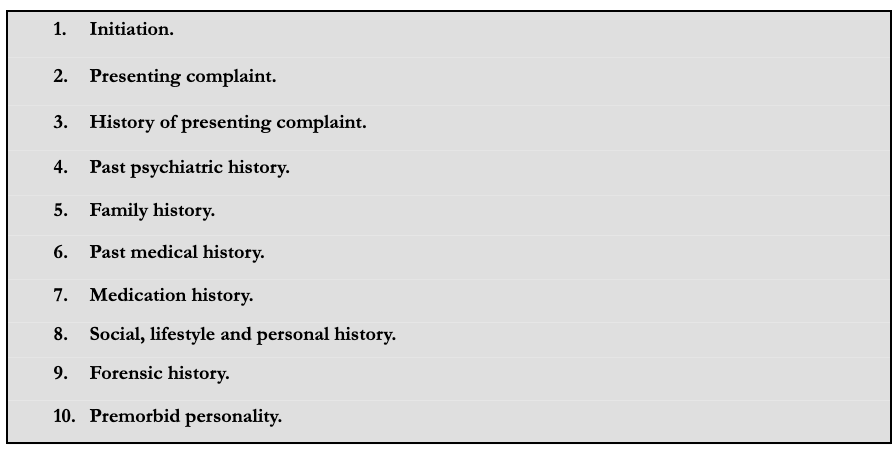
Initiating the consultation
This may well be your first time seeing this patient; therefore, first impressions are important. This initial interaction can set the tone for the remainder of the consultation, so it is imperative to ensure you get off on the right foot. Consider the set-up of the room where you are sitting, and limit distractions or interruptions where possible. Remember that flexibility is important, and although having a rough structure in mind is useful, fluidity and flexibility tailored to your patient is needed.
From the moment you first meet your patient, your assessment should begin in the form of a continued mental state exam (MSE); note this will be covered in detail later in the chapter.
- Start by introducing yourself.
- Ensure a comfortable and confidential environment.
- Ask the patient for their name, date of birth, what they prefer to be called and how they are today – The beginning of the consultation can take a relaxed tone to initiate the construction of rapport.
Presenting complaint
After initiating the consultation, allow the patient to take the lead where possible and express their thoughts in their own words. Your role at this point should be to guide and steer the conversation when necessary whilst gaining as much information from the patient as possible. It may be useful to reassure the patient that this is a confidential environment and a safe space for them to speak openly and freely. You will begin to build a picture of what has been going on and, where possible, begin to establish a chronological order of events. Remember, structure is useful but not compulsory; patients will relay information in a way that is comfortable for them. Do not underestimate the power of listening and silence.
- The history is to be taken directly from the patient; if this is not possible, a collateral history can be useful.
- Initiate the consultation with open questions (questions that typically can’t be answered with a ‘yes’ or ‘no’):
- ‘Can you tell me what’s brought you in today?’
- ‘Can you tell me what’s been happening lately?’
- ‘Can you tell me what you have been feeling lately?’
- Considerations at this point:
- What are the symptoms that brought the patient in?
- Who has initiated seeking help / seeing a doctor?
- Has this patient been referred / voluntarily consulted or detained?
- Probe symptoms further where necessary: ‘Tell me more about that.’
- Use simple, non-technical language.
- Use the same language the patient uses – e.g. if they state they are gay, use the same word rather than a term such as homosexual, which you may perceive to mean the same thing.
History of presenting complaint
This section delves deeper into exploring the presenting complaint. Allow the patient to tell their story with minimal interruptions. You can make notes to refer back to, but try to let the patient voice their experience in their own words and at their own pace.
- This section should explore screening, likely to include but not exclusive to:
- Depression.
- Anxiety.
- Mania.
- Psychosis.
- PTSD.
- ADHD.
- Obsessions and compulsions.
- Body image disturbances.
- Eating disorders.
- Consider the following for the above:
- Explore the onset and course of symptoms.
- Explore each symptom in depth whilst screening for other possible differential diagnoses.
- ‘When did you first notice these feelings?’
- ‘How long have you been feeling this way?’
- ‘Have you ever had these feelings before?’
- ‘Are these feelings always present, or do they come and go?’
- Are there any events that have now led to the patient seeking help?
- Explore possible triggers/events that may have contributed.
- Are these resolved or ongoing?
- Why has the patient decided to seek help now?
The table below explores the presenting complaint and associated symptoms, as well as example questions you can use to elicit more information:
| Depression | Depression is characterised by persistent feelings of sadness, hopelessness, and a loss of interest in once enjoyable activities. It is a common and serious condition that affects people of all ages and can interfere with daily activities, relationships, and quality of life. Symptoms of depression include persistent feelings of sadness, loss of interest or pleasure in activities, fatigue, changes in appetite and sleep patterns, feelings of worthlessness or guilt, and difficulty concentrating or making decisions.
Screen for depression
Mood
Sleep
Appetite
Libido
Cognitive symptoms (concentration, guilt, perception)
Rule out organic causes – Vitamin deficiencies, endocrine disorders, viral infection, drug related conditions, central nervous system (Parkinson’s, multiple sclerosis, dementia). |
| Anxiety | Generalised anxiety disorder (GAD) is a type of anxiety disorder characterised by persistent and excessive worry about a variety of everyday concerns, such as work, health, or family. People with GAD often have trouble controlling their worries and may experience physical symptoms such as fatigue, irritability, muscle tension, and difficulty sleeping. The symptoms of GAD can be severe enough to interfere with daily activities and can cause significant distress.
Anxiety can be associated with panic attacks:
Rule out organic causes – Arrhythmias, ACS, hyperthyroidism, pheochromocytoma, hypoglycaemia. |
| Mania/hypomania | Mania is a state of abnormally elevated or irritable mood, energy, and activity levels that can occur as a symptom of several mental health conditions, including bipolar disorder and some types of schizophrenia. During a manic episode, an individual may experience racing thoughts, a decreased need for sleep, increased self-esteem, impulsivity, and reckless behaviour. Mania can have serious consequences if left untreated, including financial ruin, legal troubles, and relationship problems.
Mania and hypomania will largely display the same symptoms; however, mania is when the symptoms manifest more intensely, have a greater impact on the patient’s life, present with psychotic symptoms, and typically last longer (more than a week) Mania/hypomania can present as part of bipolar disorder:
Screening
Grandiosity
Pressured speech
Flight of ideas
Other areas to consider include increased activity/motivation/recklessness and sleep deficit:
|
| Psychosis | Psychosis is a state in which thoughts, emotions and perceptions are affected to the point of losing contact with reality. Psychosis is typically experienced rather than being a diagnosis itself and is often caused by other mental illnesses such as schizophrenia or depression. It is important to note that people can have episodes of psychosis without formally diagnosing a mental health condition, e.g., drug-induced psychosis.
Hallucinations
Psychotic screening
Psychosis can often be caused by and strongly associated with schizophrenia. When screening for schizophrenia, remember to ask questions regarding the following:
|
| PTSD | PTSD stands for post-traumatic stress disorder, a mental health condition that can develop after experiencing or witnessing a traumatic event. Symptoms of PTSD may include re-experiencing the trauma through flashbacks or nightmares, avoiding reminders of the trauma, negative changes in mood and thinking, and increased arousal or reactivity. PTSD can significantly impact a person’s daily functioning and quality of life.
In the past month, have you:
|
| ADHD | ADHD stands for attention-deficit / hyperactivity disorder, a neurodevelopmental disorder affecting a person’s ability to focus, control impulses, and regulate their activity level. Symptoms of ADHD may include inattention, hyperactivity, and impulsivity. ADHD can significantly impact a person’s academic, social, and occupational functioning.
Screening for ADHD will involve a mixture of interviewing the patient, observing them, and taking into account collateral reports to build a full picture. The following mnemonics can be used to guide your interviewing and screening (Stubbe, 2007). Inattention criteria (CALL FOR FRED)
Hyperactivity-Impulsivity Criteria (RUNS FASTT)
|
| Obsessions and compulsions | OCD stands for obsessive-compulsive disorder, which is a mental health condition characterised by recurrent unwanted and intrusive thoughts (obsessions) that lead to repetitive behaviours or mental acts (compulsions) that a person feels compelled to perform to alleviate anxiety or distress.
Screening questions
Assess the above by questioning whether these behaviours occupy a significant amount of time or interfere with the patient’s life, e.g., interfering with work/school / social engagement. Furthermore, assess the patient’s insight into these behaviours and thoughts and whether they feel as if it is causing difficulties. |
| Eating disorders/body image disturbances | Eating disorders are a range of mental health conditions characterised by unhealthy eating habits and an obsession with body shape and weight. The most common types of eating disorders are anorexia nervosa, bulimia nervosa, and binge-eating disorder.
Body dysmorphic disorder (BDD) is a mental health condition in which an individual becomes preoccupied with perceived flaws or defects in their appearance, even if these flaws are not noticeable to others or are very minor. BDD can lead to social isolation, anxiety, and depression and can affect a person’s ability to function in daily life. Points to consider:
|
Past psychiatric history
The next part of the consultation to consider is past psychiatric history. Most psychiatric conditions will never be truly ‘cured’ in the same way other medical presentations might. It is better to look at mental health conditions entering phases of ‘recovery and remission’. Hence, there is the need to establish whether patients have previously been treated and counselled for psychiatric conditions in the past.
- Past psychiatric diagnoses:
- Treatment – Medications/counselling / talking therapies?
- Previous admissions – MHA / voluntary?
- Community involvement – GP / CMHT / home therapy/crisis team?
- Number of depressive/manic/psychotic episodes.
Remember, the focus should primarily be on the presenting complaint. Try to get a snapshot of past psychiatric history to inform your ongoing assessment, but do not lose focus on the problem that brought the patient to see you.
If there are past admissions and diagnoses, how does this episode differ from previous admissions?
Family history
Many psychiatric conditions have a genetic component to them. Taking a family history can be a useful tool in assessing this further.
- Family history of mental illness:
- Previous or ongoing psychiatric diagnoses in the family?
- Previous or ongoing psychiatric admissions in the family?
- Previous suicide attempts/suicide in the family/self-harm?
- Any family member displaying unusual/unexplainable symptoms? (possible undiagnosed psychiatric conditions)
- Consider problematic alcohol or drug abuse in family members as well as neurodegenerative disorders and dementia.
Past medical history
- Comorbidities.
- Past surgical history.
- Past hospital admissions.
Systems to consider as possible contributors to mental illness (Haq and Ezeani, 2022):
- Neurological – Epilepsy, encephalitis, Parkinsonian, Huntington’s.
- Infections.
- Endocrine – Thyroid, Cushing’s, Addison’s.
- Systemic – SLE.
- Haematological – B12 / folate deficiency
Medication history
- History of allergies.
- Current medications:
- Compliance?
- Length of course?
- Indication and understanding of medication (avoid polypharmacy).
- History of any previous psychiatric medications.
- Supplements:
- Herbal, vitamins, steroids.
- Anything else over the counter (e.g., consider St John’s wort and interactions).
- Recreational drugs.
Social, lifestyle and personal history
This is an opportunity to learn more about your patient’s life and get to know who they are.
- Developmental:
- Birth and any difficulties.
- Experiences of childhood and growing up.
- School experience.
- Patient’s perception of themselves in childhood.
- History of bullying.
- Where did they grow up, and where have they lived?
- Relationships with family and friends.
- Traumatic experiences.
- Protective factors:
- Children – How many, age, health, relationship with them.
- Religion affiliations.
- Relationship status.
- Lifestyle:
- Recreational drugs, alcohol, and smoking.
- Exercise, nutrition, and diet.
- Stress management.
- Sleep – Number of hours and quality.
- Personal history:
- Education – Qualifications, perception, relationships with educators and peers.
- Job – Types of job, employment timeline, employment status.
Forensic history
- ‘Have you ever had any interactions with the police?’
- Explore convictions/arrests/sentences/court hearings/prosecutions / pending investigations / any trouble with the law.
Premorbid personality
This final section explores what the patient was like before their current presentation
- Assess the patient’s views, reactions, and attitudes to various aspects of their life.
- Explore how family, friends and peers describe the patient prior to their illness.
Closing the consultation
Thank your patients and ask them if they have any concerns or questions.
References
- Waldinger, R., & Jacobson, A.M.,: The Initial Psychiatric Interview, Available online at: https://www.brown.edu/Courses/BI_278/Other/Clerkship/Didactics/Readings/THE%20INITIAL%20PSYCHIATRIC%20INTERVIEW.pdf [Accessed Feb 2023]
- Haq, M.Z., & Ezean, P. (2022). How To Take a Psychiatric History, Available online at: https://mindthebleep.com/psychiatric-history/ [Accessed March 2023]
- El-Sayegh, S., Bea, S., & Agelopoulos, A. (2003). Obsessive-compulsive disorder: unearthing a hidden problem. Cleveland Clinic Journal of medicine, 70(10), https://doi.org/10.3949/ccjm.70.10.824
- National Institute for Health and Care Excellence. (2019). Eating Disorders: How should I assess a person with a suspected eating disorder? Available online at: https://cks.nice.org.uk/topics/eating-disorders/diagnosis/assessment/ [Accessed Feb 2023]
- Phelan, M. and Blair, G. (2008) ‘Medical history-taking in psychiatry,’ Advances in Psychiatric Treatment. Cambridge University Press, 14(3), pp. 229–234. doi: 10.1192/apt.bp.105.001099.
- Carlat, D. J. (2005). The Psychiatric Interview: A Practical Guide. Lippincott Williams & Wilkins.
- Goldbloom, D. S., & Davine, J. (2011). Psychiatry in Primary Care: A Concise Canadian Pocket Guide. Centre for Addiction & Mental Health.
- Stubbe, D. (2007). Child and Adolescent Psychiatry: A Practical Guide. Lippincott Williams & Wilkins.
Complete Guide to Clinical Genetics ST3 Application and Recruitment (2027)
Written by Medibuddy. Last updated: October 2026. Clinical Genetics is

Complete Guide to Clinical Radiology ST3 Application and Recruitment (2027)
Recruitment paused: NHS England is not running Clinical Radiology ST3+ recru

Complete Guide to Paediatric Surgery ST3 Application and Recruitment in United Kingdom (2026)
Written by Medibuddy. Last updated: October 2026. If you’re planning


Take your subscriptions with you
Our mobile app allows you to access your interview and exam question banks wherever you are.

