


 Close
Close
 8th December 2023
Infectious Conjunctivitis
Conjunctivitis is inflammation of the conjunctiva as a response to either exogenous or endogenous processes. In infectious conjunctivitis, there is an inflamed conjunctiva in response to infection by a pathogen. It is a common cause of red eye in primary and secondary care. It is usually benign and self-limiting. It can be classified as acute or chronic.
Viral conjunctivitis
This is the commonest cause of infectious conjunctivitis, and adenoviruses account for up to 90% of cases. Viral conjunctivitis may also be caused by viruses of the herpes family or enteroviruses. It is transmitted by direct contact with ocular or respiratory secretions, or via fomites such as towels. Common symptoms include redness, burning sensation, foreign body sensation, mild photophobia, watery discharge and transient blurred vision. It may be bilateral or unilateral. There may be prodromal symptoms such as malaise or recent history of a viral upper respiratory tract infection. This is especially true in children, where pharyngoconjunctival fever presents fever, pharyngitis, periauricular lymphadenopathy, and acute follicular conjunctivitis. This condition is self-limiting and resolves within weeks. The conjunctiva is usually diffusely red, and there may be follicles present. There may be haemorrhage, especially in severe infection and pseudo-membranes might be present. Pre-auricular lymphadenopathy is common in viral conjunctivitis.
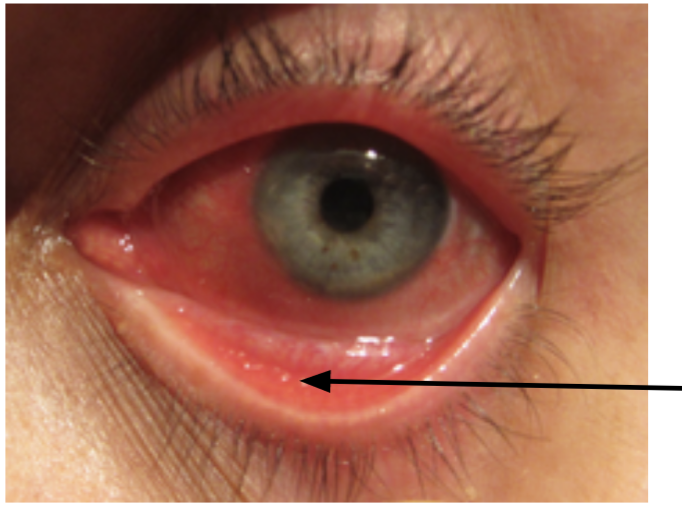
Image Source: Wikimedia Commons (2015). Conjuntivitis (RPS 03-06-2015), Licensed under a creative commons licence. Available for free at: https://commons.wikimedia.org/wiki/File:Conjuntivitis_(RPS_03-06-2015).png (Accessed on: 5 May 2022).
Diagnosis is clinical, but investigations may be useful in specific cases where there is uncertainty and viruses such as the herpes family are suspected. As it is a self-limiting condition and viral, topical antibiotics are not usually required. Cold compresses and artificial tears will provide symptomatic relief. Adenovirus conjunctivitis is very contagious, and patients should be advised on infection control procedures, such as not sharing towels at home. Herpes simplex keratitis should be treated with antivirals.
Bacterial conjunctivitis
Bacterial conjunctivitis is typically a self-limiting condition that occurs on direct inoculation with bacteria. Common pathogens include Staphyloccoccus Aureus, Streptococcus Pneumoniae, Haemophilus influenza and Moraxella Catarrhis. Other less common but more serious causes include Chlamydia and Gonorrhoea. It is usually more common in children.
Symptoms include mucopurulent discharge, particularly in the morning, redness, burning sensation, foreign body sensation, transient blurred vision and mild photophobia. Eyelid oedema may be present in severe cases. Gonococcal infection presents hyperacutely with copious mucopurulent discharge and rapid progression of symptoms. It is important to take a sexual history in these patients, particularly those with persistent bacterial conjunctivitis not responding to topical treatment such as chloramphenicol.
Examination shows conjunctival hyperaemia, mucopurulent discharge, which may be present only in fornices if the eye has been recently cleaned; papillae and follicles may be present in chlamydia conjunctivitis. Pre-auricular lymphadenopathy can occur in gonococcal conjunctivitis. Less commonly, there may be formation of pseudo-membranes or membranes.
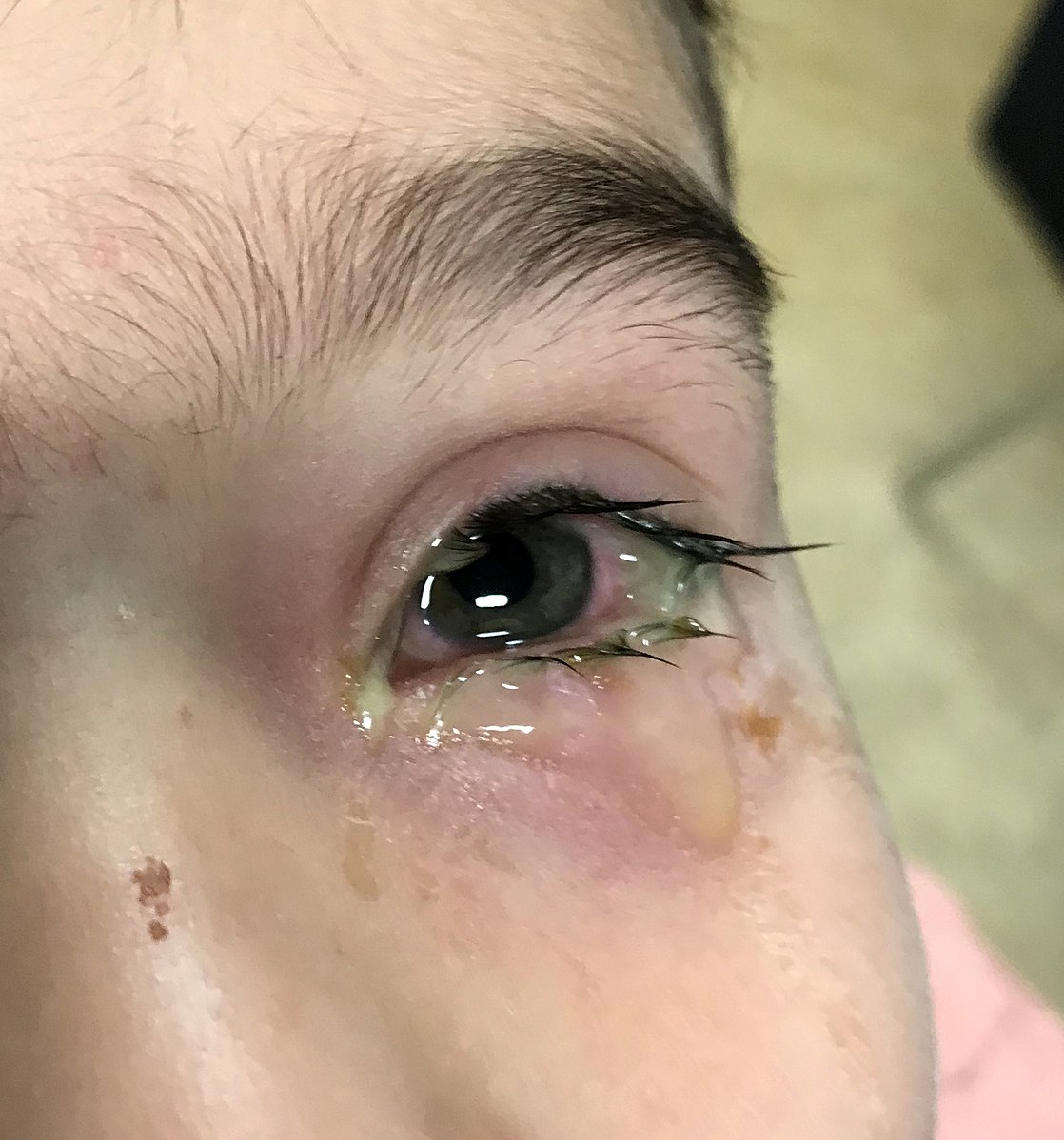
Image Source: Wikimedia Commons (2019). Bacterial conjunctivitis, Licensed under a creative commons licence. Available for free at: https://commons.wikimedia.org/wiki/File:Bacterial_conjunctivitis.jpg (Accessed on: 5 May 2022).


Image Source: Wikimedia Commons (2019). Swollen eye with conjunctivitis, Licensed under a creative commons licence. Available for free at: https://commons.wikimedia.org/wiki/File:Swollen_eye_with_conjunctivitis.jpg (Accessed on: 5 May 2022).

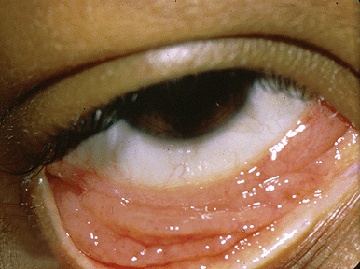
Image Source: Wikimedia Commons (2011). Chlamydial-conjunctivitis, Licensed under a creative commons licence. Available for free at: https://commons.wikimedia.org/wiki/File:Chlamydial-conjunctivitis.jpg (Accessed on: 5 May 2022).


Image Source: Wikimedia Commons (2016). Membranous conjunctivitis, Licensed under a creative commons licence. Available for free at: https://commons.wikimedia.org/wiki/File:Membranous_conjunctivitis.jpg (Accessed on: 5 May 2022).

Bacterial conjunctivitis is a clinical diagnosis, but investigations may be appropriate if gonococcal, chlamydial or meningococcal infection is suspected. Investigations are also useful in cases where there is failure of treatment. Although bacterial conjunctivitis is self-limiting, topical treatment can be given to hasten resolution. This includes anti-bacterials such as chloramphenicol and fluoroquinolones. Gonococcal conjunctivitis is treated with one dose of intramuscular Ceftriaxone, and systemic Azithromycin is given for Chlamydial infection. Advice should be given regarding handwashing and not sharing towels.
Neonatal conjunctivitis
Inflammation of the conjunctiva within the first 28 days of life is termed neonatal conjunctivitis. It can be chemical or infectious in nature. It is the most common infection in neonates. Chlamydia is a leading cause9. Other organisms include staphylococci, streptococci, and chlamydia. Route is typically via vertical transmission during delivery or from caregivers in the post-natal period. History taking should include parental symptoms of sexually transmitted infection, prophylactic eyedrops instilled at birth and systemic illness in the neonate. Symptoms include sticky eyes, mucopurulent or watery discharge, red eyes and eyelid oedema. Examination should include corneal examination to look for ulceration and the tarsal and bulbar conjunctiva.

Image Source: Wikimedia Commons (2016). OSC Microbio 21 02 neonatorum, Licensed under a creative commons licence. Available for free at: https://commons.wikimedia.org/wiki/File:OSC_Microbio_21_02_neonatorum.jpg (Accessed on: 5 May 2022).

Investigation is unnecessary in mild cases, but conjunctival swabs and/or scrapes can be taken and sent for analysis in moderate to severe cases. Untreated, there is a risk of blindness, disability, and significant morbidity. Neonates with suspected infective conjunctivitis should be referred urgently for same-day Ophthalmology assessment9. Mild conjunctivitis can be treated with broad-spectrum topical antibiotics such as Chloramphenicol. Moderate to severe cases Gonococcal conjunctivitis is treated with Ceftriaxone according to weight and chlamydial infections with Azithromycin according to weight.
Complete Guide to Clinical Genetics ST3 Application and Recruitment (2027)
Written by Medibuddy. Last updated: October 2026. Clinical Genetics is

Complete Guide to Clinical Radiology ST3 Application and Recruitment (2027)
Recruitment paused: NHS England is not running Clinical Radiology ST3+ recru

Complete Guide to Paediatric Surgery ST3 Application and Recruitment in United Kingdom (2026)
Written by Medibuddy. Last updated: October 2026. If you’re planning


Take your subscriptions with you
Our mobile app allows you to access your interview and exam question banks wherever you are.

