


 Close
Close
 13th January 2024
Central Sleep Apnoea Syndromes (CSAS)
Overview
CSAS is less common than OSAHS and often occurs secondary to another condition; rarely, there is primary or idiopathic cause for the condition. It is more common amongst older adults (especially >65 years old), males and patients with heart failure, renal failure, atrial fibrillation/flutter (AF), neurological disorders and those using medications that cause respiratory depression. It is estimated to affect about 0.9% of patients above 40 years old.
Patients with CSAS most often tend to develop CSA with Cheyne-Stokes breathing. Cheyne-Stokes breathing is a pathological breathing pattern. It is when there are periods of progressively increased hyperpnea (in a crescendo-decrescendo pattern) to compensate for an increased pCO2. This leads to hypocapnia, triggering a central apnoea. This, in turn, causes a rise in pCO2, restarting the cycle again (see Image 5).
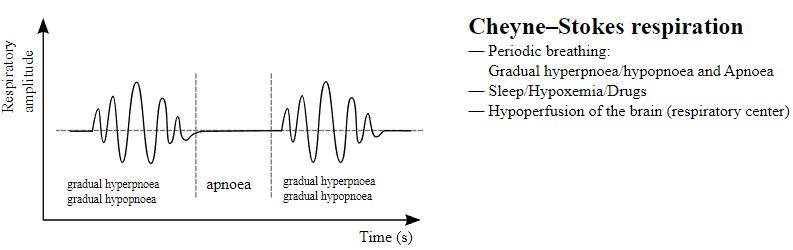
Note original image adapted to only show Cheyne-Stokes Respiration
Image Source: Wikimedia Commons (2012). Breathing abnormalities, Licensed under a creative commons licence. Available for free at: https://commons.wikimedia.org/wiki/File:Breathing_abnormalities.svg (Accessed: 17 August 2022).
Diagnosis
CSA requires formal overnight lab Polysomnography (PSG) to be diagnosed.
Diagnosis of CSA with Cheyne-Stoke breathing requires:
- PSG showing ≥5 central AHI/hour, there are three consecutive central apnoeas/hypopneas in a Cheyne-Stokes breathing pattern, ≥50% of the total apnoeas/hypopneas are central in nature.
- Patient has concurrent AF, heart failure or a neurological disorder
- Patient has clinical features of a sleep apnoea syndrome
- There is no better diagnosis for the symptoms, nor is there any association with medication use
Diagnosis of CSA with medication or substance use requires:
- PSG showing ≥5 central AHI/hour, ≥50% of the total apnoeas/hypopneas are central in nature, there is no evidence of Cheyne-Stokes breathing
- Patient is taking opioids or other respiratory depressant medication
- Patient has clinical features of a sleep apnoea syndrome
- There is no better diagnosis for the symptoms
Diagnosis of Primary CSA
- PSG showing ≥5 central AHI/hour, ≥50% of the total apnoeas/hypopneas are central in nature, there is no evidence of Cheyne-Stokes Breathing
- Patient is not taking opioids or other respiratory depressant medication
- Patient has clinical features of a sleep apnoea syndrome
- There is no better diagnosis for the symptoms
Management
Management of CSA is often rooted in treating the underlying conditions associated with CSA. Any possible drug culprits should be stopped, and the associated medical condition should be optimised. For most patients with mild-moderate complications secondary to the sleep apnoea, this tends to be primary approach to treatment. Often, this, in turn, helps resolve or improve the CSA.
In patients with severe complications, management of the underlying condition occurs in conjunction with targeted treatments for the CSA. This involves:
– Positive Airway Pressure (PAP) therapy: this can be CPAP, BiPAP or even Adaptive Servo -Ventilation (ASV). ASV machines monitor the airflow and deliver PAP dependent on a person’s breathing patterns
– Supplemental oxygen during sleep. This may be in conjunction with PAP therapy or as a second-line option
Complete Guide to Clinical Genetics ST3 Application and Recruitment (2027)
Written by Medibuddy. Last updated: October 2026. Clinical Genetics is

Complete Guide to Clinical Radiology ST3 Application and Recruitment (2027)
Recruitment paused: NHS England is not running Clinical Radiology ST3+ recru

Complete Guide to Paediatric Surgery ST3 Application and Recruitment in United Kingdom (2026)
Written by Medibuddy. Last updated: October 2026. If you’re planning


Take your subscriptions with you
Our mobile app allows you to access your interview and exam question banks wherever you are.

