


 Close
Close
 18th January 2024
Mood disorders
Depression
It is defined as at least 2 weeks of low mood in conjunction with varied emotional, physical, behavioural, and cognitive symptoms. It can be classified as mild, moderate, or severe according to the nature and number of the associated symptoms, duration and the degree of functional and social impairment caused.
Depressive illness reduces the quality of life for those afflicted as well as their families and carers, in addition to increasing the morbidity and mortality of comorbid conditions such as diabetes mellitus and coronary heart disease. Depression also increases rates of self-injurious behaviour, substance misuse and social problems.
Suicide is the main cause of increased mortality in those affected.
More than 50% of those affected will recover within 6 months; however, recurrence rates are high and chronic depressive illness develops in up to 27% of patients.
Pathophysiology
The cause is unknown, but depression evolves from a complex interaction of biological, social, and psychological factors.
Factors that increase risk include:
- Chronic comorbidities (e.g., COPD, thyroid disorders)
- Medicines (e.g., corticosteroids, ß-blockers)
- Female sex
- Older age
- Recent childbirth
- Psychosocial issues (e.g., unemployment, bereavement, poverty, divorce)
- Personal or family history of depression
- Adverse early experiences (e.g., childhood physical abuse)
- Past head injury
Symptoms
The following have all been described as symptoms of depression:
| Core symptoms | Additional symptoms | Somatic symptoms |
|---|---|---|
|
|
|
Source: NICE. (2021). Depression | CKS | NICE. Retrieved July 6, 2022, from https://cks.nice.org.uk/topics/depression/
WHO. (2019). ICD-10 Version: 2019. In ICD-10 Version: 2019. Retrieved from https://icd.who.int/browse10/2019/en#/V
Definitions
- Subthreshold depressive symptoms: When a patient has some of the core symptoms, but their number or severity is insufficient to meet the criteria for full diagnosis
- Persistent subthreshold depressive symptoms: previously known as dysthymia, the persistence of subthreshold symptoms for more than 2 years.
- Recurrent depressive disorder: repeated episodes of depression without a history of episodes of elation and increased energy (mania).
- Cyclothymia: a persistent instability of mood in which the patient experiences periods of mild depression and mild elation, which are not severe enough to be classed as bipolar affective disorder or recurrent depressive disorder.
- Atypical depression: involves abnormal symptoms such as weight gain, hyperphagia, hypersomnia, mood reactivity (improved mood upon exposure to positive stimuli), leaden paralysis (an unusually heavy feeling in the arms or legs), rejection sensitivity (feeling anxious and hyper-reactive to rejection or perceived rejection)
Severity grading
- Mild depression: at least 2 symptoms present; the patient is distressed by their symptoms but usually able to continue with activities
- Moderate depression: at least 4 symptoms present; the patient will have considerable difficulty continuing with activities
- Severe depression without psychotic symptoms: several marked, distressing symptoms present, often with somatic symptoms and/or suicidal ideation, without psychotic symptoms. The patient is often unable to continue normal activities
- Severe depression with psychotic symptoms: also termed psychotic depression; an episode of severe depression with symptoms of psychosis such as hallucinations, delusions, psychomotor retardation, or stupor
Diagnosis
Depression is diagnosed using the Diagnostic and Statistical Manual of Mental Disorders 5ᵗʰ edition (DSM-5) or International Classification of Diseases 10ᵗʰ revision (ICD-10) criteria.
In order to make a diagnosis, patients must have at least 1 core symptom that has been present most of the time, on most days of the week, for at least 2 weeks.
There are various validated measures to assess patients presenting with depressive symptoms; these include:
- Patient Health Questionnaire-9 (PHQ-9) (https://www.mdcalc.com/calc/1725/phq-9-patient-health-questionnaire-9)
- Hamilton Depression Rating Scale (HAM-D) (https://www.mdcalc.com/calc/10043/hamilton-depression-rating-scale-ham-d)
- Major Depression Index (MDI) (https://www.mdcalc.com/calc/1844/major-depression-index-mdi)
- DSM-5 Criteria for Major Depressive Disorder (https://www.mdcalc.com/calc/10195/dsm-5-criteria-major-depressive-disorder)
Investigations are not routinely indicated but may be necessary to exclude other causes of depression or conditions that are known to be associated with depression. Any of these may co-exist with depression, and the presence of one does not exclude the possibility of another.
Investigations
- Blood glucose
- Hyperglycaemia suggesting diabetes mellitus
- Urea, electrolytes & creatinine
- Normal values suggesting electrolyte imbalances
- Low eGFR, high creatinine suggesting renal dysfunction
- ESR & CPR
- Raised suggesting infection or inflammation
- Liver function
- LFTs suggestive of hepatic dysfunction
- High GGT suggesting high alcohol intake
- Thyroid function
- High T4 / low TSH indicating hyperthyroidism
- Low T4 / high TSH indicating hypothyroidism
- Calcium Levels
- Abnormal values indicative of hyper or hypocalcaemia
- Full blood count
- Low Hb indicating anaemia
- Urine drug screen
- Suggesting substance use/misuse
Differential diagnosis
- Anxiety disorders
- Can present with a wide range of physical and affective abnormalities, including fatigability, sleep disturbance, cognitive dysfunction, and unwanted thoughts.
- These may present with physical symptoms not seen in depression, such as panic attacks, cognitive distortions, and muscle tension.
- Neurological conditions (such as Parkinson’s disease, Multiple Sclerosis, dementia)
- Neurodegenerative and neurological diseases can be associated with affective symptoms, changes to behaviour and cognitive function, such as memory and attention. However, depression does not cause focal neurological signs, and the presence of these should alert to the possibility of other pathology.
- Substance misuse
- Pharmacologic agents can have physiological effects on mood and behaviour
- Substance abuse can often produce similar symptoms to depression, such as feelings of guilt or worthlessness, appetite changes, psychosis, and suicidal ideation
- The substance use should pre-date the depressive symptoms in order to diagnose substance-induced depression
- Diabetes mellitus
- Depression and diabetes share symptoms such as weight loss, fatigue, and low mood. However, the key difference is the blood glucose dysregulation defining diabetes.
- Chronic Obstructive Pulmonary Disorder
- Physiological abnormalities such as hypoxaemia and hypercapnia can present with similar symptoms to depression, such as lethargy, impaired concentration, and irritability.
- The presence of physiological changes in COPD, such as alterations to lung function, can help set the diagnoses apart.
- Hypothyroidism or hyperthyroidism
- Endocrine disorders can produce changes similar to depressive disorders, such as lethargy, weight changes, and mood disturbance. However, endocrine diseases have distinct laboratory abnormalities to help identify them.
- Obstructive Sleep Apnoea Syndrome
- Often produces feelings of fatigue, insomnia, cognitive deficits and decreased libido.
- This is more common among patients with obesity and can be diagnosed using the aid of polysomnography.
- Infectious and inflammatory disorders
- Many infectious and inflammatory disorders can produce neuropsychiatric signs and symptoms; however, they usually have other associated pathology that can be used to help identify them, such as sensory loss or biomarkers in the form of antibodies.
Always consider suicide and self-harm risk in patients with suspected depressive disorders.
Management
All patients should be provided information about the nature and course of their illness.
Important principles in the management of depressive illness include recognising that people have a right to decline treatment and that the most appropriate, least intrusive, and resource-intensive treatment should be tried first.
If capacious patients do not want an intervention, use a watchful waiting approach, offering a follow-up in 2 weeks.
The image below outlines the NICE recommendations for patients who want treatment based on illness severity. They are listed in order of the Committee’s interpretation of clinical and cost-effectiveness.
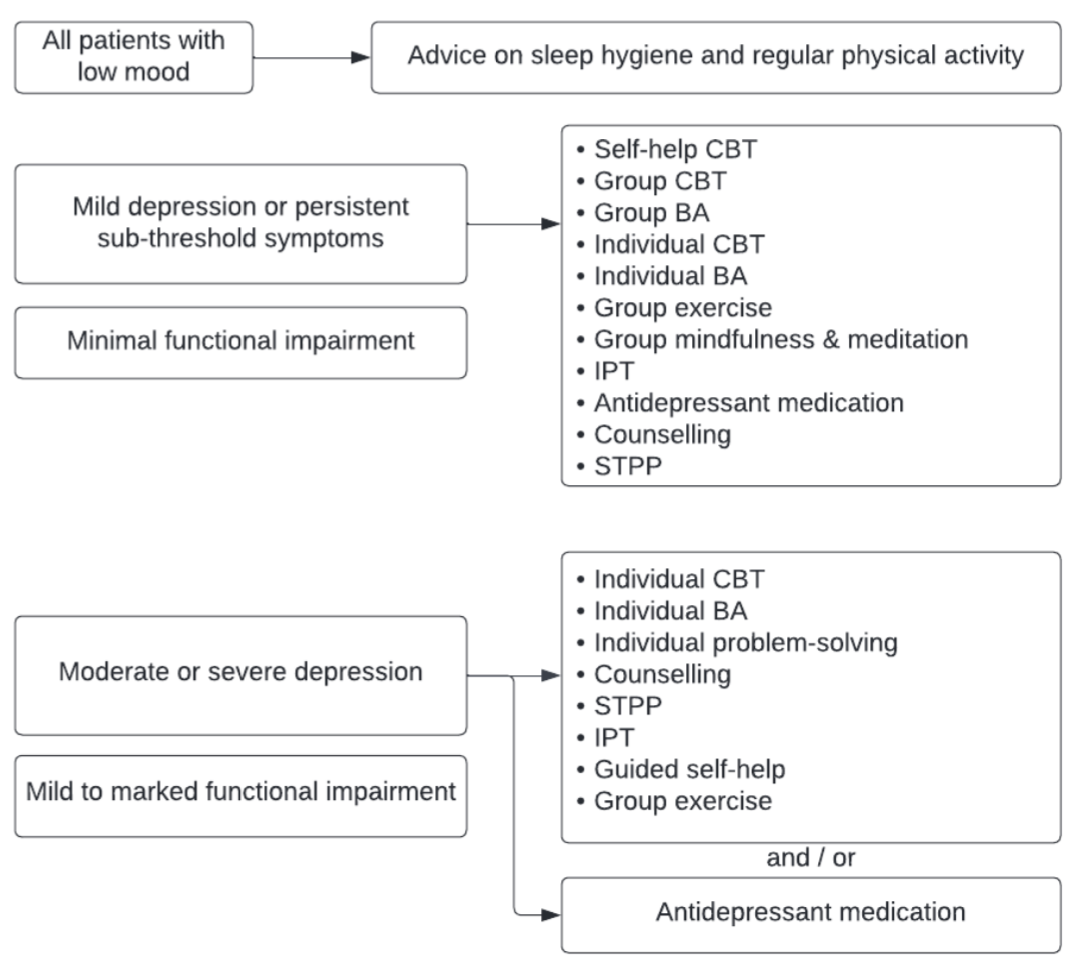
Source: Adapted from (NICE, 2022c)(NICE, 2022a)(NICE, 2022b)
CBT: Cognitive Behavioural Therapy
BA: Behavioural Activation
IPT: Interpersonal Psychotherapy
STPP: Short-term Psychodynamic Psychotherapy
For a full explanation of these therapies, see https://www.nice.org.uk/guidance/ng222/chapter/recommendations#more-severe-depression
References:
- NICE. (2022a). Depression in adults: discussing first-line treatments for less severe depression. NICE Guidance. NICE.
- NICE. (2022b). Depression in adults: treatment and management. Retrieved July 11, 2022, from https://www.nice.org.uk/guidance/ng222/chapter/Recommendations
- NICE. (2022c). Recommendations | Depression in adults. Retrieved July 4, 2022, from https://www.nice.org.uk/guidance/ng222/chapter/Recommendations#recognition-and-assessment
Anti-depressant medication
No antidepressant is recommended above all others, and drugs should be chosen judicially based on patient factors (such as comorbidities, suicide risk, current medications) and side-effect profiles. SSRIs are often first-line as they are often safer in overdose and better tolerated than other classes.
In general:
| Scenario | Consider |
|---|---|
| First episode depression | SSRI |
| Recurrent episode | An antidepressant with a previous good response |
| Aged ≤ 16 years | Fluoxetine |
| Recent MI | Sertraline |
Below is a list of common antidepressants and key considerations in their use. This list is not exhaustive.
| Class | Examples | Considerations |
|---|---|---|
| SSRIs
(Selective Serotonin Reuptake Inhibitors) |
|
|
| SNRIs
(Serotonin & Noradrenaline Reuptake Inhibitors) |
|
|
| NaSSAs
(Noradrenergic & Specific Serotonergic Antidepressants) |
|
|
| TCAs
(Tricyclic Antidepressants) |
|
|
| MAOIs
(Monoamine Oxidase Inhibitors) |
|
|
References
- NICE. (2022b). Depression in adults: treatment and management. Retrieved July 11, 2022, from https://www.nice.org.uk/guidance/ng222/chapter/Recommendations
- NICE. (2021). Depression | CKS | NICE. Retrieved July 6, 2022, from https://cks.nice.org.uk/topics/depression/
- Pompili, M., Serafini, G., Innamorati, M., Ambrosi, E., Giordano, G., Girardi, P., … Lester, D. (2010). Antidepressants and Suicide Risk: A Comprehensive Overview. Pharmaceuticals, 3(9), 2861. https://doi.org/10.3390/PH3092861
- NICE. (n.d.). Antidepressant drugs | Treatment summaries. Retrieved July 4, 2022, from https://bnf.nice.org.uk/treatment-summaries/antidepressant-drugs/
Follow-up and treatment cessation
Initial review should occur 2 weeks after commencing medication unless there is an increased risk of self-harm or the patient is aged < 30 years, in which case they should be reviewed after 1 week. This is due to disturbances that may occur on initiation, such as over-stimulation, agitation, anxiety, psychosis, and increased impulsivity.
Regular reviews should then be scheduled every 2-4 weeks. To reduce the risk of relapse, the minimum recommended treatment duration is 6 months, but patients may safely continue treatment beyond this.
If no benefit is seen after 2 weeks, check adherence and consider increasing the dose, switching class of antidepressant, or adding psychological therapies.
Caution must be exercised when switching between antidepressants – specific guidance can be found in The Maudsley prescribing guidelines in psychiatry (authored by Taylor and Barnes, 2018).
Antidepressants should be reduced slowly over an average of 4 weeks to minimise discontinuation symptoms.
Discontinuation symptoms may include:
- Restlessness
- Problems sleeping
- Diaphoresis
- Abdominal symptoms
- Altered sensations (paraesthesia, electric shock feelings)
- Altered mood (irritability, anxiety, confusion)
- Headache
Discontinuation symptoms tend to start within a few days of treatment cessation and are self-limiting, resolving within 2 weeks in most cases.
If depression is treatment-resistant, Electroconvulsive Therapy (ECT) or lithium augmentation may be considered.
Electroconvulsive Therapy
ECT is a therapy in which generalised seizure activity is induced by an electric current passed through the patient’s brain via scalp electrodes. The patient is placed under general anaesthesia and is given muscle relaxants to prevent muscle spasms.
Risks include retrograde and anterograde amnesia, status epilepticus, laryngospasm, and headache.
Most patients will undertake a course of twice-weekly sessions for 6 weeks.
ECT should only be used to achieve rapid improvement in severe symptoms after other treatment options have failed or when the condition is considered life-threatening.
Situations in which ECT may be used:
- Treatment-resistant depression
- Life-threatening depression
- Catatonia
- Prolonged or severe manic episodes
- Psychotic depression
References
- Davidson, J. R. T., Miller, R. D., Turnbull, C. D., & Sullivan, J. L. (2006). Atypical Depression. Archives of General Psychiatry, 39(5), 527–534. https://doi.org/10.1001/archpsyc.1982.04290050015005
- NICE. (n.d.). Antidepressant drugs | Treatment summaries. Retrieved July 4, 2022, from https://bnf.nice.org.uk/treatment-summaries/antidepressant-drugs/
- NICE. (2021). Depression | CKS | NICE. Retrieved July 6, 2022, from https://cks.nice.org.uk/topics/depression/
- NICE. (2022). Depression in adults: discussing first-line treatments for more severe depression. NICE Guidance. NICE.
- NICE. (2022). Depression in adults: treatment and management. Retrieved July 11, 2022, from https://www.nice.org.uk/guidance/ng222/chapter/Recommendations
- NICE. (2009). Guidance on the use of electroconvulsive therapy. NICE. Retrieved from https://www.nice.org.uk/guidance/ta59/chapter/1-Guidance
- NICE. (2022). Recommendations | Depression in adults. Retrieved July 4, 2022, from https://www.nice.org.uk/guidance/ng222/chapter/Recommendations#recognition-and-assessment
- Pompili, M., Serafini, G., Innamorati, M., Ambrosi, E., Giordano, G., Girardi, P., … Lester, D. (2010). Antidepressants and Suicide Risk: A Comprehensive Overview. Pharmaceuticals, 3(9), 2861. https://doi.org/10.3390/PH3092861
- WHO. (2019). ICD-10 Version: 2019. In ICD-10 Version: 2019. Retrieved from https://icd.who.int/browse10/2019/en#/V
Self-harm and suicide
Deliberate self-harm (DSH) and suicide are manifestations of emotional distress and illness. Their incidence is rising over the years and is common in patients of all ages and social groups.
Unfortunately, there is relatively poor provision of resources and treatment available to help those who self-harm, and unhelpful attitudes from health and care staff, as well as the wider public, are commonplace.
Rates of self-harm are higher among females than males; however, completed suicide is more prevalent among males.
The majority of self-poisonings involve over-the-counter or prescribed medications, and the majority of self-injury incidents involve cutting.
Definitions
- Self-harm: an intentional act of self-injury or self-poisoning, regardless of the motivation or the degree of suicidal intent. It is a wide spectrum of behaviour with harmful physical effects.
- A person who repeatedly self-harms is at higher risk of committing suicide. It is important to note that an act of self-harm is not always an attempt at suicide; for some patients, it can be an act of self-preservation, for example, to reduce internal tension. In most cases, the motivation for DSH is complicated, involving a number of biological, social, and psychological factors.
- Suicide: an intentional self-inflicted death
- Suicide attempt: an act that is potentially self-injurious, that is committed with an intent to die
- Suicidal intent: the intensity of the individual’s wishes to die. Suicidal thoughts can be present without suicidal intent (known as passive suicidal ideation)
Factors influencing suicide risk
Risk factors for DSH include:
- Age:
- DSH rates peak between 16-35 years
- Suicide rates peak between 45-49 years
- Socio-economic problems or disadvantage
- Social isolation
- Mental health problems, especially depressive, psychotic and personality disorders
- Chronic physical health problems/illness
- Stressful life events such as relationship breakdown, abuse, neglect, domestic violence
- Exposure to suicide, e.g., through bereavement
- Early adversity, e.g., childhood abuse
- Drug and/or alcohol misuse
- Involvement with the criminal justice system
- High-risk occupations (e.g., healthcare professionals, farmers, construction workers)
Protective factors that may reduce the risk of suicide include:
- Effective coping strategies
- Supportive relationships
- Dependents (e.g., children, pets, other family members)
- Religious beliefs
Symptoms and diagnosis
The assessment and management of persons presenting with DSH should utilise a bio-psycho-social approach to consider the person’s problems, needs and future risk.
It is impossible to precisely predict suicidal risk, and various assessment tools can be used, such as the Columbia Suicide Severity Rating Scale (C-SSRS Screener) and the Patient Safety Screener 3 (PSS-3).
These scales are designed to measure the severity and intensity of suicidal ideation, the suicidal behaviour and the lethality of any attempts.
All psychiatric assessments should include screening for suicidal ideation and self-harm.
The SAD PERSONS scale was developed to help screen suicide risk in adults. Although the scale has been found to have poor predictive validity in real-world studies, it can provide a useful memory aid for some of the risk factors for suicide rather than being an official risk-calculation tool.
| S | male Sex |
| A | Age < 19 or > 45 years |
| D | Depression |
| P | Previous attempt |
| E | Excess alcohol or substance use |
| R | Rational thinking loss |
| S | Social supports lacking |
| O | Organised plan |
| N | No spouse |
| S | Sickness |
Source: MD App. (n.d.). SAD PERSONS Scale Calculator. Retrieved July 12, 2022, from https://www.mdapp.co/sad-persons-scale-calculator-411/
It is scored with 1 point for each factor, with the final score reflecting risk:
0 – 4: low risk
5 – 6: medium risk
7 – 10: high risk
Management
Acute management
Patients who present with self-harm should be met with a sensitive, compassionate attitude to help minimise their distress.
If possible and appropriate:
- See the individual alone for the initial psychosocial interview
- Allow family members, friends, or advocates to be present if requested
- Assess the individual’s emotional and mental state
- Ask the individual to explain their feelings and understanding of the episode in their own words
- Make treatment decisions jointly with the individual
- If there is doubt regarding the person’s capacity to make informed decisions, the opinion of a psychiatrist with experience in this area should be sought
- Examine physical injuries
Patients who are found to be at acute risk of suicide will require immediate and intensive management; the exact nature of this depends on the presentation and mental state; for example, some patients will need treatment under the Mental Health Act.

Adapted from (BMJ Best Practice, 2020). BMJ Best Practice. (2020). Suicide risk mitigation. Retrieved July 11, 2022, from https://bestpractice.bmj.com/topics/en-gb/3000095/treatment-algorithm#patientGroup-0-0
In episodes of self-poisoning, it may be useful to access the TOXBASE® website (http://www.toxbase.org/) or telephone the UK National Poisons Information Service (NPIS) on 0344 8920111 for a patient-specific risk assessment.
Any person who presents with DSH who does not necessitate referral to an emergency department or mental health crisis team should still be fully assessed and risk evaluated.
Particular points to take note of include:
- Features of depressive illness
- Presence of mental health disorders
- Feelings of hopelessness, impulsivity, or futility
- Features suggesting suicidal intent
- Perceived lethality of the method
- Use of violent methods
- History and frequency of DSH
- Risk is increased by more frequent, recent, or lethal attempts
- Evidence of planning (e.g., a written suicide note, changes to will, closure of bank accounts, plans for care of dependents/pets)
- Misuse of drugs and/or alcohol
- Safeguarding concerns of young persons or vulnerable adults
- Seriousness of physical injuries
- Access to methods of further self-harm and future intent
Immediate interventions that may be used to reduce harm include:
- Psychiatric admission
- Providing reassurance and reducing tension
- Acute sedation
- Making family, carers, and friends aware of the risk
- Removing access to means of harm (e.g., disposing of stockpiled medication)
Complications from DSH depend on the method employed, for example, acute liver failure after paracetamol overdose, permanent scarring or damage to nerves following cutting.
Longer term care
Upon discharge, persons who have self-harmed should be followed up in primary care within 48 hours. They should be offered risk management and psychosocial support where appropriate.
In most cases, patients are discharged to the care of their GP with no further specialist intervention; thus, prompt and clear communication with the GP is vital.
Identified mental health problems should be suitably managed.
Patients should be offered written and verbal information about sources of support (see table, right)
Management looks different in every patient; for example, if stopping DSH completely is unrealistic, patients may be given harm-minimisation advice (e.g., advice on less dangerous methods, carer advice), producing a crisis plan with contact numbers or treatment for substance misuse.
Examples of long-term interventions include:
- Effective treatment of psychiatric disorders
- Alleviating psychosocial stress
- Enhancing positive coping strategies
- Developing crisis management plans
References
- BMJ Best Practice. (2020). Suicide risk mitigation. Retrieved July 11, 2022, from https://bestpractice.bmj.com/topics/en-gb/3000095/treatment-algorithm#patientGroup-0-0
- Cutler, J. (2014). Psychiatry (3rd ed.). Retrieved from https://ebookcentral.proquest.com/lib/ed/reader.action?docID=1665577
- Gulati, G., Lynall, M.-E., & Saunders, K. E. A. (2014). Psychiatry. John Wiley & Sons. Retrieved from https://ebookcentral.proquest.com/lib/ed/reader.action?docID=1481184
- MD App. (n.d.). SAD PERSONS Scale Calculator. Retrieved July 12, 2022, from https://www.mdapp.co/sad-persons-scale-calculator-411/
- NICE. (2020, August). Self-harm. Retrieved July 8, 2022, from https://cks.nice.org.uk/topics/self-harm/background-information/definition/
- Nodentoft, M., Madsen, T., Erlangsen, A., Kapur, N., Steeg, S., Moreton, A., … Pitman, A. (2020). Suicide. In J. R. Geddes, N. C. Andreasen, & G. M. Goodwin (Eds.), New Oxford Textbook of Psychiatry (2nd ed.). https://doi.org/10.1093/med/9780198713005.001.0001
- Royal College of Psychiatrists. (2010). Self-harm, suicide, and risk: Position statement. Retrieved from www.rcpsych.ac.uk.
Bipolar Affective Disorder (BPD)
A long-term mental disorder featuring 2 or more episodes of significantly disturbed mood and activity levels. On some occasions, their mood is elevated, and in some, it is depressed.
Incidence and impact
Patients will experience periods of relapse and remission, especially in the presence of poor treatment adherence. Recovery may not be complete between episodes, and episodes may become more frequent over time.
Around 2% of the UK population screen positive for BPD, rates are similar between males and females. It is more common between the ages of 16 and 24.
BPD has the highest risk for suicide attempts and completion of all psychiatric conditions. Up to 56% of patients will make at least 1 suicide attempt in their lifetime, and up to 59% have suicidal ideation.
Other consequences of BPD include those resulting from impaired disinhibition and functioning, for example, damage to reputation, occupation and relationships, financial difficulties due to overspending, injuries, accidents, unplanned pregnancy, self-neglect, substance misuse and exploitation by others.
BPD is often comorbid with anxiety disorders, substance misuse disorders, ADHD, and personality disorders. Additionally, mortality from cardiovascular disease is twice that of the general population.
Definitions
The Diagnostic and Statistical Manual of Mental Disorders (DSM-5) subtypes BPD into Bipolar I disorder and Bipolar II disorder:
| Bipolar I disorder | Bipolar II disorder | |
| At least 1 manic episode, with or without a history of major depressive episodes | At least 1 major depressive episode with at least 1 hypomanic episode, with no evidence of mania |
- Manic episode: a period of at least 1 week of an abnormally and persistently elevated or irritable mood, plus at least 3 additional symptoms which are severe enough to cause significant impairment in social or occupational functioning, or which requires hospitalisation, or which includes psychotic features.
- Hypomanic episode: a period of at least 4 days of a mildly elevated or irritable mood, which is not severe enough to cause a significant impairment in social or occupational functioning or necessitate hospitalisation without psychotic features.
- Depressive episode: a period of at least 2 weeks of depressed mood or anhedonia, with additional symptoms.
- Mixed episode: A period of rapid alteration between manic and depressive symptoms OR a period of at least 1 week in which symptoms meet the criteria for a manic/hypomanic episode, and at least 3 symptoms of depression are present on most days OR a period of at least 1 week in which symptoms meet the criteria for a depressive episode, and at least 3 symptoms of mania/hypomania are present on most days.
- Rapid-cycling bipolar disorder: when at least 4 mood (depressive, manic, hypomanic, or mixed) episodes are experienced within a 12-month period.
Pathophysiology
BPD is considered one of the most heritable psychiatric disorders, with 1st degree relatives having a 5x increased risk compared to the general population. A number of risk alleles have been identified by genomic studies as having a small effect.
Environmental factors such as early life stress, maternal death before age 5, childhood trauma or abuse, emotional neglect, cannabis use, cocaine exposure and Toxoplasma Gonddi exposure have all been associated with onset or relapse of BPD.
Symptoms and diagnosis
A diagnosis of BPD can be suspected in primary care, but a specialist psychiatric assessment must be carried out in order to confirm diagnosis.
Use clinical judgement to determine the urgency of referral or admission.
Symptoms of mania may include:
- Increased energy and activity
- Marked feelings of wellbeing
- Feelings of physical and mental efficiency
- Increased sociability, talkativeness, over-familiarity
- Increased sexual energy
- Decreased need for sleep
- Irritability
- Conceit
- Impolite behaviour and loss of social inhibitions
- Inattention and distractibility
- Elation
- Pressured speech
- Inflated self-esteem and grandiose ideas
- Overconfidence
In episodes of mania with psychotic features, the following may be seen:
- Delusions
- Hallucinations
- Flight of ideas
- Manic stupor
Symptoms may be mood-congruent or mood-incongruent
Management
BPD is best managed through a combination of treatment modalities, the choice of which should consider suicide risk, disease polarity, treatment adherence and pharmacokinetics.
Mania
The treatment aims for a manic patient are to reduce the core symptoms, reduce psychotic symptoms, minimise abnormal behaviour, and minimise the side effects of treatment.
Dopamine antagonists are the first line choice, typically one of Haloperidol, Olanzapine, Quetiapine, or Risperidone.
- If this is not effective or tolerated, an alternative from the above may be tried
- Following this, Lithium or Sodium valproate may be added
If the patient is already on an antidepressant medication, this should be tapered and discontinued.
Mixed episodes
Usually treated in the same way as manic episodes.
Depression
One of the difficulties in pharmacological management of bipolar depression is the risk of (hypo-)manic or mixed switch resulting from antidepressant treatment. For this reason, antidepressants may be judiciously used as long as antidepressant monotherapy is avoided and they are co-prescribed with an anti-manic agent.
Options are:
- Quetiapine alone
- Fluoxetine + olanzapine
- Olanzapine alone
- Lamotrigine alone
Maintenance
Maintenance therapy aims to prevent new (hypo)manic, mixed, and depressive episodes, as well as to improve residual symptoms.
Long-term management is typically commenced 4 weeks after the acute episode has resolved. The options for maintenance include:
- Continuing current anti-manic agent
- Starting long-term therapy with Lithium (or, failing this valproate* or olanzapine alone or in combination with lithium)
Lithium
Lithium is highly effective in reducing relapse risk and is the only drug to meet the stringent criteria of being a true mood stabiliser. It works in acute mania, depression and as a maintenance therapy.
It can be combined with other drugs, commonly anticonvulsants and dopamine antagonists. Most patients will respond to one of these drugs.
The exact pharmacological mechanism by which lithium benefits mood disorders is unknown.
Monitoring
All patients on lithium therapy must be routinely monitored via blood tests.
- Lithium levels are measured 12 hours post-dose
- The first level should be taken 1 week after initiation
- Subsequent measurements should occur 1 week after every dose change and weekly until levels stabilise
- After levels have stabilised, they can be measured every 3 months
Individual serum lithium targets will be prescribed. Typically 0.6-0.8 mmol/L is suitable for those prescribed lithium for the first time, with higher levels suggested for those who have relapsed on lithium treatment previously.
Adverse effects
- Nausea, diarrhoea
- Muscle weakness
- Fine tremors
- Polyuria, polydipsia, diabetes insipidus
- Hypo- or hyperthyroidism
- Hyperparathyroidism
- Nephrotoxicity
- Rhabdomyolysis
Toxicity
Toxicity occurs at concentrations greater than 1.5 mmol/L.
Severe toxicity occurs when levels exceed 2 mmol/L.
Signs of toxicity include:
- Diarrhoea
- Vomiting
- Anorexia
- Muscle weakness
- Lethargy
- Ataxia
- Tinnitus
- Blurred vision
- Coarse tremor
- Choreoathetoid movements
- Dysarthria
- Drowsiness
- Hyperreflexia
- Psychosis
- Seizures
- Coma
- Renal failure
Note: there is a list of conditions in which lithium is contraindicated, including patients who refuse regular blood tests.
Women of childbearing potential should be advised to use reliable contraception.
* Note on Sodium valproate:
- There is significant risk of fetal malformations and adverse neurodevelopmental outcomes due to Valproate exposure during pregnancy. It is not recommended for women of childbearing potential unless all other alternatives are inappropriate, ineffective, or not tolerated.
- If prescribed to females of childbearing potential, they should be placed on a pregnancy prevention plan.
Electroconvulsive Therapy
As in unipolar major depression, ECT can be used in cases of bipolar major depression, as well as mixed episodes and occasionally mania. The indications for its use include failure to respond to multiple medication trials, acute life-threatening illness (such as suicidality or severe neglect), severe psychosis and catatonia.
There is a risk of precipitating hypo-/mania with the use of ECT, but is lower than that posed by antidepressant medications.
- In patients who develop mania during their ECT treatment course, ECT is often continued alongside an antipsychotic as ECT is effective for mania.
It is used in mania less commonly than in depression, as manic patients often respond to pharmacological therapy.
Psychotherapy
It is recommended that targeted psychotherapy is provided alongside pharmacotherapy.
Psychoeducational approaches are considered best as these allow patients to develop skills to recognise and manage their moods, stressors and maximise their quality of life. These approaches may include:
- Structured group psychoeducation
- Family interventions
- Cognitive behavioural therapy
- Interpersonal therapy
Other advice for preventing relapse should be given to patients, for example:
- Encouraging treatment compliance
- Maintaining good sleep hygiene and adequate sleep duration
- Avoiding shift work, night flying and routinely working excessive hours
- Structuring their day with activities and social contact
- Self-monitoring symptoms, triggers, and early warning signs
- Coping strategies
- Reduction or cessation of smoking (nicotine is a stimulant)
- Avoiding misuse of alcohol and drugs
- Avoiding excessive caffeine
References
- Churchill, G. C., Nisha, S., & Berridge, M. J. (2020). Bipolar Disorder. In J. R. Geddes, N. C. Andreasen, & G. M. Goodwin (Eds.), New Oxford Textbook of Psychiatry (2nd ed.). https://doi.org/10.1093/med/9780198713005.001.0001
- Solomon, D. (2014). Bipolar disorder in adults: Indications for and efficacy of electroconvulsive therapy (ECT). Retrieved July 18, 2022, from https://www-uptodate-com.ezproxy.is.ed.ac.uk/contents/bipolar-disorder-in-adults-indications-for-and-efficacy-of-electroconvulsive-therapy-ect?search=Bipolar disorder in adults: Indications for and efficacy of electroconvulsive therapy (ECT)&source=search_result&selectedTitle=1~150&usage_type=default&display_rank=1#H518772946
- NICE. (2021). Bipolar disorder. Retrieved July 6, 2022, from https://cks.nice.org.uk/topics/bipolar-disorder
- NICE. (n.d.). Lithium carbonate. Retrieved July 4, 2022, from https://bnf.nice.org.uk/drugs/lithium-carbonate/#monitoring-requirements
- NICE. (2021). Valproate | Prescribing information | Bipolar disorder | CKS | NICE. Retrieved July 6, 2022, from https://cks.nice.org.uk/topics/bipolar-disorder/prescribing-information/valproate/#monitoring
- Vieta, E., Pacchiarotti, I., & Miklowitz, D. J. (2020). Management and treatment of bipolar disorder. In J. R. Geddes, N. C. Andreasen, & G. M. Goodwin (Eds.), New Oxford Textbook of Psychiatry (2nd ed.).
- WHO. (2019). ICD-10 Version: 2019. In ICD-10 Version: 2019. Retrieved from https://icd.who.int/browse10/2019/en#/V
- Key points on Lithium therapy (NICE, n.d.-b; Vieta, Pacchiarotti, & Miklowitz, 2020) NICE. (n.d.). Lithium carbonate. Retrieved July 4, 2022, from https://bnf.nice.org.uk/drugs/lithium-carbonate/#monitoring-requirements Vieta, E., Pacchiarotti, I., & Miklowitz, D. J. (2020). Management and treatment of bipolar disorder. In J. R. Geddes, N. C. Andreasen, & G. M. Goodwin (Eds.), New Oxford Textbook of Psychiatry (2nd ed.).
Complete Guide to Clinical Genetics ST3 Application and Recruitment (2027)
Written by Medibuddy. Last updated: October 2026. Clinical Genetics is

Complete Guide to Clinical Radiology ST3 Application and Recruitment (2027)
Recruitment paused: NHS England is not running Clinical Radiology ST3+ recru

Complete Guide to Paediatric Surgery ST3 Application and Recruitment in United Kingdom (2026)
Written by Medibuddy. Last updated: October 2026. If you’re planning


Take your subscriptions with you
Our mobile app allows you to access your interview and exam question banks wherever you are.

