


 Close
Close
 20th February 2024
Basics of genetics
DNA
The nucleus of the human cells contains 46 chromosomes, two pairs of autosomal chromosomes with two sex chromosomes, known as diploid. Human chromosomes consist of deoxyribonucleic acid (DNA) wound in a double helix. Ribonucleic acid (RNA) is a single-stranded molecule that mediates protein formation from DNA. Three main subtypes exist:
- Messenger RNA (mRNA) – Formed during transcription and forms the template for protein synthesis.
- Transfer RNA (tRNA) – Transport molecules that interact with the mRNA within the ribosome. An amino acid is attached to one end of the tRNA molecule. During translation, tRNA adds the amino acid to the polypeptide chain.
- Ribosomal RNA (rRNA) – Component of the ribosome organelle. Aids in the binding of mRNA to tRNA during translation.
There are several types of DNA. Single-copy DNA accounts for half of the human genome and accounts for the introns and exons. The remainder of the human genome consists of repetitive DNA. Repetitive DNA can be divided into:
- Dispersed repetitive DNA – Found as short, interspersed elements and long interspersed elements. They function as polymorphisms and are randomly distributed within the genome.
- Satellite DNA – Clustered repetitive segments of tandem repeats with varying lengths (tens to thousands of base pairs). Useful for genetic mapping due to variable sizes between individuals.
Mitochondrial DNA is a circular genome that encodes proteins in the mitochondrial respiratory chain and specific transfer RNAs. Mitochondrial DNAs are derived from the ovum as no mitochondria are transferred from the spermatozoa during fertilisation.
Cell cycle
Normal cell division occurs by mitosis, resulting in 2 genetically identical daughter cells.
Mitosis occurs in 4 distinct phases: prophase, metaphase, anaphase, and telophase.
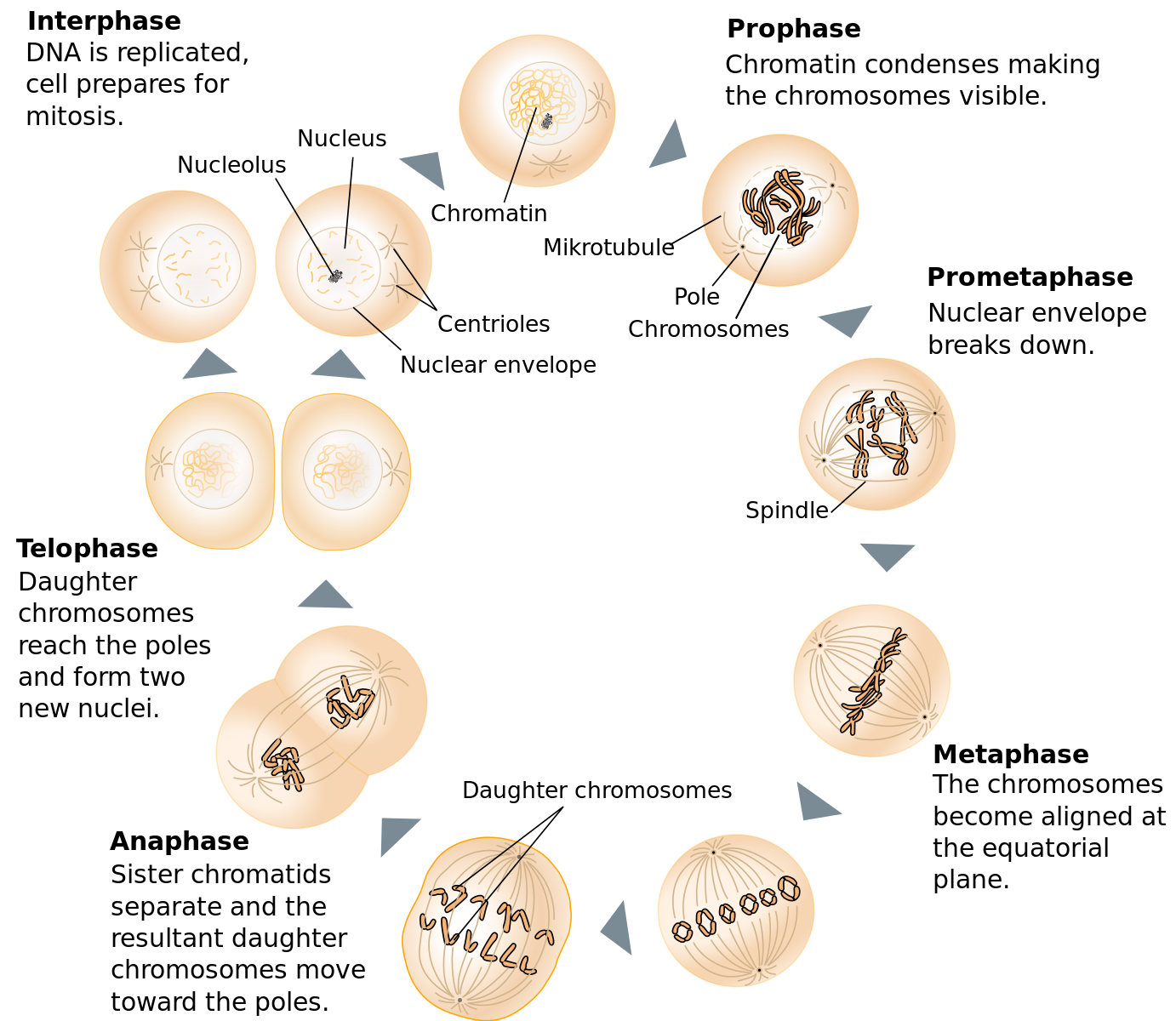
Image Source: Wikimedia Commons (2022). Mitosis schematic diagram, Licensed under a creative commons licence. Available for free at: https://commons.wikimedia.org/wiki/File:Mitosis_schematic_diagram-en.svg (Accessed: 4 January 2024).
Reproductive cells divide by meiosis, resulting in daughter cells containing one chromosome of each chromosome pair, known as the haploid daughter cells. Genetic diversity occurs through a process of “crossing-over”, where segments of homologous chromosomes are exchanged. Meiosis occurs in 2 distinct steps, meiosis I and II. Homologous chromosomes are divided during meiosis I, forming the haploid cells, while sister chromatids are separated during meiosis II.

Image Source: Wikimedia Commons (2016). Meiosis Stage, Licensed under a creative commons licence. Available for free at: https://commons.wikimedia.org/wiki/File:Meiosis_Stages.svg (Accessed: 4 January 2024).
Further details can be obtained from the cell cycle section.
Complete Guide to Clinical Genetics ST3 Application and Recruitment (2027)
Written by Medibuddy. Last updated: October 2026. Clinical Genetics is

Complete Guide to Clinical Radiology ST3 Application and Recruitment (2027)
Recruitment paused: NHS England is not running Clinical Radiology ST3+ recru

Complete Guide to Paediatric Surgery ST3 Application and Recruitment in United Kingdom (2026)
Written by Medibuddy. Last updated: October 2026. If you’re planning


Take your subscriptions with you
Our mobile app allows you to access your interview and exam question banks wherever you are.

