


 Close
Close
 8th March 2024
Ventricular Septal Defect
A ventricular septal defect (VSD) is one of the most common congenital cardiac defects (second to bicuspid aortic valve) with a prevalence of about 20-25% of all congenital heart diseases. Males and females are affected equally. Acquired VSDs, e.g., from myocardial infarction, are not discussed here.
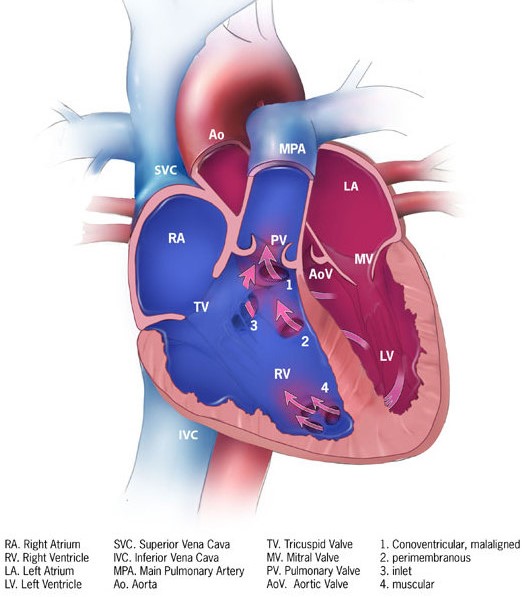
Image Source: Wikimedia Commons (2013). Ventricular septal defect, Licensed under a creative commons licence. Available for free at: https://en.wikipedia.org/wiki/Ventricular_septal_defect (Accessed: 26 January 2024).
There are four subtypes of VSD the commonest of which is membranous VSD, accounting for 80% of defects. They occur within the membranous septum with potential involvement of the tricuspid and aortic valves.
Muscular VSDs are completely surrounded by muscle. They make up to 15-20% of VSDs.
5% of VSDs are outlet/infundibular defects located below the aortic and pulmonary valves. They may be associated with aortic regurgitation.
Inlet VSD, also known as AV canal/AVSD type, typically occur in Down’s syndrome and is found below the AV valves.
Complete Guide to Clinical Genetics ST3 Application and Recruitment (2027)
Written by Medibuddy. Last updated: October 2026. Clinical Genetics is

Complete Guide to Clinical Radiology ST3 Application and Recruitment (2027)
Recruitment paused: NHS England is not running Clinical Radiology ST3+ recru

Complete Guide to Paediatric Surgery ST3 Application and Recruitment in United Kingdom (2026)
Written by Medibuddy. Last updated: October 2026. If you’re planning


Take your subscriptions with you
Our mobile app allows you to access your interview and exam question banks wherever you are.

