


 Close
Close
 11th April 2024
Female genital mutilation (FGM)
Background
FGM describes any procedure involving the partial or total removal of the external genitalia or any other injury to the female genital organs for non-medical reasons. It is estimated that 65,000 girls aged 13 and under in the UK are at risk of FGM. It is most commonly practised among African (Egypt, Nigeria, Kenya, Sierra Leone, Somalia, Sudan) and some non-African (Afghanistan, Indonesia, Kurdistan, Malaysia, Turkey, Thailand) communities.
Clinical evaluation
Symptoms that suggest FGM is present are: (1) difficulties walking, standing or sitting; (2) urinary retention and/or incontinence; (3) menstrual problems; (4) vaginal soreness or recurrent infections; (5) depression or withdrawn behaviour. Where FGM is suspected, women should be offered STI screening, including HIV, Syphilis, hepatitis B and C. All women with FGM should be referred to FGM services (where available) or secondary care.
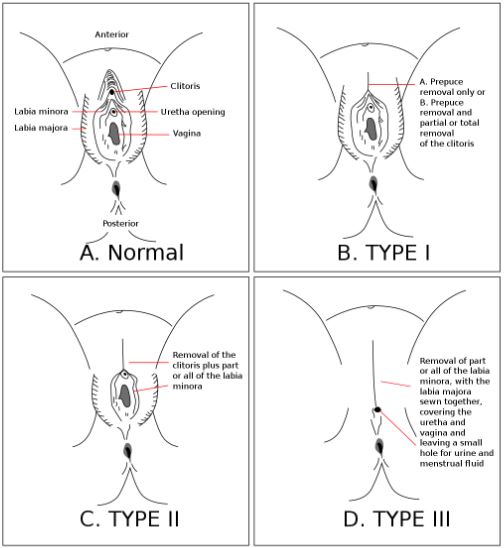
Image source: Wikimedia Commons (2020). FGC Types, Licensed under a Creative Commons licence. Available for free at: https://commons.wikimedia.org/wiki/File:FGC_Types.svg (Accessed: 07 February 2024).
Legal duties
FGM has been a criminal offence in the UK since 1985. It is illegal to arrange, assist in arranging or fail to protect a girl from the risk of FGM. Since 2014, it has been mandatory for all healthcare professionals to record the identification of FGM within a patient’s clinical record and to submit these details to the DHSC. While there is no requirement to ask every female whether they have FGM, healthcare staff are expected to use professional judgement to decide whether there are risk factors for each patient.
All vulnerable adults or children under 18 who have signs of FGM, or in whom there is good reason to suspect they are at risk of FGM, must be referred to the police and child social services within 1 month. There is no requirement to refer adult women to social services or the police.
References
- Department of Health and Social Care. Multi-agency statutory guidance on female genital mutilation (1 April 2016). Last revised on 30 July 2020. Available at https://www.gov.uk/government/publications/multi-agency-statutory-guidance-on-female-genital-mutilation.
- Royal College of Obstetricians and Gynaecologists. Female Genital Mutilation and its Management (Green-top Guidelines No. 53). July 2015. Available at https://www.rcog.org.uk/media/au0jn5of/gtg-53-fgm.pdf.
Complete Guide to Clinical Genetics ST3 Application and Recruitment (2027)
Written by Medibuddy. Last updated: October 2026. Clinical Genetics is

Complete Guide to Clinical Radiology ST3 Application and Recruitment (2027)
Recruitment paused: NHS England is not running Clinical Radiology ST3+ recru

Complete Guide to Paediatric Surgery ST3 Application and Recruitment in United Kingdom (2026)
Written by Medibuddy. Last updated: October 2026. If you’re planning


Take your subscriptions with you
Our mobile app allows you to access your interview and exam question banks wherever you are.

