


 Close
Close
 17th June 2024
Malaria
Background
Malaria is a tropical protozoal infection transmitted by the female anopheles mosquito. Plasmodium falciparum is the deadliest species. Plasmodium ovale and Plasmodium vivax both have dormant hypnozoite stages in the liver and so require a targeted drug such as primaquine for full eradication. Plasmodium malariae and Plasmodium knowlesi are the other two species known to cause human disease. Untreated malaria can cause fevers that correspond to the timing of rupture of schizonts in the bloodstream. P. ovale, P. vivax, and P. falciparum are known as tertian infections, classically causing a fever every 48 hours. P. malariae is a quartan malaria, causing a fever every 72 hours. P.knowlesi causes a fever every 24 hours.
Malaria can present non-specifically and should be included in most differentials of fever in the returned traveller. Features of severe malaria are discussed below and can be a clue to the diagnosis. Falciparum malaria is thought to exert its severe effects through a process called sequestration, whereby infected erythrocytes adhere to endothelial walls. Malarial retinopathy is indicative of cerebral malaria. Recurrent malarial infections can cause massive splenomegaly.
Investigation and Management
Thick blood films are used to determine whether parasites are present, whereas thin blood films are used to determine the species and level of parasitaemia. Rapid detection strips can be used to detect species-specific antigens. Three negative antigen tests are generally needed before malaria is ruled out. Antigen tests may be less reliable in areas of high endemicity and patients are, therefore, sometimes treated on clinical suspicion.
Criteria for severe falciparum is detailed in the table below. This is assuming that no other obvious causes are present to explain the clinical and laboratory findings. The criteria are similar for the other species of malaria, with further detail available in the referenced World Health Organization guidelines. The parasitaemia threshold for severe malaria may change if the patient has not had a previous malaria infection. Malaria severity score is a very simple single best answer question to create and so it is worth being familiar with the criteria before the MRCP exam.
Severe malaria, regardless of species, is managed with IV artesunate, with non-severe malaria usually managed with artemisinin combination therapy. IV quinine was previously the treatment of choice for severe malaria, however there may be a mortality benefit of using artesunate over quinine, as well as a reduction in adverse side-effects such as tinnitus, deafness, and hypoglycaemia. IV artesunate treatment can lead to a delayed haemolysis presentation in the days to weeks after treatment. It is, therefore, important to follow these patients up over this time period. Malaria in pregnancy is slightly more complicated, with guidance available in the referenced UK and World Health Organization documents. As mentioned previously, primaquine is necessary to clear the hypnozoite stage of P. ovale and P. vivax. This can cause haemolysis in patients with glucose-6-phosphate dehydrogenase (G6PD) deficiency and so this condition should be screened for before commencing eradication therapy.

Adapted from: https://www.who.int/publications/i/item/guidelines-for-malaria
Prophylaxis
The required type of prophylaxis, if any, depends on malaria species prevalence and resistance patterns in the region of interest. A comprehensive list by country can be found in the references below. If the risk of falciparum is negligible, no prophylaxis is recommended. If the risk of falciparum is small, bed nets alone may be sufficient. There are two broad types of chemoprophylaxis: suppressive and causal. Doxycycline is an example of a suppressive prophylactic, which kills blood stage parasites only. This means the medication must be taken for a period once the individual has left the region of risk. Conversely, causal prophylaxis, such as atovaquone with proguanil, stops parasite development in the liver and can, therefore, be discontinued shortly after leaving the endemic area.
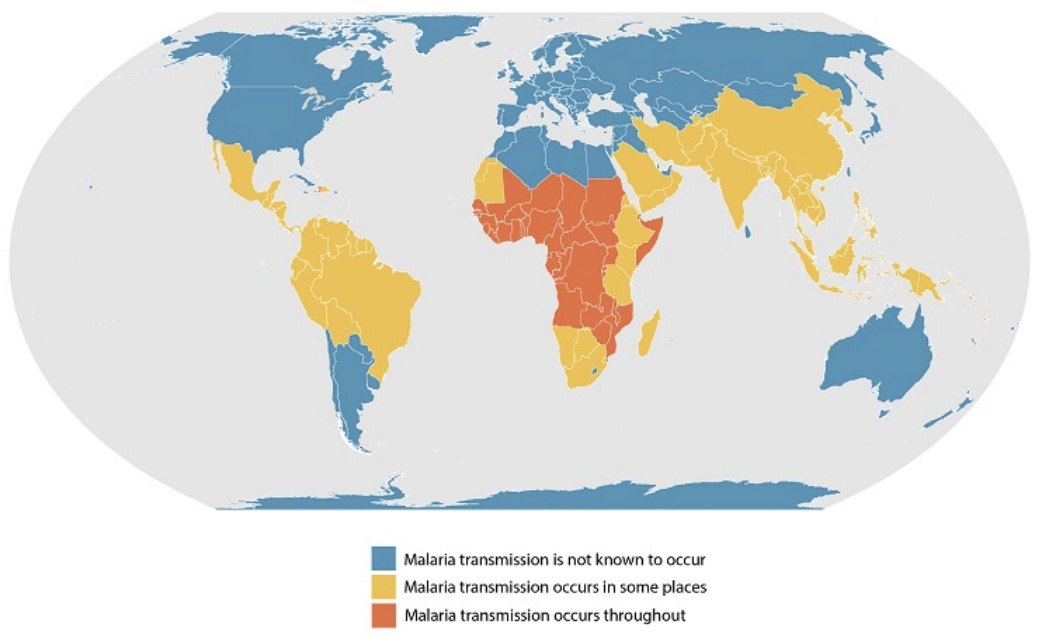
Image Source: CDC (2020). Malaria about distribution, Licensed under a creative commons licence. Available for free at: https://www.cdc.gov/malaria/about/distribution.html (Accessed:24 January 2024).
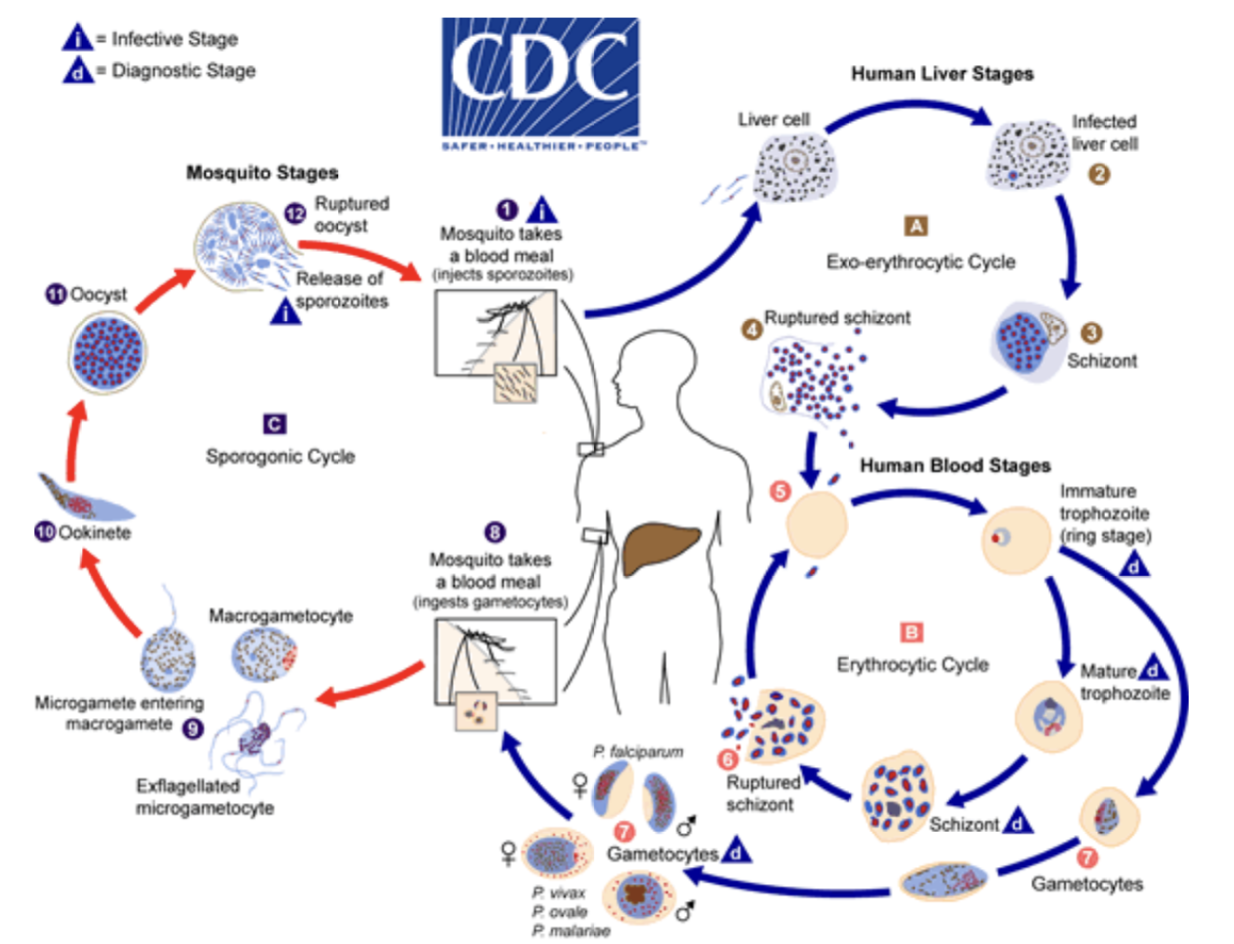
Image Source: CDC (2020). Malaria about biology, Licensed under a creative commons licence. Available for free at: https://www.cdc.gov/malaria/about/biology/index.html (Accessed: 24 January 2024).
References
- CDC Malaria species and resistance by country [Internet]. Cdc.gov [cited April 2022]. Available from: https://www.cdc.gov/malaria/travelers/country_table/a.html
- WHO Guidelines for malaria, 3 June 2022. Geneva: World Health Organization; 2022
- Lalloo DG, Shingadia D, Bell DJ, Beeching NJ, Whitty CJM, Chiodini PL; PHE Advisory Committee on Malaria Prevention in UK Travellers. UK malaria treatment guidelines 2016. J Infect. 2016 Jun;72(6):635-649. doi: 10.1016/j.jinf.2016.02.001. Epub 2016 Feb 12. PMID: 26880088; PMCID: PMC7132403
- Lebrun D, Floch T, Brunet A, Julien G, Romaru J, N’Guyen Y, Cousson J, Giltat A, Toubas D, Bani-Sadr F. Severe post-artesunate delayed onset anaemia responding to corticotherapy: a case report. J Travel Med. 2018 Jan 1;25(1). doi: 10.1093/jtm/tax091. PMID: 29394387
- Bell D, Lalloo D. Malaria. In: Beeching N, Gill G, ed. by. Tropical Medicine Lecture Notes. 7th ed. West Sussex: Wiley Blackwell; 2014. p. 53-69
Complete Guide to Clinical Genetics ST3 Application and Recruitment (2027)
Written by Medibuddy. Last updated: October 2026. Clinical Genetics is

Complete Guide to Clinical Radiology ST3 Application and Recruitment (2027)
Recruitment paused: NHS England is not running Clinical Radiology ST3+ recru

Complete Guide to Paediatric Surgery ST3 Application and Recruitment in United Kingdom (2026)
Written by Medibuddy. Last updated: October 2026. If you’re planning


Take your subscriptions with you
Our mobile app allows you to access your interview and exam question banks wherever you are.

