


 Close
Close
 13th February 2025
Non-urgent causes of red eye
Blepharitis
Blepharitis is a chronic condition involving inflammation of the eyelid margins. Anterior blepharitis involves the base of the eyelashes and is most commonly caused by bacteria or seborrhoeic dermatitis. Posterior blepharitis is due to dysfunction of the meibomian glands (that secrete the lipid layer of the tear film) on the posterior lid margin. Symptoms include a foreign body sensation, burning and itching. Lids are erythematous with crusting around the eyelashes. First-line treatment is with warm compresses and eyelid scrubs. Refractory cases may be given antibiotics or topical steroids, dependent on the cause.
Conjunctivitis
Bacterial
Usually presents as a red eye (unilateral or bilateral) with a sticky, purulent discharge (Figure 4). The patient feels irritation rather than pain. Lid erythema may be present. The most common pathogens are Staphylococcus aureus, Streptococcus pneumoniae and Haemophilus influenzae. It is usually self limiting, but broad-spectrum topical antibiotic drops or ointment can be given, e.g. chloramphenicol.
Trachoma is conjunctivitis caused by Chlamydia trachomatis and is the leading infectious cause of blindness worldwide. Active disease is characterised by follicular conjunctivitis (large conjunctival follicles located at the upper margin of the cornea may leave depressions known as ‘Herbert’s pits’, which are pathognomonic for trachoma), with repeated infection leading to inflammation and conjunctival scarring causing ingrowth of eyelashes towards the cornea (entropion) and subsequent corneal opacities due to recurrent abrasions. As part of the World Health Organisation strategy, management includes surgery, antibiotics (such as a single dose of oral azithromycin), facial cleanliness and environmental changes.
Cases of trachoma and Neisseria gonorrhoeae conjunctival infection must be referred to an ophthalmologist.
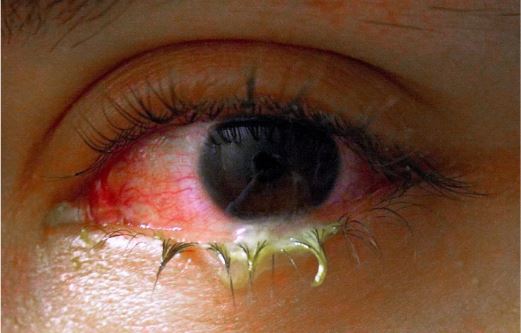
Image Source: Wikimedia Commons (2008). Swollen eye with conjunctivitis, Licensed under a creative commons licence. Available for free at: https://en.m.wikipedia.org/wiki/File:Swollen_eye_with_conjunctivitis.jpg (Accessed: 18 January 2024)
Viral
Viral conjunctivitis is most commonly caused by adenovirus (90% of cases). It may start unilaterally and spread to the other eye or be bilateral throughout its duration. It presents with watery rather than purulent discharge. The patient usually describes an irritation or grittiness. Preauricular lymphadenopathy may be present. Associated upper respiratory tract infection, pharyngitis and fever may be seen in some serotypes (pharyngoconjunctival fever). Most cases are self limiting within 2-3 weeks, but in severe cases steroids may be required. In all cases, stringent hygiene measures should be taken to prevent transmission, and lubricating eye drops may be used for symptom relief.
Allergic
Acute IgE-mediated conjunctival reaction is often to pollen or other environmental allergens. The predominant symptom is itching, which may be associated with conjunctival swelling (chemosis), conjunctival injection, lacrimation and rhinitis. Most cases can be treated with cold compresses and artificial tears, with use of antihistamines or mast cell stabilisers if no improvement.
Episcleritis
Episcleritis involves the outermost layer of the sclera in contrast to the deeper stromal inflammation seen in scleritis and is limited to the superficial episcleral plexus, causing either diffuse or nodular redness (Figure 5). Disease associations include rheumatoid arthritis, inflammatory bowel disease, spondyloarthropathies and vasculitides. Patients often have no pain or mild discomfort, but this can be variable, although when pain is more severe, scleritis should be considered. Instillation of 10% phenylephrine drops will blanch the vessels engorged in episcleritis, but will not blanch the deeper vessels involved in scleritis. Usually, it is self limiting, lasting a few weeks. Simple measures such as cool compresses or artificial tears may be used, in addition to NSAIDs for symptomatic relief.
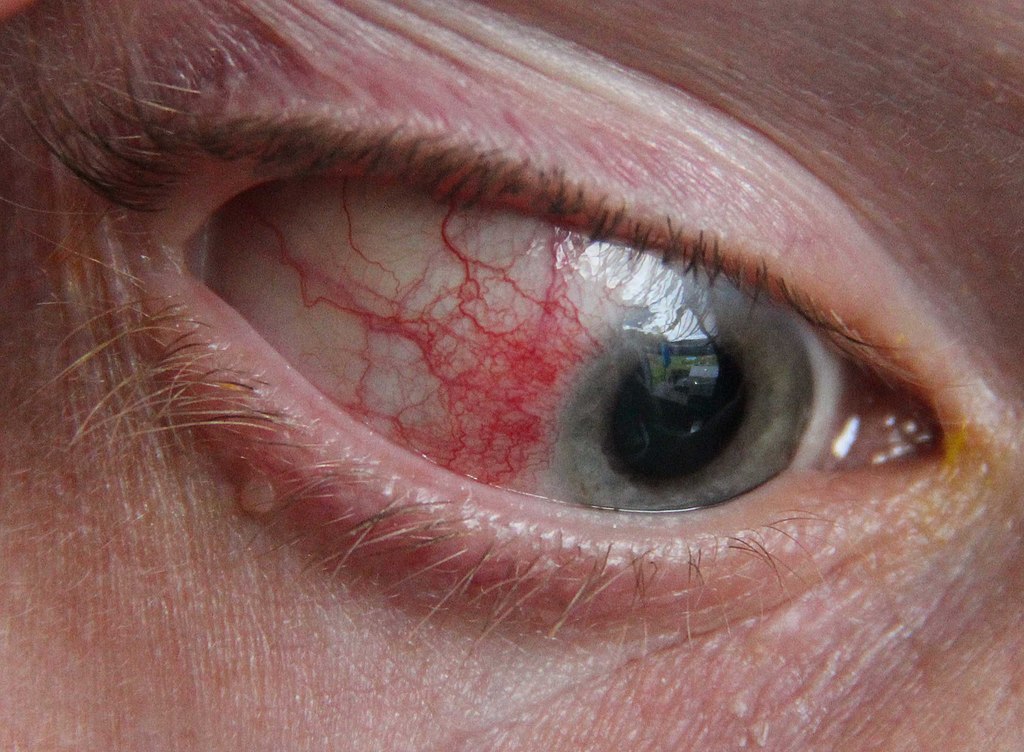
Image Source: Wikimedia Commons (2013). Episcleritiseye, Licensed under a creative commons licence. Available for free at: https://en.wikipedia.org/wiki/Episcleritis#/media/File:Episcleritiseye.jpg (Accessed: 18 January 2024).
Subconjunctival haemorrhage
Subconjunctival haemorrhage is bleeding into the subconjunctival space (Figure 6). It is largely asymptomatic, but occasionally, patients may report a transient pain or ‘pop’ sensation. It is often spontaneous and idiopathic, perhaps precipitated by vomiting, sneezing or coughing, but may also result from trauma, surgery or ocular disease. Hypertension, vascular disease and coagulopathies may be an underlying cause, more so in the older population. No specific treatment is required as this is usually self limiting.
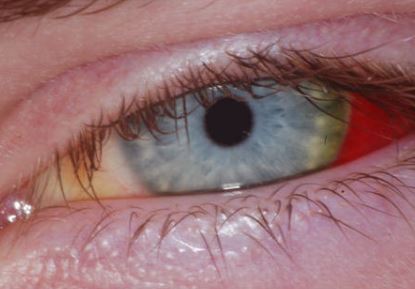
Image Source: Wikimedia Commons (2017). Subconjunctival hemorrhage before after (cropped4weeks), Licensed under a creative commons licence. Available for free at: https://en.wikipedia.org/wiki/File:Subconjunctival_hemorrhage_before_after_%28cropped4weeks%29.jpg (Accessed: 18 January 2024).
References
- Albrecht MR, Levin MJ. Epidemiology, clinical manifestations, and diagnosis of herpes zoster [Internet]. Hirsch MS, editor. UpToDate. 2021 [cited 2021 Nov 13]. Available from: https://www.uptodate.com/contents/epidemiology-clinical-manifestations-and-diagnosis-of-herpes-zoster
- Bowling B. Kanski’s Clinical Ophthalmology, A Systematic Approach. 8th ed. Elsevier Limited. 2016
- Denniston A, Murray P, editors. Oxford handbook of ophthalmology [Internet]. 4th ed. Oxford, United Kingdom: Oxford University Press; 2018 [cited 2021 Nov 13]. Available from: https://oxfordmedicine.com/view/10.1093/med/9780198804550.001.0001/med-9780198804550
- Jacobs D. The red eye: Evaluation and management [Internet]. Gardiner M, Givens J, editors. UpToDate. UpToDate Inc; 2021 [cited 2021 Nov 13]. Available from: https://www.uptodate.com/contents/the-red-eye-evaluation-and-management
- James B, Bron AJ, Parulekar MV. Lecture notes. Ophthalmology. 12th ed. Chichester, West Sussex, UK: Wiley Blackwell; 2017
- Joint Formulary Committee. British National Formulary (online) London: BMJ Group and Pharmaceutical Press. 2023. [Cited 2023 Jun 15]. Available from: http://www.medicinescomplete.com
- Kim H, Kersten R. Peri-orbital and orbital cellulitis [Internet]. BMJ Best Practice. 2020 [cited 2021 Nov 13]. Available from: https://bestpractice.bmj.com/topics/en-gb/734
- National Institute for Health and Care Excellence (NICE). Conjunctivitis – Infective. 2022 [cited 2023 Jun 13]. Available from: https://cks.nice.org.uk/topics/conjunctivitis-infective/
- National Institute for Health and Care Excellence (NICE). Management of Corneal Superficial Injury. 2022 [cited 2023 Jun 15]. Available from: https://cks.nice.org.uk/topics/corneal-superficial-injury/management/management/
- National Institute for Health and Care Excellence (NICE). Conjunctivitis: Allergic; Management in primary care. 2022. [cited 2023 Jun 24). Available from: https://cks.nice.org.uk/topics/conjunctivitis-allergic/management/management-in-primary-care/
- National Institute for Health and Care Excellence (NICE). Clinical Knowledge Summary: Blepharitis. 2023 [cited 2023 Jun 13]. Available from: https://cks.nice.org.uk/topics/blepharitis/
- Somani SN, Ronquillo Y, Moshirfar M. Acanthamoeba Keratitis. StatPearls Publishing. 2022 [cited 2023 Jun 3]. Available from: https://www.ncbi.nlm.nih.gov/books/NBK549863/
- Salmon, JF. Kanski’s Ophthalmology E-Book: A Systematic Approach. 9th Ed. Elsevier Health Sciences. 2019
- Smith J, Severn P, Clarke L. Assessment of red eye [Internet]. BMJ Best Practice. 2021 [cited 2021 Nov 13]. Available from: https://bestpractice.bmj.com/topics/en-gb/496
- Tian L, Wang NL. Trachoma control: the SAFE strategy. Int J Ophthalmol. 2018 Dec 18;11(12):1887-1888. doi: 10.18240/ijo.2018.12.01. PMID: 30588417; PMCID: PMC6288535
- Wu E. Blepharitis [Internet]. BMJ Best Practice. 2021 [cited 2021 Nov 13]. Available from: https://bestpractice.bmj.com/topics/en-gb/574
Complete Guide to Clinical Genetics ST3 Application and Recruitment (2027)
Written by Medibuddy. Last updated: October 2026. Clinical Genetics is

Complete Guide to Clinical Radiology ST3 Application and Recruitment (2027)
Recruitment paused: NHS England is not running Clinical Radiology ST3+ recru

Complete Guide to Paediatric Surgery ST3 Application and Recruitment in United Kingdom (2026)
Written by Medibuddy. Last updated: October 2026. If you’re planning


Take your subscriptions with you
Our mobile app allows you to access your interview and exam question banks wherever you are.

