


 Close
Close
 4th May 2025
Ventricular Tachycardia
Background
Ventricular tachycardia (VT) is a broad complex tachycardia originating from the ventricles. It is also defined by having a cardiac rhythm with a rate >100bpm and a QRS width >120ms.
VT occurs as there are regions of slowed conduction in the ventricle allowing the opportunity to develop reentrant arrhythmias. This process can be caused by any structural abnormality in the ventricle. In post myocardial infarction patients, ventricular scars from infarction or fibrosis provide a substrate for this process.
Risk factors for developing Monomorphic VT
- Coronary ischaemic heart disease (especially prior MI)
- Hypertrophic cardiomyopathy
- Dilated cardiomyopathy
- Arrhythmogenic right ventricular cardiomyopathy
ECG features
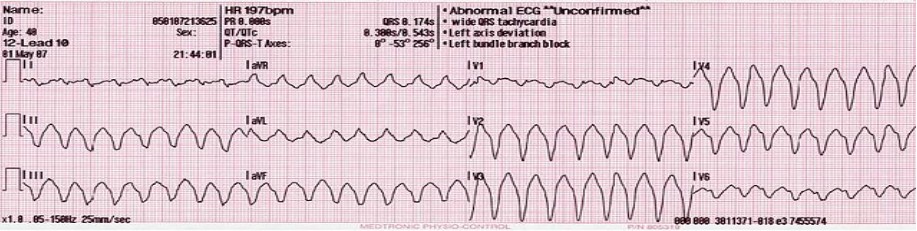
Image Source: Wikimedia Commons (2020). Lead Generated Ventricular Tachycardia, Licensed under a creative commons licence. Available for free at: https://upload.wikimedia.org/wikipedia/commons/thumb/4/45/12_lead_generated_ventricular_tachycardia.JPG/640px-12_lead_generated_ventricular_tachycardia.JPG (Accessed 1 May 2025).
Features suggestive of VT rather than SVT with aberrancy
- RSR’ complexes with a taller “left rabbit ear”
- Very broad QRS complex >160ms
- AV dissociation
- Positive or negative concordance in precordial leads
- Fusion or capture beats
- Marked left axis deviation
- Absence of typical RBBB or LBBB morphology
Even with the use of algorithms, differentiating VT vs SVT with aberrancy can still be challenging. Therefore, in an emergency, broad complex tachycardias are to be treated as ventricular in origin.
* Verapamil should NOT be given in a broad complex Tachycardia, as it may precipitate Ventricular Fibrillation in patients with VT * As this may precipitate electrical impulses travelling down an aberrant pathway in SVT’s with a bundle branch block.
Medical management
Unstable patients
- Synchronised DCCV
Stable patients
- Amiodarone
- Lidocaine
- Procainamide
Complete Guide to Clinical Genetics ST3 Application and Recruitment (2027)
Written by Medibuddy. Last updated: October 2026. Clinical Genetics is

Complete Guide to Clinical Radiology ST3 Application and Recruitment (2027)
Recruitment paused: NHS England is not running Clinical Radiology ST3+ recru

Complete Guide to Paediatric Surgery ST3 Application and Recruitment in United Kingdom (2026)
Written by Medibuddy. Last updated: October 2026. If you’re planning


Take your subscriptions with you
Our mobile app allows you to access your interview and exam question banks wherever you are.

