


 Close
Close
 6th May 2025
Heart failure
Background
Heart failure is a complex clinical syndrome where the cardiac output is unable to meet the demands of tissue perfusion. This can result from any cardiac disease which compromises the ventricular systolic or diastolic function and affects about 920 000 people in the UK. Chronic heart failure is associated with high rates of hospital admissions and increased morbidity and mortality.
Aetiology
Heart failure is commonly caused by reduced left ventricle function but can also be due to an impairment of ventricular filling. Some of the major pathogenic mechanisms leading to heart failure include ischemic myocardial damage, valvular dysfunction, pericardial or endocardial dysfunction, and disease of the great vessels.
These dysfunctions lead to ventricular remodelling and hypertrophy to increase cardiac output, but disorganised ventricular remodelling can result in fibrosis of the myocardium and aberrant electrical pathways, increasing the risk of arrhythmias and sudden cardiac death at later stages.
Furthermore, excessive neuro-humoral stimulation also occurs due to an ineffective blood volume and blood pressure. This stimulates both the sympathetic nervous system and the renin-angiotensin-aldosterone system (RAAS). This releases antidiuretic hormone (ADH) in an attempt to increase the effective circulating volume, but ultimately increases the haemodynamic overload, resulting in further left ventricular strain, remodelling and dysfunction.
Diagnosis
Heart failure is a clinical diagnosis and careful history taking and examination is key to identifying the key signs, symptoms and risk factors of heart failure. Dyspnoea on exertion or at rest is the most common presenting complaint of heart failure (sensitivity 84-100%; specificity 17-34%). Patients may also present with peripheral oedema (93% sensitivity; 10% specificity) and abdominal distension (sensitivity 23%, specificity 80%) due to fluid overload.
Symptoms
| Right ventricular symptoms | Left ventricular symptoms | Functional symptoms |
|---|---|---|
|
|
|
Table 1: Main symptoms of heart failure
| NYHA classification | Symptoms |
|---|---|
| Class I | Patients with cardiac disease with no resulting physical limitations. Asymptomatic with normal activities. |
| Class II | Patients with cardiac disease and some limitation of strenuous physical activity but are comfortable at rest. |
| Class III | Patients with cardiac disease and marked limitation of physical activity but are comfortable at rest. Symptomatic with less than ordinary physical activity. |
| Class IV | Unable to carry out physical activity without discomfort. May be symptomatic even at rest. |
Table 2: New York Heart Association (NYHA) classification
| Right ventricular signs | Left ventricular signs |
|---|---|
|
|
Table 3: Key signs of heart failure
Risk factors
- Demographics: Old age, male sex,
- Cardiac history: Myocardial infarction, left ventricular hypertrophy, valvular heart disease, congenital heart disease, atrial fibrillation
- Past medical history: Diabetes mellitus, hypertension, dyslipidaemia, renal insufficiency, thyroid disorders, anaemia
- Drug history: Exposure to cardiotoxic agents, use of recreational drugs (ie: cocaine)
- Family history: Heart failure, hereditary hemochromatosis, Wilson’s disease
- Social history: Tobacco use, alcohol use, dietary habits
Framingham Heart Failure Diagnostic Criteria
The key symptoms of congestive heart failure can be summarised with the Framingham Criteria. A diagnosis of heart failure can be made with 2+ major criteria, or with 1 major and 2 minor criteria.
| Major Criteria | Minor Criteria |
|---|---|
|
|
Table 4: Major and minor criteria of the Framingham heart failure diagnostic criteria
Investigations
Bedside investigations
- ECG: This may reveal left ventricular hypertrophy, old ischemic changes or arrhythmias
- Urinalysis: May reveal a proteinuria in cardiorenal syndrome
Blood tests
- NT-pro BNP (brain natriuretic peptide): This is a crucial blood test to order as this will determine the urgency of specialist assessment. NT pro-BNP has a sensitivity of 99% and a specificity of 83%, and is an important initial investigation. NT pro-BNP is a metabolite of BNP, which has a sensitivity of 70% and specificity of 99% for heart failure. BNP is secreted from the left ventricular myocardium in response to myocyte stretching, which can occur in volume expansion and increased pressure. This is then cleaved into the bioactive C-terminal of BNP and biologically inactive NT-proBNP, the latter providing a highly sensitive indicator of ventricular dysfunction.
- NT pro-BNP >2000: refer the patient for an urgent specialist clinical examination and transthoracic echocardiogram (TTE) within 2 weeks to confirm heart failure
- NT pro-BNP 400-2000: refer the patient for a specialist clinical examination and TTE within 6 weeks.
- NT pro-BNP <400: consider other causes for the patient’s symptoms
- NT pro-BNP may be elevated in patients above 70 years old, left ventricular hypertrophy, tachycardia, hypoxia, pulmonary embolism, chronic kidney disease, sepsis, COPD, diabetes mellitus, liver cirrhosis.
- NT pro-BNP may be reduced in patients with a body mass index (BMI) >35 kg/m2, medications such as diuretics, ACE-inhibitors, ARBs, beta blockers, MRA, African-Caribbean family origin.
- Full blood count: May reveal anaemia which can worsen heart failure
- Urea and electrolyte: To monitor for renal impairment and crucial in monitoring drug treatment of heart failure such as ACE-inhibitors and diuretics
- Liver function tests: May be raised in hepatic congestion secondary to heart failure
- Thyroid function test: Thyroid dysfunction may be the cause of a high output heart failure
- Lipids: to monitor risk factors for heart failure
Imaging
- Chest X-ray: in acute decompensated heart failure, a chest x-ray may reveal signs of pulmonary congestion (ABCDE: Alveolar shadowing, kerley B lines, Cardiomegaly, Dilated upper lobe vasculature, Effusion)
- Transthoracic echocardiogram (TTE): Ultrasound based imaging to assess the left ventricular ejection fraction, cardiac wall thickness, wall motion, valve functions and ventricular cavity size.
- Cardiac magnetic resonance imaging (CMR): This specialist imaging provides further detail on viability of the myocardium and extent of fibrosis. This can also assess the level of myocardial perfusion.
- Cardiac CT: To assess coronary vasculature for obstruction
Classification
There are multiple different classification systems for heart failure. Traditionally, heart failure was classified by the main clinical symptoms reported by the patient and could be classified as right ventricular heart failure, left ventricular heart failure. In chronic heart failure, symptoms of either right sided and left sided ventricular failure rarely present in isolation and more commonly present as a combination of both in biventricular heart failure.
Right ventricular heart failure
Blood from the systemic circulation is pumped into the right ventricle, hence right ventricular dysfunction will result in fluid overload symptoms proximal to this. Patients most commonly report bilateral peripheral oedema and abdominal distension (secondary to hepatic congestion).
Left ventricular heart failure
Blood from the pulmonary circulation feeds into the left ventricle. Left sided ventricular dysfunction causes a build up of fluid in the pulmonary circulation and patients may report breathlessness, paroxysmal nocturnal dyspnoea, orthopnoea and a productive cough.
Heart failure can also be classified as high output or low output heart failure.
Low output heart failure
Low output heart failure is the ‘classical’ form of heart failure, characterised by decreased cardiac output due to left ventricular systolic or diastolic dysfunction, typically caused by myocardial infarctions or large pulmonary emboli.
High output heart failure
This is a less common form of heart failure and reflects the inability of the heart to meet the body’s increased metabolic demand. This is defined as a resting cardiac output of >8L/min or a cardiac index of >3.9/min/m2. Common causes of high output heart failure include: hyperthyroidism, myeloproliferative disorders, sepsis, thiamine deficiency, arteriovenous fistulae, pregnancy.
Left ventricular ejection fraction
The most recent guidance introduces a standardised classification of heart failure by the left ventricle ejection fraction. The universal definition of heart failure is a clinical syndrome with current or prior signs and symptoms caused by a structural and/or functional abnormality determined by an ejection fraction of <50% and corroborated with either an elevated natriuretic peptide level or objective evidence of cardiogenic pulmonary or systemic congestion.
| Left ventricular ejection fraction | Classification |
|---|---|
| ≤40% | Heart failure with reduced ejection fraction (HFrEF) |
| 41-49% | Heart failure with mildly reduced ejection fraction (HFmrEF) |
| ≥50% | Heart failure with preserved ejection fraction (HFpEF) |
| Baseline ≤40%, a ≥10 point increase from baseline LVEF and a second measurement of LVEF >40% | Heart failure with improved ejection fraction (HFimpEF) |
Table 5: Classification of heart failure by left ventricular ejection fraction
Management
The key aim of treatment is to improve the patient’s prognosis and reduce mortality. Secondary aims include alleviating symptoms and reducing morbidity by slowing or reversing the cardiac dysfunction.
Lifestyle changes
Lifestyle modifications are crucial in the management of heart failure. This includes dietary counselling (restricting salt intake and encouraging a healthy balanced diet), moderate alcohol consumption, smoking cessation and encouraging an active lifestyle (150 minutes of moderate intensity activity a week or 75 minutes of vigorous intensity activity a week).
Pharmacological therapy
Heart failure with preserved ejection fraction (HFpEF)
No pharmacological therapies have been shown to benefit HFpEF. Treatment is focused on managing comorbidities such as atrial fibrillation, hypertension, diabetes and ischemic heart disease and encouraging lifestyle modifications, including smoking cessation, moderate alcohol use, healthy dietary habits and maintaining an active lifestyle. Patients should also be offered a personalised exercise-based cardiac rehabilitation programme.
Heart failure with reduced ejection fraction (HFrEF)
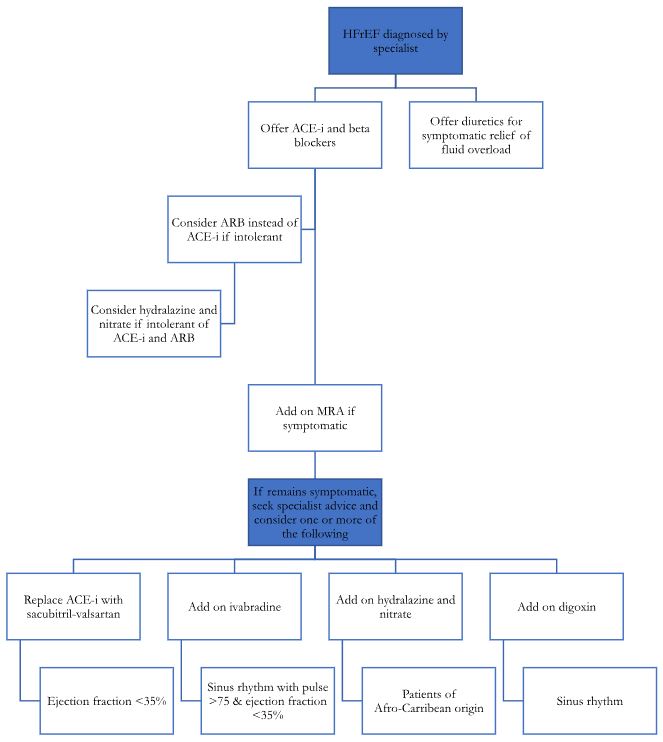
Heart failure patients should be commenced on an ACE-inhibitor and a beta-blocker, which have both been shown to reduce mortality in heart failure. If the patient remains symptomatic following these medications, a mineralocorticoid receptor antagonist (MRA) can be added to the regime. If patients are unable to tolerate ACE-inhibitors or an ARB, they can be offered hydralazine and nitrates.
If symptoms persist despite the medications above, the patient should be referred for specialist advice and can be commenced on one of the medications specified in Figure 1.
Sodium-glucose co-transporter-2 (SGLT-2) inhibitors
In 2019, a landmark trial on the use of dapagliflozin in patients with heart failure (DAPA-HF) showed that SGLT-2 inhibitors reduced cardiovascular morbidity and mortality in patients with heart failure independent of their diabetes status. This has been reflected in the NICE guidance for type 2 diabetes control where SGLT-2 inhibitors are preferentially selected in patients who are comorbid with diabetes and heart failure. Please note: the NICE guidance for heart failure in 2018 does not comment on the routine initiation of SGLT-2 inhibitors.
| Medication | Side effects | Monitoring requirements |
|---|---|---|
| Loop diuretics | Common:
Uncommon:
|
Renal function, serum electrolytes & blood pressure |
| ACE-inhibitors | Common:
If patients are unable to tolerate dry cough, consider switching to an angiotensin II receptor blocker (ARB). |
Renal function, serum electrolytes & blood pressure |
| Beta-blockers | Common:
|
No routine blood test monitoring. Monitor blood pressure and pulse rate whilst adjusting dosage. |
| Mineralocorticoid antagonist | Common:
Gynaecomastia is more common with spironolactone, and less common with eplerenone. This should be considered when starting MRA in male patients as gynaecomastia can affect treatment concordance. |
Renal function, serum electrolytes & blood pressure |
| Digoxin | Common:
Uncommon:
Digoxin binds to the potassium binding site of the Na-K ATPase pump; hence, hypokalaemia can precipitate digoxin toxicity as there is reduced competition for the binding site. |
ECG, renal function, serum electrolytes |
Table 6: Common side effects of heart failure medications and drug monitoring.
Non-pharmacological therapy
Patients can also be considered for cardiac resynchronisation therapy (CRT) or an implantable cardioverter defibrillator (ICD). CRT is indicated in patients who remain symptomatic on optimum medical therapy, with low LVEF of <35% and a QRS duration of >120ms. Biventricular pacing through CRT decreases the risk of heart failure events, improves cardiac function and can reverse left ventricular remodelling.
ICD is indicated in patients with a low LVEF <35%, previous ventricular tachycardia and symptoms no worse than NYHA Class III. ICD has been shown to increase survival in heart failure by 23% (SCD-HeFT).
These two devices can also be combined into a CRT-D (cardiac resynchronisation therapy – defibrillator) and has been shown to reduce the progression of heart failure in patients with NYHA I/II.
Complications
| Complication | Management |
|---|---|
| Acute decompensated heart failure
Pulmonary oedema |
|
| Cardiorenal syndrome | Inadequate cardiac output leads to reduced renal perfusion pressure. Activation of the sympathetic nervous system and the RAAS due to ineffective circulating volume results in vasoconstriction, further reducing renal blood flow and perfusion.
|
| Cardiogenic shock | Patients with end-stage heart failure can eventually progress into multiorgan failure. Cardiogenic shock typically occurs with large ischemic events (i.e.: myocardial infarction) but patients with heart failure can suddenly ‘fall off the cliff’. |
| Sudden cardiac death | Dysfunctional myocardium remodelling can result in aberrant electrical pathways, predisposing patients to serious arrhythmias such as ventricular fibrillation, leading to sudden cardiac death. These patients require an implantable cardiac defibrillator. |
Table 7: Main complications of heart failure
Follow up
- Patient education about heart failure and its management is key in empowering patients to engage with treatment and follow up. Patients should understand how to monitor for key signs and symptoms of decompensation at home, including monitoring their weight as an indication of fluid overload.
- Lifestyle modifications should be discussed: dietary counselling (including salt restriction and encouraging a healthy balanced diet), moderate alcohol consumption, smoking cessation, encouraging an active lifestyle.
- Managing comorbidities such as diabetes mellitus, hypertension and hypercholesterolaemia is crucial and these should be reviewed during follow up. Of note, the patient’s drug history should be reviewed for contraindications and interactions; for instance, thiazolidinediones used in the management of diabetes mellitus is contraindicated in patients with heart failure.
- The importance of medical therapy should be highlighted to patients to encourage greater concordance; regular medication reviews can help with early identification of any intolerances which may interfere with concordance (i.e.: a patient who has not been taking their ACE-inhibitor due to a dry cough would benefit from switching to an angiotensin receptor blocker (ARB).
- Patients should also have regular follow up appointments; this involves the greater multidisciplinary team and can be provided by the virtual ward team post-discharge and by clinical nurse specialists.
- Patients with chronic heart failure are vulnerable to infections and have a higher risk of decompensating when unwell. Hence, they should have a one-off pneumococcal vaccine (provided that they do not have comorbidities resulting in functional or structural hyposplenism) and a yearly influenza vaccine.
References
- Dharmarajan K, Hsieh AF, Kulkarni VT, Lin Z, Ross JS, Horwitz LI, et al. Trajectories of risk after hospitalization for heart failure, acute myocardial infarction, or pneumonia: retrospective cohort study. BMJ [Internet]. 2015;350. Available from: https://www.bmj.com/content/350/bmj.h411
- Inamdar AA, Inamdar AC. Heart Failure: Diagnosis, Management and Utilization. J Clin Med. 2016;5(7):62.
- Mahmood SS, Wang TJ. The epidemiology of congestive heart failure: the Framingham Heart Study perspectiveGlob Heart. 2013;8(1):77–82.
- National Institute for Health and Care Excellence. Chronic heart failure in adults: Diagnosis and management. 2018;NG106.
- Albakri A. Low-output heart failure: A review of clinical status and meta-analysis of diagnosis and clinical management methods. Clin Med Investig. 2019;4(1):1–11.
- Mehta PA, Dubrey SW. High output heart failure. QJM An Int J Med [Internet]. 2009 Apr 1;102(4):235–41. Available from: https://doi.org/10.1093/qjmed/hcn147
- Bozkurt B, Coats AJ, Tsutsui H, Abdelhamid M, Adamopoulos S, Albert N, et al. Universal Definition and Classification of Heart Failure: A Report of the Heart Failure Society of America, Heart Failure Association of the European Society of Cardiology, Japanese Heart Failure Society and Writing Committee of the Universal Definition of Heart Failure. J Card Fail. 2021;27(4):387.
- Group TCTS. Effects of Enalapril on Mortality in Severe Congestive Heart Failure. N Engl J Med [Internet]. 1987 Jun 4;316(23):1429–35. Available from: https://doi.org/10.1056/NEJM198706043162301
- The Cardiac Insufficiency Bisoprolol Study II (CIBIS-II): a randomised trial. Lancet [Internet]. 1999 Jan 2;353(9146):9–13. Available from: https://doi.org/10.1016/S0140-6736(98)11181-9
- Pitt B, Zannad F, Remme WJ, Cody R, Castaigne A, Perez A, et al. The Effect of Spironolactone on Morbidity and Mortality in Patients with Severe Heart Failure. N Engl J Med [Internet]. 1999 Sep 2;341(10):709–17. Available from: https://doi.org/10.1056/NEJM199909023411001
- Liu M.D PP. Cardiorenal syndrome in heart failure: A cardiologist’s perspective. Can J Cardiol. 2008;24(Suppl B):25B-29B.
- Morici N, Oliva F, Ajello S, Stucchi M, Sacco A, Cipriani MG, et al. Management of cardiogenic shock in acute decompensated chronic heart failure: The ALTSHOCK phase II clinical trial. Am Heart J. 2018;204:196–201.
- https://www.nice.org.uk/guidance/ng28/resources/visual-summary-full-version-choosing-medicines-for-firstline-and-further-treatment-pdf-10956472093
- https://cks.nice.org.uk/topics/heart-failure-chronic/diagnosis/how-to-assess/
- https://bnf.nice.org.uk/drugs/pioglitazone/#:~:text=Patients%20who%20take%20pioglitazone%20should,a%20history%20of%20heart%20failure.
- https://www.ahajournals.org/doi/full/10.1161/01.CIR.97.16.1632
Complete Guide to Clinical Genetics ST3 Application and Recruitment (2027)
Written by Medibuddy. Last updated: October 2026. Clinical Genetics is

Complete Guide to Clinical Radiology ST3 Application and Recruitment (2027)
Recruitment paused: NHS England is not running Clinical Radiology ST3+ recru

Complete Guide to Paediatric Surgery ST3 Application and Recruitment in United Kingdom (2026)
Written by Medibuddy. Last updated: October 2026. If you’re planning


Take your subscriptions with you
Our mobile app allows you to access your interview and exam question banks wherever you are.

