


 Close
Close
 7th May 2025
Patent Foramen Ovale
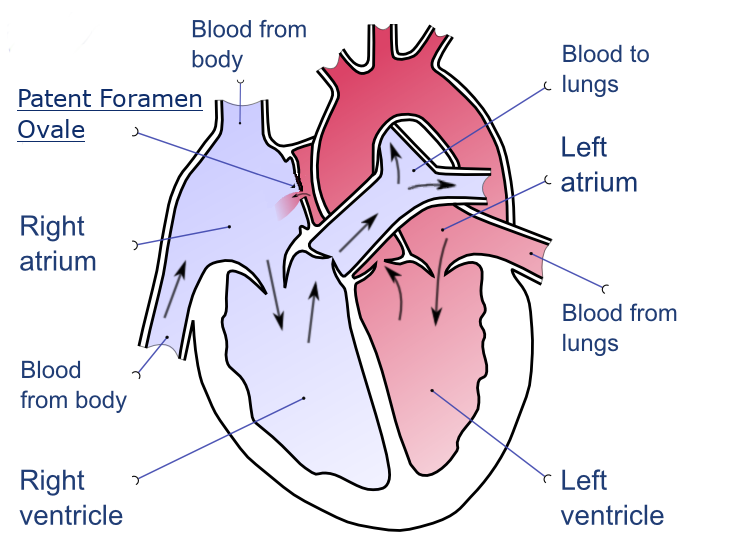
Image Source: Wikimedia Commons (2020). Patent Foramen Ovale, Licensed under a creative commons licence. Available for free at: https://upload.wikimedia.org/wikipedia/commons/0/0a/Patent-foramen-ovale-en.png?20201209214228 (Accessed 2 May 2025).
Patent Foramen Ovale (PFO) is a CHD in which the foramen ovale, located within the atrial septum, remains open into adulthood. Typically, in those without PFO, the foramen ovale closes due to raised left atrial pressure during the first breath after birth. PFO is often asymptomatic but can cause a cerebrovascular accident due to paradoxical embolism, i.e., venous to arterial transit of emboli. The key summary of PFO can be reviewed in Table Six.
| Feature | Summary |
|---|---|
| Epidemiology | Present in around 10% of patients having contrast echo. The incidence of PFO declines with age, suggesting that spontaneous closure can result in adulthood. |
| Aetiology | Idiopathic |
| Clinical History/Examination | Most patients are asymptomatic. However, one should exclude PFO in those under sixty and presenting with a cryptogenic stroke, sudden onset pain and coldness in any limb, transient ischaemic attack and where no obvious embolic source is identified.
Risk factors include atrial septal aneurysms and congenital heart defects. |
| Clinical Examination | In some instances, second heart sound splitting and a systolic murmur are noted on auscultation. |
| Diagnostic Investigations | A transthoracic echo with contrast and colour Doppler is used to visualise the passage of microbubbles from the right atrium into the left atrium. This is often when there is low clinical suspicion of PFO.
A trans-oesophageal echo with contrast and colour Doppler is used when a definitive diagnosis is required. |
| Management | If the individual is asymptomatic, then observation is often the main treatment. However, is it best to think of patients categories as per below:
Asymptomatic
Cryptogenic stroke or transient ischaemic attack Patient selection based on a MDT approach involving neurology and cardiology
High-risk professions, e.g. astronauts, pilots and deep-sea divers
|
| Follow Up | In small PFOs which are asymptomatic, then no long-term follow-up is required. In those with TIA or CVA, routine follow-up is required. A 6-month echo is required in patients who have undergone a percutaneous closure to confirm sufficient closure and rationalisation of antiplatelet treatment.
Prognosis is variable, dependent on the category of patient. In most, however, PFO is not correlated with a higher risk of death or stroke if medically treated. In those with CVA and/or TIA, the risk of a reoccurrence of CVA and/or TIA is 3x higher in PFO, and this increases to 6x higher in those with a concurrent atrial septal aneurysm. |
Table 6: This table provides an overview of patent foramen ovale. Sourced and adapted from Aggarwal, Patent Foramen Ovale: BMJ Best Practice 2022 and Hara, Patent Foramen Ovale: UpToDate; 2022.
Complete Guide to Clinical Genetics ST3 Application and Recruitment (2027)
Written by Medibuddy. Last updated: October 2026. Clinical Genetics is

Complete Guide to Clinical Radiology ST3 Application and Recruitment (2027)
Recruitment paused: NHS England is not running Clinical Radiology ST3+ recru

Complete Guide to Paediatric Surgery ST3 Application and Recruitment in United Kingdom (2026)
Written by Medibuddy. Last updated: October 2026. If you’re planning


Take your subscriptions with you
Our mobile app allows you to access your interview and exam question banks wherever you are.

