


 Close
Close
 10th May 2025
Brugada syndrome
Brugada syndrome is characterized by right bundle branch block (RBBB) and ST-segment elevation in the anterior precordial leads of ECG, often without evidence of structural heart disease
Classification
- Type 1: Coved ST segment elevation
- Type 2: Saddleback ST elevation ≥ 1 mm
- Type 3: Saddleback ST elevation < 1mm
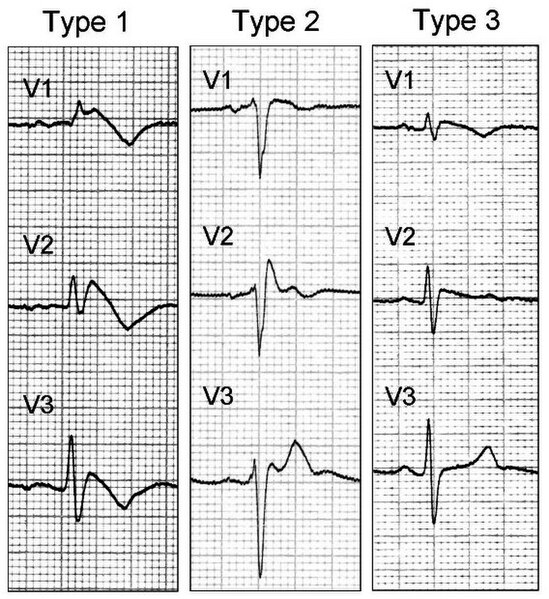
Image Source: Wikimedia Commons (2008). Brugada ECG, Licensed under a creative commons licence. Available for free at: https://commons.wikimedia.org/w/index.php?search=brugada+ecg&title=Special:MediaSearch&go=Go&type=image (Accessed 7 May 2025).
Diagnosis
Diagnostic criteria
- Type 1 ECG pattern occurring spontaneously
- Type 1 ECG provoked by class I anti-arrhythmic drugs with one additional clinical feature: documented ventricular tachycardia (VT) or ventricular fibrillation (VF), syncope of probable arrhythmic cause, family history of sudden cardiac death (SCD) before age 45, family history of brugada type 1 or nocturnal agonal respiration.
Clinical features
- Asymptomatic
- Syncope
- Aborted cardiac arrest due to VT/VF
Management
- Fever should be aggressively treated (can precipitate VT/VF)
- Avoid drugs that provoke Brugada syndrome (e.g. flecainide)
- ICD is indicated in patients with aborted SCD or spontaneous VT/VF or with a history of syncope
- Ablation may be considered in patients with frequent ICD shocks
- Quinidine may be considered in patients with frequent ICD shocks or who refuse ICD or in whom ICD is contraindicated
Complete Guide to Clinical Genetics ST3 Application and Recruitment (2027)
Written by Medibuddy. Last updated: October 2026. Clinical Genetics is
Clinical Genetics ST3

Complete Guide to Clinical Radiology ST3 Application and Recruitment (2027)
Recruitment paused: NHS England is not running Clinical Radiology ST3+ recru
Clinical Radiology ST3

Complete Guide to Paediatric Surgery ST3 Application and Recruitment in United Kingdom (2026)
Written by Medibuddy. Last updated: October 2026. If you’re planning
Paediatric Surgery ST3


Take your subscriptions with you
Our mobile app allows you to access your interview and exam question banks wherever you are.

