


 Close
Close
 16th May 2025
Aminoglycosides
Aminoglycosides are broad spectrum antibiotics with activity against some gram-positive and many gram-negative organisms. They are bactericidal and exhibit concentration dependent bacterial killing. These antibiotics exhibit a post-antibiotic effect meaning that there is a continued suppression of bacterial growth even when drug concentration falls below the minimum inhibitor concentration.
Aminoglycosides are hydrophilic in nature which can lead to changes in volume of distribution in certain conditions such as sepsis, resulting in lower drug plasma concentrations. They are primarily excreted through the kidneys, therefore patients with acute kidney injury or chronic kidney disease may accumulate the medication.
Empiric therapy with aminoglycosides should usually be limited to 48 hours, if treatment extends beyond this point levels should be monitored due to the increased risk of adverse effects. The main adverse effects are ototoxicity and nephrotoxicity. Ototoxicity occurs in 2-45% of adults and can be categorised as vestibular or cochlear. Vestibular damage is often reversible whereas hearing loss is not. Gentamicin and tobramycin are more likely to cause vestibular damage whereas amikacin is more likely to cause cochlear damage. Nephrotoxicity occurs in 10-25% of patients and the mechanism is thought to be due to proximal tubular dysfunction. Aminoglycoside toxicity is often reversible.
Gentamicin
Gentamicin is the most used aminoglycoside in the UK, but others include tobramycin and amikacin. It was traditionally dosed through multiple daily dosing but extended once daily dosing has been found to be as effective, no more nephrotoxic, and less complex to administer. Multiple daily dosing is still commonly used in endocarditis.
Dosing is usually based on actual body weight unless patients are obese where adjusted body weight is used (actual body weight >20% of ideal body weight). Monitoring for once-daily dosing can differ from trust to trust so trust guidelines should be consulted, but two common methods are taking ‘trough’ levels and using a nomogram. In the first method mentioned, pre-dose ‘trough’ levels are usually required to ensure the drug is being sufficiently cleared (<1mg/L) from the body. The second method involves a level that is taken 6-14 hours post dose which is then evaluated with a Hartford nomogram. This nomogram is shown below:
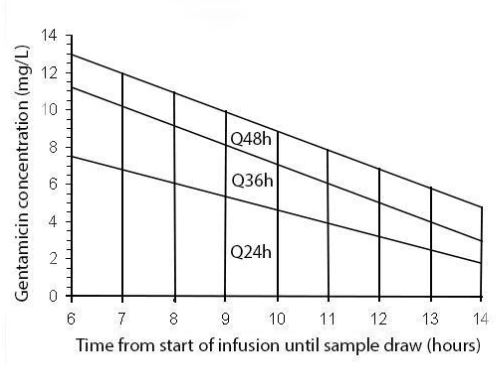
Figure 2: Hartford Nomogram
Image Source: Wikimedia Commons (2017). Detail, Licensed under a creative commons licence. Available for free at: http://www.lhp.leedsth.nhs.uk/detail.aspx?id=1944 (Accessed 12 May 2025).
If the level falls within the Q24h, Q35h, or Q48H the dosing interval should be changed correspondingly. If the level falls on the line, the longer dosing interval should be used. If the level falls above Q48h treatment should be held and serial levels taken until the level falls below <1mg/L). In multiple day dosing samples should be taken one hour post dose (‘peak’ level) and pre-dose (‘trough’ level). If the trough concentration is high, the interval between doses must be increased. If the peak concentration is high, the dose must be decreased. Ensure that you consult local guidance regarding dosing and monitoring of gentamicin.
Complete Guide to Clinical Genetics ST3 Application and Recruitment (2027)
Written by Medibuddy. Last updated: October 2026. Clinical Genetics is

Complete Guide to Clinical Radiology ST3 Application and Recruitment (2027)
Recruitment paused: NHS England is not running Clinical Radiology ST3+ recru

Complete Guide to Paediatric Surgery ST3 Application and Recruitment in United Kingdom (2026)
Written by Medibuddy. Last updated: October 2026. If you’re planning


Take your subscriptions with you
Our mobile app allows you to access your interview and exam question banks wherever you are.

