


 Close
Close
 23rd May 2025
Graves’ disease
- Grave’s disease is an autoimmune thyroid condition that is associated with hyperthyroidism. It is due to TSH receptor autoantibodies that lead to overstimulation of thyroid gland, and excessive thyroid hormone production. It is the most common cause for hyperthyroidism in iodine sufficient parts of the world, affecting females more and of peak age between 20-40 years old.
- 50% of the patients will report having a family history of other autoimmune disorders such as T1DM or pernicious anaemia. There is also association with human leukocytic antigen (HLA-DR3, HLA-B8) alleles.
- Grave’s disease occurs due to B and T cell autoimmunity, and an increase in the production of stimulating IgG against TSH receptors, leading to an increase in the thyroid gland size and function with manifest hyperthyroidism and goitre.
Associated conditions
- Endocrine: T1DM, Addison’s disease,
- Dermatological: Vitiligo, Alopecia areata
- Haematological: Pernicious anaemia
- Neurological: Myasthenia gravis
- Gastrointestinal: Coeliac disease
- Other autoimmune conditions occur with HLA-DR3
Risk factors
- Female sex
- Smoking
- Drug-induced (alemtuzumab used for multiple sclerosis)
- Infection with Yersinia enterocolitica and Borrelia burgdorferi
- Pregnancy (due to overstimulation by high levels of hCG and TSH receptor antibodies (TRAb) during 1st trimester)
- Stress (due to cortisol mediated immune suppression followed by rebound immunologic hyperactivity)
Clinical picture
In addition to the thyrotoxic picture described above, patients also present with triad of: Diffuse goitre, Graves ophthalmopathy and dermopathy.
- Diffuse goitre which is smooth, uniformly enlarged, and non-tender. Sometimes bruit can be heard over the superior poles due to increased vasculature.
- Ophthalmopathy occurs due to activated B and T cells lymphocytic infiltration retro-orbitally, that leads to a cascade of immunological reactions occurring and cytokine release (TNF-α and INF-γ). Accordingly, fibroblast proliferation leads to an increase in the hyaluronic acid, glycosaminoglycans (GAGs) and adipocytes causing an increase in intra-orbital fat and muscle tissue volume. These changes are manifested as exophthalmos, ophthalmoplegia, lid retraction and exposure conjunctivitis and keratopathy.
- Other manifestations of Grave’s disease can be pretibial myxoedema which is a non-pitting oedema on both lateral and anterior aspects of the leg.
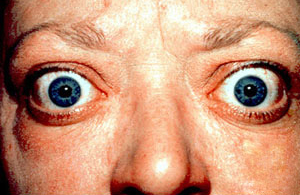
Image Source: Wikimedia Commons (2022). Graves Opthalmopathy, Licensed under a Creative Commons licence. Available for free at: https://en.wikipedia.org/w/index.php?title=Graves%27_ophthalmopathy&oldid=1130342091 (Accessed 13 May 2025).
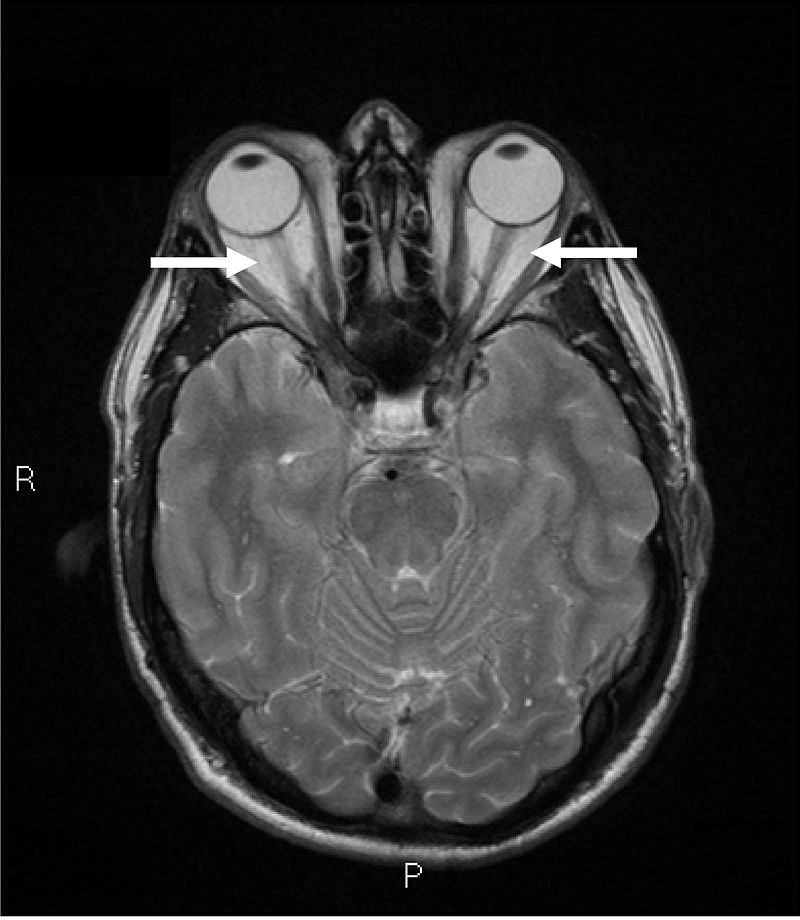
Image Source: Wikimedia Commons (2022). Graves Opthalmopathy, Licensed under a creative commons licence. Available for free at: https://en.wikipedia.org/w/index.php?title=Graves%27_ophthalmopathy&oldid=1130342091 (Accessed 13 May 2025).
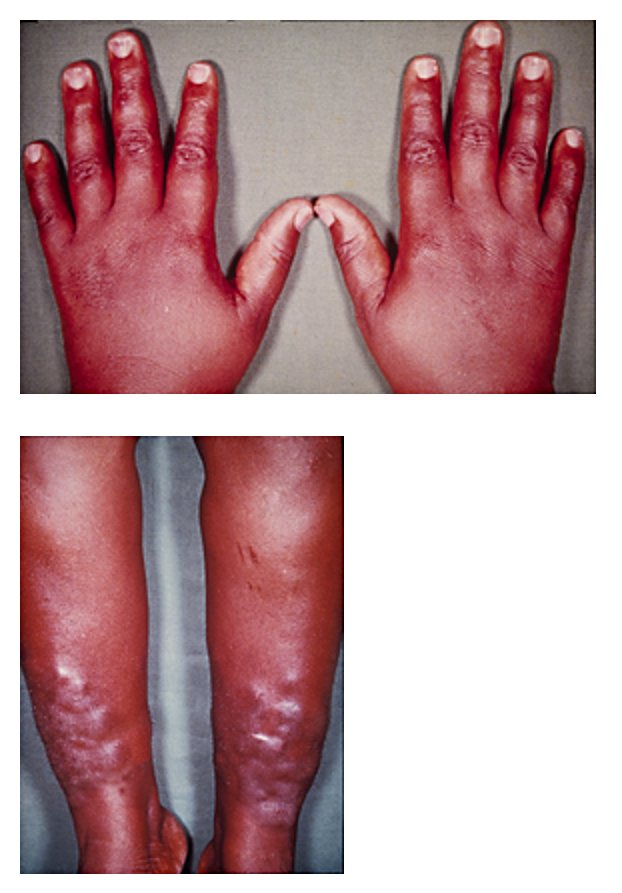
Image Source: Wikimedia Commons (2008). Pretibial Myxedema, Licensed under a creative commons licence. Available for free at: https://commons.wikimedia.org/wiki/Category:Pretibial_myxedema#/media/File:Myxedema.jpg (Accessed 13 May 2025).
Investigations
Diagnosis is based on the clinical picture and is confirmed through thyroid function tests (TFTs) and antibody findings.
- TFTs: low or undetectable TSH with high T3 and T4
- Thyroid antibodies can be specific such as high TRAbs, or non-specific as high Antithyroid peroxidase (anti-TPO) antibodies, and Thyroglobulin (anti-Tg) antibodies.
- Thyroid ultrasound which shows enlarged hypervascular thyroid. Can be used in pregnancy if TRAbs are low.
Management
Goals and principles:
- Induce remission.
- Monitor for any relapse, Monitoring initially is 6-8 weekly for the 1st 6 months, then 6-monthly for 2 years. Afterwards, annually depending on the symptoms.
- For relapse, radiotherapy or surgery are considered as definitive treatment.
- Treatment is usually subdivided into hyperthyroidism state control and symptomatic control.
NICE guidelines recommends the following management:
- Hyperthyroidism state control via Antithyroid drugs (ATDs)
| Medication | Mechanism | Indication | Side effects | Contraindication |
|---|---|---|---|---|
| Carbimazole |
|
|
|
|
| Propylthiouracil (PTU) |
|
|
Table 2: Antithyroid (ATDs) drugs mechanism of action and indications
Two treatment regimens are identified; dose titration and block and replace regimes.
- Dose titration regime:
A relatively high dose of ATDs is started and dose is titrated according to TFTs (TSH particularly) that are performed every 4-8 weeks. It continues for 18 weeks. Some cases of relapses can be seen after discontinuing the therapy. Hence, Long-term therapy at a low dose can be an option. This regime has lower SE compared to block and replace regime.
2. Block and replace regime:
After achieving euthyroid state on carbimazole, Levothyroxine is started. This regime I can continue for 6 months. It allows fewer visits to the hospital for multiple TFTs.
- Hyperthyroidism state control via Radioactive ablation:
Intention is ablation of the gland then commencing thyroxine replacement therapy. It is becoming introduced more to children >10 years old. Sometimes ATDs are started after radioiodine administration and tapered down gradually as per TFTs. There is no risk of thyroid malignancy post-treatment.
Indications for radioactive ablation can be as 1st line after failure of ATDs or surgery. Multinodular goitre or adenoma or relapsed Grave’s disease are other indications. Side Effects of radioactive ablation are radiation induced-thyroiditis, transient hypothyroidism and rarely rebound thyroid storm.
Contraindications for radioactive ablation are pregnancy and lactation. Women of childbearing age should avoid pregnancy for a minimum of 6 months post-treatment. Similarly for men should avoid fathering for minimum of 4 months post-radiation. Other contraindications are Graves ophthalmopathy (due to risk of symptoms worsening), or young children (due to risk of thyroid carcinogenesis).
- Hyperthyroidism state control via Surgery:
Prior to surgery, ATDs, are used to achieve euthyroidism. Rarely, potassium iodide is needed. Β-blockers are needed to prevent an unwanted liberation of thyroid hormones during surgery.
Indications for surgical management are usually preserved for suspicious/malignant thyroid nodules. pregnant women with post-ATDs failure or complications. Surgery is done in the 2nd trimester. Patients who have poor compliance to medical treatment, refuse radiation therapy, have either relapsed Graves’ disease, severe Graves’ ophthalmopathy, or large goitres with have low-radioiodine uptake and with local compressive symptoms are also offered surgical management.
Thyroidectomy can lead to nerve damage, hypoparathyroidism, local haemorrhage or wound infection, hypothyroidism, or keloid formation.
- Symptomatic control
One of the common symptoms that requires treatment in hyperthyroidism is AF. Rate control medications particularly propranolol is commonly used. Propranolol is non-selective β-Blocker which not only has HR control effect but also, inhibits the conversion of T4 to T3 peripherally. Anticoagulation should also be considered.
Complete Guide to Clinical Genetics ST3 Application and Recruitment (2027)
Written by Medibuddy. Last updated: October 2026. Clinical Genetics is

Complete Guide to Clinical Radiology ST3 Application and Recruitment (2027)
Recruitment paused: NHS England is not running Clinical Radiology ST3+ recru

Complete Guide to Paediatric Surgery ST3 Application and Recruitment in United Kingdom (2026)
Written by Medibuddy. Last updated: October 2026. If you’re planning


Take your subscriptions with you
Our mobile app allows you to access your interview and exam question banks wherever you are.

