


 Close
Close
 23rd May 2025
Acromegaly
Acromegaly is an insidious chronic and progressive disorder caused by the overproduction of GH and characterised by features of gigantism. It is usually caused by a somatotroph adenoma in the adenohypophysis. The incidence of acromegaly is between 40-130 cases per million adults. An excess of GH leads to increased secretion of insulin-like-growth factor-1 (IGF-1) leading to multi-systemic symptoms.
Clinical effects
- Facial: Frontal bossing, macroglossia, prognathism, large nose
- Skin: Hyperhidrosis, increased skin thickness
- Respiratory: Sleep apnoea
- Joint: Osteoarthritis, arthropathy, bone enlargement
- Cardiovascular: Hypertension, arrhythmias, valvular heart disease, congestive cardiac failure, ischaemic heart disease
- Metabolic and electrolyte: diabetes mellitus, impaired glucose tolerance, hypercalciuria
- Organomegaly
- Increased height
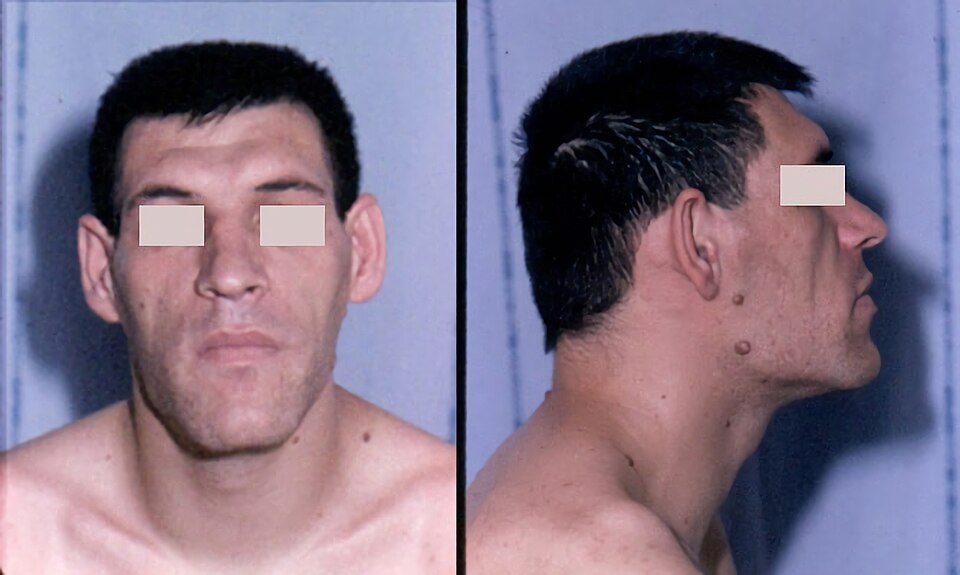
Image Source: Wikimedia Commons (2008). Acromegaly facial Features, Licensed under a creative commons licence. Available for free at: https://commons.wikimedia.org/w/index.php?curid=15072125 (Accessed 13 May 2025).
Investigations
Biochemical
- Excluded in most cases of normal IGF-1 levels
- Random GH >1 microgram/L or >2.5 micrograms/L
- Glucose tolerance test with 75g oral glucose and measuring plasma glucose and GH every 30 mins for 2 hrs. Lack of GH suppression <1 microgram/L (<1 nanogram/mL) suggestive of acromegaly
- Other pituitary hormone plasma levels: cortisol, prolactin, thyroid-stimulating hormone and free thyroxine, follicle-stimulating hormone, luteinising hormone, oestradiol, or testosterone
- Consider genetic testing for AIP
Imaging
- MRI with contrast of pituitary gland
- In <1% of the cases, the above is negative. In this case a CT Thorax, Abdo, Pelvis will likely be needed to locate ectopic hormones producing GH/GHRH
Management
- Transsphenoidal surgery is first-line for enclosed somatotroph microadenomas (< 10mm diameter) and macroadenomas (>10mm diameter)
- If surgery fails, or the tumour is unresectable, somatostatin analogues (SSAs) are used e.g., octreotide with an initial dose of 20mg every month
- If there is mixed GH/PRL release, or IGF-1 levels are <1.5 the upper limit of normal a dopamine agonist, e.g., cabergoline, can be used as an additional treatment
- Pegvisomant, a growth hormone receptor antagonist, is considered in patients who are unsuitable or who have not responded to the above
- If medical and surgical treatments fail, radiotherapy can be attempted
Monitoring
Lifelong monitoring of GH and IGF-1 will be required
Complications
- Cardiovascular (including HTN) (30-40%)
- Sleep apnoea (60-80%)
- Joint (70%)
- Endocrine (50%)
- Pre-cancerous polyps
- Carpal tunnel (64%)
- Hypopituitarism
Prognosis
Surgery is effective in 70-90% of microadenomas and 30-60% of macroadenomas. SSAs control disease in 30-40% of cases.
Complete Guide to Clinical Genetics ST3 Application and Recruitment (2027)
Written by Medibuddy. Last updated: October 2026. Clinical Genetics is

Complete Guide to Clinical Radiology ST3 Application and Recruitment (2027)
Recruitment paused: NHS England is not running Clinical Radiology ST3+ recru

Complete Guide to Paediatric Surgery ST3 Application and Recruitment in United Kingdom (2026)
Written by Medibuddy. Last updated: October 2026. If you’re planning


Take your subscriptions with you
Our mobile app allows you to access your interview and exam question banks wherever you are.

