


 Close
Close
 5th June 2025
Acanthosis Nigricans
Cause and presentation
Acanthosis Nigricans is a cutaneous disorder characterised by velvety plaques of hyperpigmented, papillomatous, hypertrophic skin found on the neck, flexural and intertriginous surfaces. Less commonly, it can also affect the cheeks and dorsal hands. The disorder can be present at birth or early childhood with a familial association. However, it is commonly associated with obesity along with an insulin-resistant state or diabetes. When acanthosis nigricans is associated with obesity, it tends to affect females and Hispanic or black ethnicities. It can also occur with other metabolic, autoimmune, or genetic syndromes, or malignancies such as gastric adenocarcinoma.
Diagnosis
A diagnosis using history and examination is sufficient for Acanthosis Nigricans.
Patients present with darkening and thickening of affected skin. If it is caused by a malignancy, it can have a rapid onset with weight loss. If it is caused by obesity, it may follow weight gain. If it is unilateral or benign then there may be a positive family history.
On physical examination, the lesions are usually found on flexural surfaces as symmetric, hyperpigmented plaques that range in colour from yellow to dark brown. They may be accompanied by skin tags and patients may be overweight. Commonly affected sites include the posterior neck, axilla, vulva, umbilicus, inner thighs, and groins. In malignant Acanthosis Nigricans, there may be mucosal involvement and hyperkeratosis of the palms and soles.
Patients should be checked for type 2 diabetes mellitus (such as fasting glucose and insulin tests) if they are overweight.
They should also be investigated for malignancy if no cause with rapid onset and involvement of mucosal surfaces and palms. The patients usually affected by malignant Acanthosis Nigricans are thin and over 40 years of age. They may also present with generalised pruritus and sudden appearance of multiple seborrheic keratoses. After history and examination an abdominal CT may be needed to check for intra- abdominal malignancy.
A skin biopsy is helpful when the diagnosis of acanthosis nigricans is uncertain. With a skin biopsy epidermal acanthosis with papillomatosis and hyperkeratosis may be seen, which is the cause for the dark clinical appearance.
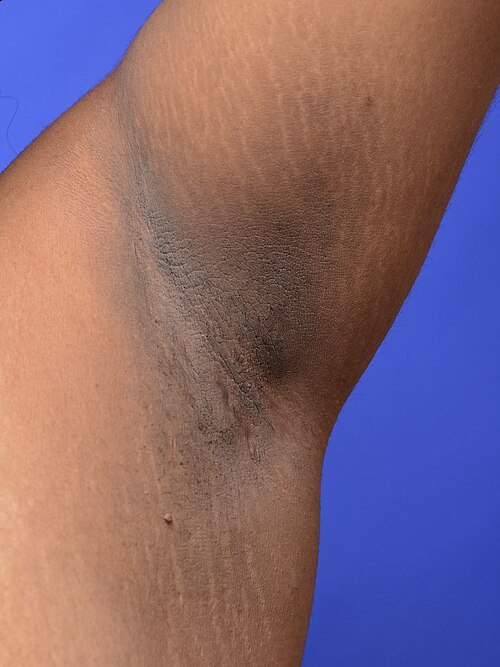
Image Source: Wikimedia Commons (2019). Acanthosis Nigricans, Licensed under a creative commons licence. Available for free at: https://commons.wikimedia.org/wiki/File:Acanthosis_nigricans.jpg (Accessed 20 May 2025).
Management
- Treatment of the underlying cause such as obesity, diabetes mellitus or malignancy
- Stop medications that promote hyperinsulinemia
- When hereditary, idiopathic or unresolved after treatment of underlying cause then topical agents used as first line
- First line agents: ammonium hydrate, vitamin D analogues and retinoic acid
- Second-line agents: oral medications such as isotretinoin, metformin, octreotide and acitretin
- Laser therapy if extensive or disfiguring and not responsive to topical or oral therapy
- However, in darker skin types, there is a significant risk of post treatment hypopigmentation
- The last resort is surgical excision when large, disfiguring lesions are not responsive to other treatments.
Complete Guide to Clinical Genetics ST3 Application and Recruitment (2027)
Written by Medibuddy. Last updated: October 2026. Clinical Genetics is

Complete Guide to Clinical Radiology ST3 Application and Recruitment (2027)
Recruitment paused: NHS England is not running Clinical Radiology ST3+ recru

Complete Guide to Paediatric Surgery ST3 Application and Recruitment in United Kingdom (2026)
Written by Medibuddy. Last updated: October 2026. If you’re planning


Take your subscriptions with you
Our mobile app allows you to access your interview and exam question banks wherever you are.

