


 Close
Close
 5th June 2025
Albinism
This is a congenital loss of pigment caused by defective melanin production. Albinism is typically inherited in an autosomal recessive pattern however some forms are X-linked.
Oculocutaneous albinism (OCA) affects skin, hair, and eyes whilst ocular albinism (OA) which is less common only affects the eyes.
Levels of pigmentation depend on the type of albinism and how much melanin their body produces. Usually, individuals with albinism have very light skin and hair which can appear white.
Presentation
The appearance differs between types of albinism and there is a lack of genotype-phenotype correlation especially in severity of albinism.
The features include varying degrees of skin hypopigmentation. The hair colour can range from white to yellow, red, grey, or brown. The skin can also be more photosensitive. It is worth noting that albinism can be less obvious in fair-skinned individuals as pale features are common.
Melanin is involved in the development of the retina so reduced melanin production can cause visual problems. They can have reduced visual acuity from foveal hypoplasia and misrouting of optic nerves. They can also have astigmatism, photophobia, ametropia, nystagmus, colour vision impairment, and strabismus. Hypopigmentation of the iris leading to iris transillumination is possible.
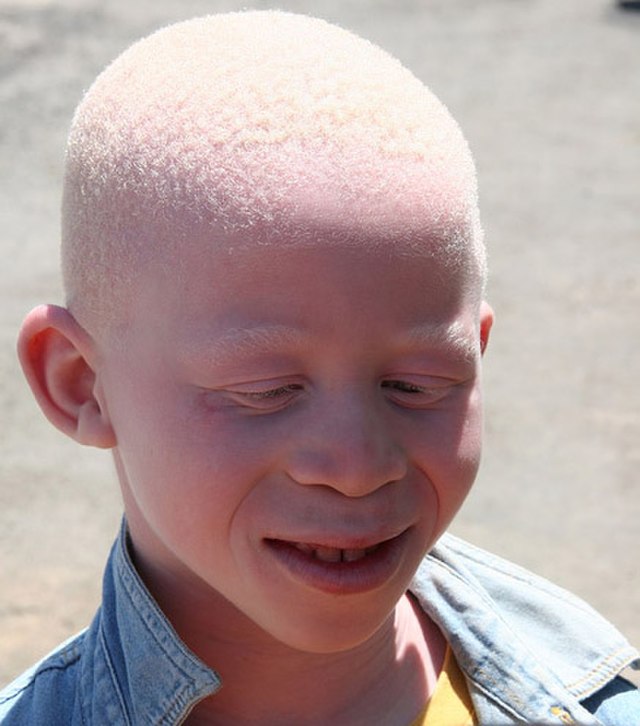
Image Source: Wikimedia Commons (2007). Albinistic Man Portrait, Licensed under a creative commons licence. Available for free at: https://commons.wikimedia.org/w/index.php?search=Albinisitic_man_portrait.jpg&title=Special:MediaSearch&type=image (Accessed 20 May 2025).
Diagnosis
Diagnosis is based on hypopigmentation of skin, hair, and eyes. Therefore, a baby will be examined on appearance when they’re born to check for signs of missing pigment.
Individuals with potential albinism will also be referred to an ophthalmologist to check for eye problems. They may use electrodiagnostic testing which is when electrodes are stuck on the scalp to check the connection for the eyes to the part of the brain that controls vision.
Genetic testing is required to determine the specific subtype of albinism as they overlap clinically.
Treatment
Treatment is aimed at improving vision from eye problems present in albinism. There is no cure as the failed visual neural development cannot be fixed.
Individuals with albinism will need regular eye assessments. They will need lenses for low visual acuity, dark glasses for photophobia, surgery for nystagmus and patches for amblyopia. They will also need visual aids such as large computer screens, large print textbooks and magnifying lenses.
Individuals are also more susceptible to sunburn and hence more likely to develop skin cancers. Therefore, avoiding sunlight, wearing high-factor protection sun cream and examining for skin changes is crucial.
Complete Guide to Clinical Genetics ST3 Application and Recruitment (2027)
Written by Medibuddy. Last updated: October 2026. Clinical Genetics is

Complete Guide to Clinical Radiology ST3 Application and Recruitment (2027)
Recruitment paused: NHS England is not running Clinical Radiology ST3+ recru

Complete Guide to Paediatric Surgery ST3 Application and Recruitment in United Kingdom (2026)
Written by Medibuddy. Last updated: October 2026. If you’re planning


Take your subscriptions with you
Our mobile app allows you to access your interview and exam question banks wherever you are.

