


 Close
Close
 6th June 2025
Hair Disorders
Alopecia
- Alopecia Areata
- Thought to be an autoimmune condition that causes hair to fall out
- Androgenetic Alopecia
- Male pattern hair loss and female pattern hair loss. Hair falls out in a well-defined pattern in men, whereas in women, the hair usually becomes thinner all over the head rather than receding from the temples.
- Central Centrifugal Cicatricial Alopecia
- A form of scarring alopecia that starts in the centre of the scalp.
- Chemotherapy-Induced Alopecia (CIA)
- When the hair falls out following chemotherapy.
- Frontal Fibrosing Alopecia (FFA)
- A type of Scarring Alopecia, where the hair follicle is destroyed and replaced with scar tissue.
- Traction Alopecia
- when hair falls out because it has been pulled in the same way for a long time.
- Trichotillomania
- A psychological condition, where you cannot stop pulling out hair, which leads to hair loss.
Alopecia Areata
Alopecia is the medical term for bald and areata means patchy. This patchy baldness can develop anywhere on the body, including the scalp, beard area, eyebrows, eyelashes, armpits, inside the nose, or ears. Alopecia areata happens when the immune system attacks hair follicles and causes hair loss. Researchers do not fully understand what causes the immune attack on hair follicles, but they believe that both genetic and environmental factors play a role. Anyone can have alopecia areata. Men and women get it equally, and it affects all racial and ethnic groups. If it occurs when you are younger typically it is more extensive. People with certain autoimmune diseases, such as psoriasis, thyroid disease, or vitiligo, are more likely to get alopecia areata, as are those with allergic conditions such as hay fever. Types of alopecia areata include patchy alopecia areata, alopecia totalis, alopecia universalis, alopecia barbae, diffuse alopecia areata and alopecia ophiasis.
Treatment of alopecia areata
- Finasteride: treatment for male pattern baldness
- Minoxidil: treatment for male and female pattern baldness
- Tattooing: Tattoo used to look like short hair and eyebrows
- Topical immunotherapy: applied to bald patches
- Scalp reduction surgery: sections of scalp with hair are stretched and stitched together
- Artificial hair transplant
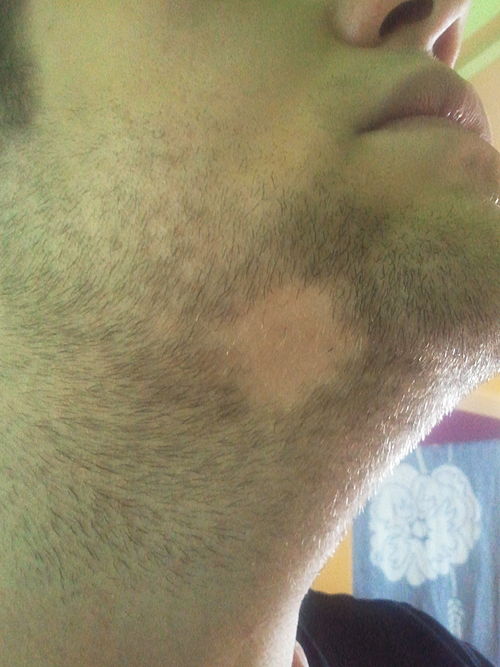
Image Source: Wikimedia Commons (2012). Alopecia Areata under the chin, Licensed under a creative commons licence. Available for free at: https://commons.wikimedia.org/wiki/File:Alopecia_areata_unter_dem_Kinn.jpg (Accessed 22 May 2025).
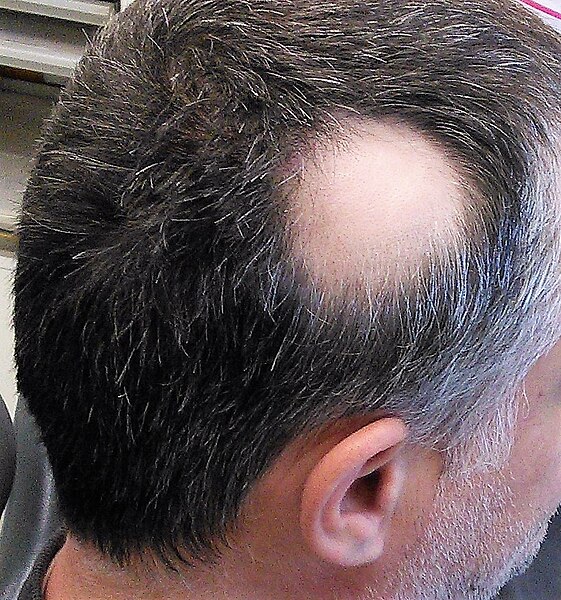
Image Source: Wikimedia Commons (2017). Alopecia Areata, Licensed under creative commons licence. Available for free at: https://commons.wikimedia.org/wiki/File:Alopecia_areata_1.jpg (Accessed 22 May 2025).
Hirsutism
Hirsutism is where women have thick, dark hair on their face, neck, chest, abdomen, lower back, buttocks, or thighs. Hirsutism occurs if the level of androgens in the body increases or if sensitivity to them increases. The two most common causes of hirsutism are polycystic ovary syndrome (PCOS) and idiopathic hirsutism. It affects around 5-10% of women. Hirsutism is usually the result of an underlying endocrine imbalance, which may be adrenal, ovarian, or central. The amount and location of the hair is measured by a Ferriman-Gallwey score. It is different from hypertrichosis, which is excessive hair growth anywhere on the body. The examiner scores the subjects on a scale of 0–4 for terminal hair growth on eleven different body areas according to the Ferriman-Gallwey scoring system (see figure 5). A Ferriman-Gallwey score of 8 or more was considered diagnostic of hirsutism.
Treatments for hirsutism include contraceptive pills, antiandrogen tablets or insulin sensitisers. Other forms of treatment include epilation, waxing, laser hair removal and electrolysis.
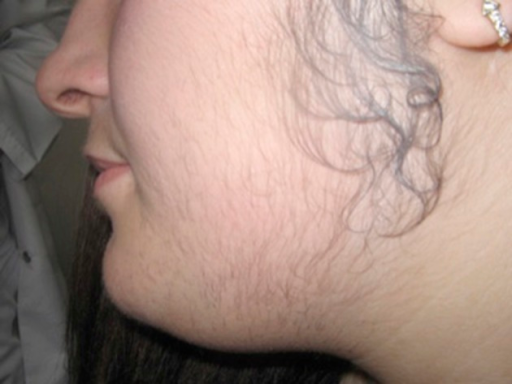
Image Source: Wikimedia Commons (2014). PMC410300, Licensed under a creative commons licence. Available for free at: https://commons.wikimedia.org/wiki/File:PMC4103002_ircmj-16-9410-g001.png (Accessed 22 May 2025).
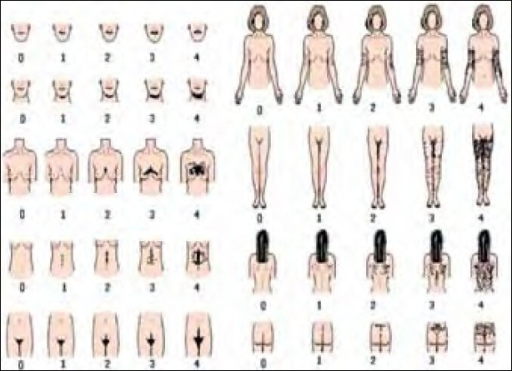
Image Source: Wikimedia Commons (2010). Ferriman-Gallwey Score, Licensed under a creative commons licence. Available for free at: https://upload.wikimedia.org/wikipedia/commons/8/88/Modified_Ferriman-Gallwey-score.png (Accessed 22 May 2025).
Hypertrichosis
Hypertrichosis is defined as excessive hair growth anywhere on the body in either males or females. It is important to distinguish hypertrichosis from hirsutism, which is a term reserved for females who grow an excessive number of terminal hairs in androgen-dependent sites. Hypertrichosis can be either congenital (present at birth) or acquired later in life.
Two methods of classification are used for hypertrichosis. One divides them into either generalised versus localised hypertrichosis, while the other divides them into congenital versus acquired.
Definitions of Hypertrichosis
Congenital: Congenital forms of hypertrichosis are caused by genetic mutations, and are extremely rare, unlike acquired forms. Congenital hypertrichosis is always present at birth.
Acquired: Acquired hypertrichosis appears after birth. The multiple causes include the side effects of drugs, associations with cancer, and possible links with eating disorders. Acquired forms can usually be reduced with various treatments. Drugs associated with acquired generalised hypertrichosis include; Antibiotics such as streptomycin, Anti-inflammatory drugs such as benoxaprofen and corticosteroids, Vasodilators (diazoxide, minoxidil, prostaglandin E1), Diuretics (acetazolamide), Anticonvulsants (phenytoin), Immunosuppressives (cyclosporine, mycophenolate mofetil), Psoralens (methoxypsoralen, trimethylpsoralen), Antiseptic agents (hexachlorobenzene), Chelators (penicillamine), Interferon-alpha, Fenoterol and EGFR inhibitors (cetuximab, panitumumab, erlotinib, gefitinib).
There is no treatment for the underlying cause of hypertrichosis, but the symptoms may be managed with hair removal methods, such as shaving, waxing, epilation, or electrolysis – the chosen method is guided by the patient’s preference.
Complete Guide to Clinical Genetics ST3 Application and Recruitment (2027)
Written by Medibuddy. Last updated: October 2026. Clinical Genetics is

Complete Guide to Clinical Radiology ST3 Application and Recruitment (2027)
Recruitment paused: NHS England is not running Clinical Radiology ST3+ recru

Complete Guide to Paediatric Surgery ST3 Application and Recruitment in United Kingdom (2026)
Written by Medibuddy. Last updated: October 2026. If you’re planning


Take your subscriptions with you
Our mobile app allows you to access your interview and exam question banks wherever you are.

