


 Close
Close
 7th June 2025
Hyperhidrosis
Hyperhidrosis or excessive sweating is a common problem, with an estimated worldwide prevalence of 2-16%. It can occur in children and adults, with onset most often in the mid to late teens. It is usually a primary condition but can be secondary to an underlying cause. Hyperhidrosis can be generalised, or focal, mostly affecting the hands (palmar), feet (plantar), axillae or head (craniofacial). It may have serious social and emotional consequences impacting on patients’ quality of life.
Cause
The cause depends on whether it is primary or secondary hyperhidrosis.
- Primary
- Complex over-reactivity or hyperexcitability of neurological circuits likely involving cortical, hypothalamic and autonomic nervous system interactions
- Usually focal hyperhidrosis: palmoplantar, axillary or craniofacial
- Positive family history
- Secondary hyperhidrosis
- Systemic and neurological effects of organic conditions and their effect on thermoregulatory centres of hypothalamus
- Generalised hyperhidrosis (more common):
- Anxiety
- Physiological (pregnancy, menopause)
- Cardiovascular (heart failure, endocarditis)
- Infections (acute/chronic viral or bacterial infections)
- Malignancy (Hodgkin’s disease, myeloproliferative disorders)
- Endocrine or metabolic (hyperthyroid, diabetes mellitus, diabetes insipidus, phaeochromocytoma, acromegaly, carcinoid syndrome, hyperpituitarism, obesity and gout)
- Neurological (Parkinson’s disease, epilepsy, hypothalamic lesions)
- Drugs (e.g. cholinesterase inhibitors, antidepressants, pilocarpine eye drops, propranolol, proton pump inhibitors, ciprofloxacin, aciclovir, esomeprazole, opioids)
- Drug or alcohol misuse or withdrawal (cocaine, heroin)
- Focal hyperhidrosis:
- neurological (cerebrovascular disease, peripheral neuropathies, diabetic autonomic neuropathy, spinal cord lesions, complex regional pain syndrome)
- intrathoracic lesions (mesothelioma, cervical rib)
- Gustatory sweating, sweating caused by food or drink (diabetic neuropathy, preauricular herpes zoster, invasion of cervical sympathetic trunk by tumour, surgery/injury to parotid gland)
- Compensatory hyperhidrosis (myelopathy, cerebrovascular disease, nerve trauma or post-surgery)
- Others –Raynaud’s phenomenon, arteriovenous fistula, cold injury, rheumatoid arthritis, nail-patella syndrome
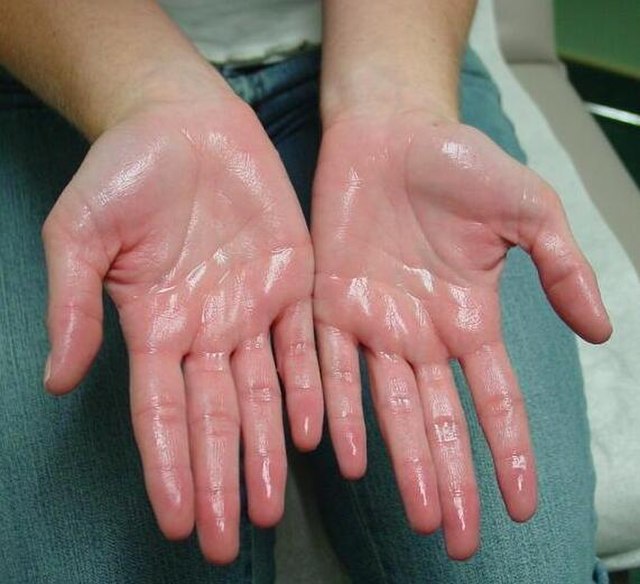 Image Source: Wikimedia Commons (2018). Hyperhidrosis Treatment, Licensed under a creative commons licence. Available for free at: https://commons.wikimedia.org/w/index.php?search=Hyperhidrosis_Treatment.jpg&title=Special:MediaSearch&type=image (Accessed 23 May 2025).
Diagnosis
Diagnosis is based on the cause of hyperhidrosis; for primary, history and physical examination are enough. Investigations may be required to confirm or exclude secondary causes.
Diagnostic criteria for primary focal hyperhidrosis
- Occurs in at least one of the following locations: axillae, palms, soles or craniofacial region AND
- Lasted 6 months AND
- No apparent cause AND
- At least two of the following:
- Bilateral and relatively symmetrical
- Impairs daily activities
- At least one episode per week
- Onset before 25 years of age
- Positive family history
- Cessation of local sweating when sleeping
- If symptoms less than 6 months or onset after 25 years, can be primary focal hyperhidrosis if other criteria are met, but clinically should exclude any underlying causes
Tests to consider for secondary hyperhidrosis depend on the clinical scenario
- Urine analysis for substance abuse
- Urine evaluation for metanephrines, catecholamines and 5-hydroxyindoleacetic acid
- Bloods – FBC, ESR, CRP, U+E, LFT, TFT, HIV, TB
- Blood film for malarial parasites, if indicated
- Chest X-ray
- ECG
- CT scanning – thyroid, pituitary, diabetic, infectious, neoplastic disorders, as well as phaeochromocytoma and carcinoid tumours
Management
Treatment is dependent on the cause of hyperhidrosis. Secondary hyperhidrosis is managed by treating the underlying cause. For management of primary focal hyperhidrosis, it is as follows:
- Minimise exposure to identified triggers
- Self-care management strategies:
- Primary axillary hyperhidrosis – commercial antiperspirant, avoid tight clothing and man-made fabrics, white/black clothing to minimise sweating signs, armpit or sweat shield to absorb excess moisture
- Primary plantar hyperhidrosis – moisture wicking socks, absorbent soles, absorbent foot powder, alternate shoes daily, avoid occlusive footwear
- 20% aluminium chloride hexahydrate preparations as roll-on antiperspirant and spray for symptom relief (must be applied when skin is dry to minimise potential for irritation)
- If skin irritation occurs, reduce frequency of application, hydrocortisone 1% cream for 2 weeks, topical emollients and soap substitutes
- Review in 6 weeks and continue long-term if effective
- Identify any anxiety and manage as needed
- Selective serotonin reuptake inhibitors and propranolol can worsen symptoms
- Referral to dermatologist if above not effective or tolerated
Specialist treatment
- Oral and topical treatment
- Topical glycopyrrolate (antimuscarinic) for primary craniofacial hyperhidrosis (off-label indication)
- Oral antimuscarinic (propantheline, oxybutynin, glycopyrronium bromide [off label indication; the latter may be difficult to procure])
- Often limited by adverse effects such as dry mouth, blurred vision, constipation, urinary retention
- Iontophoresis (for palmoplantar sweating)
- Hyperhidrosis site immersed in warm water through which weak electric current is passed
- Introduces charged ion into skin which inhibits function of sweat gland in that area
- If unsuccessful or in severe cases, glycopyrronium bromide added to water
- Every 1-4 weeks
- Adverse effects – transient discomfort, erythema, vesicle formation at treatment site
- Botulinum A toxin (mostly used for axillae)
- Multiple intradermal injection to hyperhidrosis area
- Inhibiting acetylcholine release from sympathetic cholinergic nerve terminals that innervate sweat glands
- Lasts 6-9 months
- Adverse effects – pain during injection, compensatory sweating
- Surgery
- Localised curettage or resection of axillary eccrine sweat glands under local anaesthesia
- Endoscopic thoracic sympathectomy if other measures unsuccessful
- Division of sympathetic chain over the neck of the ribs in pleural cavity under general anaesthesia
- Prevent transmission nerve signals from sympathetic ganglia to fibres innervating areas producing excess sweat
- Indications – severe palmar, axillary or craniofacial hyperhidrosis
- Complications – compensatory hyperhidrosis elsewhere, gustatory sweating, pneumothorax, atelectasis, significant bleeding, recurrence
Complete Guide to Clinical Genetics ST3 Application and Recruitment (2027)
Written by Medibuddy. Last updated: October 2026. Clinical Genetics is

Complete Guide to Clinical Radiology ST3 Application and Recruitment (2027)
Recruitment paused: NHS England is not running Clinical Radiology ST3+ recru

Complete Guide to Paediatric Surgery ST3 Application and Recruitment in United Kingdom (2026)
Written by Medibuddy. Last updated: October 2026. If you’re planning


Take your subscriptions with you
Our mobile app allows you to access your interview and exam question banks wherever you are.

