


 Close
Close
 8th June 2025
Diagnosis
History and Examination
- Onset
- 18-39 years of age usually
- Site
- Intertriginous skin of axillary, groin, perianal, perineal and inframammary regions
- Double- headed open comedones
- Inflamed nodules
- Solitary lesion initially before multiple sites affected
- Recurrences common
- Develop into pustules and rupture with purulent discharge
- Abscesses
- Sinus tracts or fistulae (draining skin tunnels)
- Chronic as recurrence in same regions
- Scar formation
- Due to healing with dense fibrosis
- Discomfort or pain which can be severe
- Malodour
- Disfigurement
- Reduced quality of life
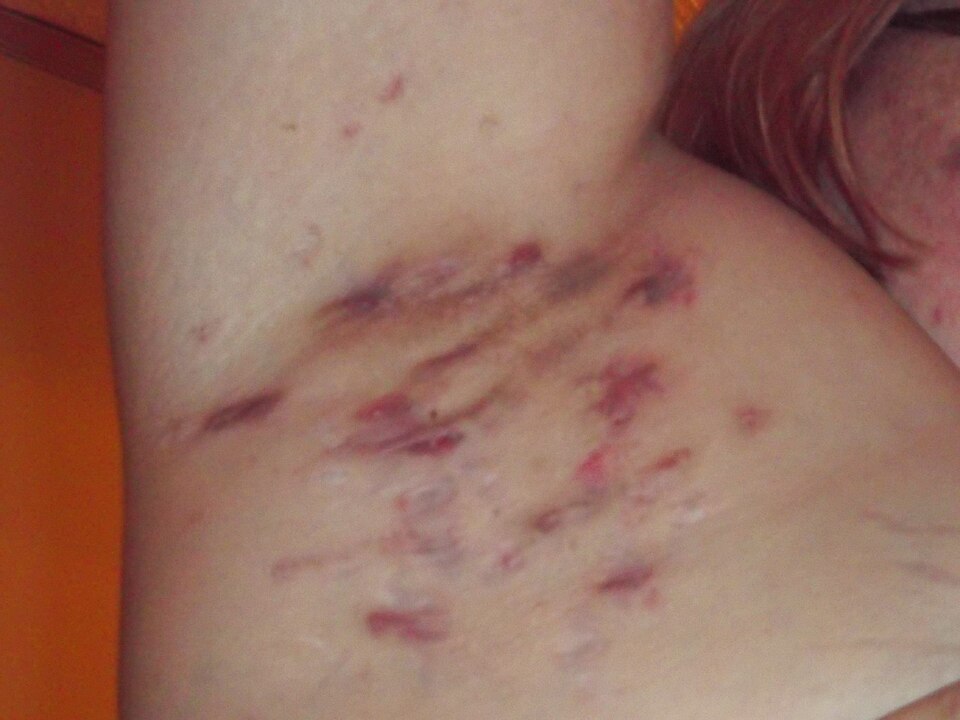 Image Source: Wikimedia Commons (2012). Lesions from Hidradenitis Suppurativa, Licensed under a creative commons licence. Available for free at: https://commons.wikimedia.org/wiki/File:Lesions_from_hidradenitis_suppurativa.jpg (Accessed 23 May 2025).
Classification
Severity of HS can be classified using Hurley staging which can help guide the type of treatment.
- Hurley Stage 1 (mild) – single or multiple, discrete abscesses and inflammatory nodules. There is no scarring or sinus tract formation.
- Hurley Stage 2 (moderate) – single or multiple, discrete abscesses and inflammatory nodules. There is scarring and widely separated sinus tracts.
- Hurley Stage 3 (severe) – multiple and extensive interconnected scars with or without active inflamed lesions.
Investigation
Hidradenitis suppurativa is a clinical diagnosis based on symptoms and signs. However, the following investigations may be useful:
- Bacterial swab – usually negative
- Blood tests if secondary infection is suspected or to exclude diabetes mellitus
- Skin biopsy – occasionally undertaken to exclude squamous cell carcinoma and differentiate from other inflammatory diseases such as Crohn’s disease.
- MRI scan – used in severe disease to check sinus tract path and plan surgery.
Complete Guide to Clinical Genetics ST3 Application and Recruitment (2027)
Written by Medibuddy. Last updated: October 2026. Clinical Genetics is

Complete Guide to Clinical Radiology ST3 Application and Recruitment (2027)
Recruitment paused: NHS England is not running Clinical Radiology ST3+ recru

Complete Guide to Paediatric Surgery ST3 Application and Recruitment in United Kingdom (2026)
Written by Medibuddy. Last updated: October 2026. If you’re planning


Take your subscriptions with you
Our mobile app allows you to access your interview and exam question banks wherever you are.

