


 Close
Close
 9th June 2025
Pyoderma Gangrenosum
Pyoderma gangrenosum is a rare neutrophil dominated skin disorder. It manifests with painful skin ulcers with irregular edges, often covered with a haemorrhagic exudate and excessive granulation tissue with slough.
Associations
Approximately half of patients with Pyoderma gangrenosum have an underlying disease. The most commonly associated conditions are:
- Inflammatory Bowel Disease (IBD).
- Inflammatory Arthropathies
- Vasculitis
- Haematological malignancies
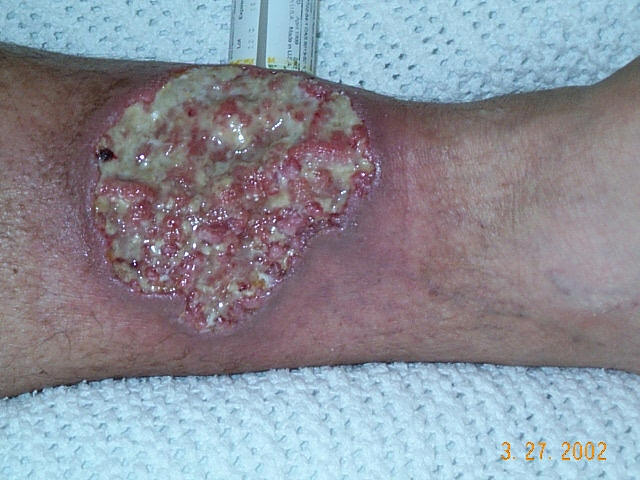
Image Source: Wikimedia Commons (2002). Pyoderma Gangrenosum, Licensed under a creative commons licence. Available for free at: https://en.wikipedia.org/wiki/Pyoderma_gangrenosum (Accessed 23 May 2025).
Management
Treatment is challenging, typically relying on specialist input, with immunosuppressants used as a mainstay of treatment.
When associated with IBD and haematological malignancies, Pyoderma gangrenosum will usually self-resolve with condition improvement. When still persisting, management includes good wound care and topical or systemic treatment.
Topical therapies centre broadly around topical corticosteroids. Whilst systemic therapy includes Ciclosporin which is often the first line systemic treatment, sulfasalazine, dapsone, sulphonamides and systemic corticosteroids. Biological therapies such as infliximab may be required in more severe or refractory cases.
Good wound care is essential, and patients with particularly severe or poorly-healing lesions may require surgical debridement
Complete Guide to Clinical Genetics ST3 Application and Recruitment (2027)
Written by Medibuddy. Last updated: October 2026. Clinical Genetics is

Complete Guide to Clinical Radiology ST3 Application and Recruitment (2027)
Recruitment paused: NHS England is not running Clinical Radiology ST3+ recru

Complete Guide to Paediatric Surgery ST3 Application and Recruitment in United Kingdom (2026)
Written by Medibuddy. Last updated: October 2026. If you’re planning


Take your subscriptions with you
Our mobile app allows you to access your interview and exam question banks wherever you are.

