Close
Close

 7th August 2026
Complete Guide to Clinical Radiology ST3 Application and Recruitment (2026)
This guide to Clinical Radiology ST3 Application walks you through everything on the recruitment side for 2026: eligibility, the application process via Oriel, self-assessment scoring, portfolio evidence and how the numbers actually shake out. Clinical Radiology in the UK is a five-year run-through programme (ST1–ST5) overseen by the Royal College of Radiologists and NHS England, with ST3 acting as a defined external entry point for doctors not already in a radiology training post. We’ll cover what the ST3 person specification asks for, how to build evidence ahead of time, and where candidates typically pick up, or drop, easy points. The interview itself is covered in depth on the Clinical Radiology ST3 Interview Question Bank page, so we’ll keep that brief here.
Always verify with the current-year person specification. Eligibility wording, evidence requirements and timeline details are updated annually by NHS England on the Medical Hub. Treat this guide as orientation and the official documents as definitive.
Key Facts at a Glance
- Recruitment route: ST3 entry via NHS England national recruitment, hosted on Oriel
- Training length from ST3: approximately 3 years to CCT (5-year run-through total)
- Key entry requirement: FRCR Part 1 plus evidenced ST1/ST2 radiology competences
- Shortlisting basis: scored self-assessment with evidence verification (no MSRA for ST3)
- 2026 interview date: 5 February 2026 (Round 1 only; no Round 3)
- Final ranking: interview score combined with verified self-assessment (exact weighting unconfirmed for ST3; check the current applicant guidance)
Table of Contents
- What Is Clinical Radiology ST3 Higher Specialty Training?
- Is Clinical Radiology ST3 Competitive and What Is the Lifestyle Like?
- Clinical Radiology ST3 Eligibility Criteria and Entry Requirements
- How to Apply for Clinical Radiology ST3 National Recruitment
- Clinical Radiology ST3 Recruitment Timeline and Key Dates (2026)
- Clinical Radiology ST3 Competition Ratios and Application Trends
- How Clinical Radiology ST3 Applications Are Scored (2026)
- Clinical Radiology ST3 Self-Assessment and Portfolio: How to Maximise Your Score
- The Clinical Radiology ST3 Interview: A Brief Overview
- Clinical Radiology ST3 Offers, Preferencing and What Happens Next
- Frequently Asked Questions About Clinical Radiology ST3 Application
- Clinical Radiology ST3 Useful Resources
What Is Clinical Radiology ST3 Higher Specialty Training?
Clinical Radiology is a five-year, run-through specialty training programme in the UK, normally entered at ST1 and leading to a Certificate of Completion of Training (CCT) in Clinical Radiology. The curriculum is set by the Royal College of Radiologists (RCR) and approved by the GMC, while recruitment and programme delivery are overseen by NHS England (Workforce, Training and Education) in partnership with the devolved nations. Applications run centrally through Oriel.
ST3 sits at a meaningful crossroads. The first three years (ST1–ST3) form “core” radiology, covering modality- and system-based rotations alongside the FRCR examinations. ST3 itself is the RCR-recognised progression point into special interest training, or, for those choosing interventional radiology, into IR subspecialty training (extending to ST6 for an IR CCT). Importantly for this guide, there’s also a separate national ST3 recruitment round for eligible doctors not already in a radiology programme. Successful candidates join at ST3 and complete the remaining three years to CCT.
Completion confers entry onto the GMC Specialist Register in Clinical Radiology, the gateway to a substantive NHS consultant post. During training you’ll also work through the FRCR exams; note that reforms to FRCR Part 2B took effect from June 2025, so always check the latest RCR guidance.
Day-to-day training varies by deanery (local Schools of Radiology shape your rotations, on-call patterns and sub-specialty exposure), but the curriculum endpoints are uniform UK-wide.
Is Clinical Radiology ST3 Competitive and What Is the Lifestyle Like?
Clinical Radiology is consistently one of the most sought-after specialties in UK national recruitment, and the ST3 route is particularly tight: it exists as a recognised entry point (especially valuable for IMGs using the RCR Alternative Certificate or doctors switching from another specialty), but the number of advertised seats is small. NHS England reported approximately 88 applications for 9 ST3 posts in the 2025 round, a ratio of about 9.78:1, and figures vary year to year, with single-figure post counts in some deaneries. That makes self-assessment scoring and portfolio evidence unusually decisive.
On lifestyle, radiology earns its reputation honestly. The GMC’s 2025 National Training Survey shows radiology trainees report “heavy/very heavy” workload far less often than emergency medicine (70%), O&G (63%) or surgery (48%). By ST3, you’ll be on a resident on-call rota covering acute CT and plain film, increasingly with home reporting options, and you’re expected to have passed FRCR Part 1, with 2A by the end of the year. If you’re heading toward interventional radiology, expect additional procedural on-call (BSIR sets a minimum 1-in-6 standard).
Pay (England, 2025/26): ST3 sits at nodal point 4 of the resident doctor scale. Following the April 2025 4% DDRB uplift, basic pay is in the high £60,000s, plus supplements for additional hours, weekends, nights and on-call (roughly £4,946 on-call allowance, with London weighting around £4,678 where applicable). LTFT is well-established in radiology. Category 3 (personal choice) is now embedded in NHS England policy, with the CCT date extended pro rata.
Career outlook: the 2024 RCR Workforce Census flagged a ~29% consultant shortfall, projected to reach ~39% by 2029, so post-CCT job prospects, including subspecialisation in MSK, abdominal, neuro or IR, remain strong.
Clinical Radiology ST3 Eligibility Criteria and Entry Requirements
Clinical Radiology in the UK is unusual in that it’s a run-through specialty whose principal entry point is ST1, but NHS England also runs a separate, smaller ST3 round each year for doctors who aren’t already in a Clinical Radiology training programme. That distinction matters: the ST3 person specification is its own document, published annually on the NHS England Medical Hub, and the rules are stricter on the radiology competences you must already hold. Always cross-check the year-specific wording before you submit. This is the single most important document for your application.
For the 2026 round, you’ll need to meet the following at the point of application:
- Primary medical qualification: MBBS or equivalent recognised by the GMC.
- GMC registration: full registration with a licence to practise at the time of application (not just provisional).
- Right to work in the UK: UK/Irish nationality, settled/pre-settled status, or eligibility for a Skilled Worker (Health and Care Worker) visa, sponsored by the lead employer.
- Foundation competences: completion of a UK Foundation Programme or evidence via the Certificate of Readiness to Enter Specialty Training (CREST 2024) if you trained outside the UK.
- ST1 and ST2 radiology competences: signed off by an RCR fellow consultant who has worked with you for at least three months. This is the big ST3-specific hurdle.
- Not currently in a Clinical Radiology training programme: the ST3 round is closed to existing CR NTN/DRN holders.
- English language proficiency: GMC-accepted evidence, typically IELTS Academic (7.5 overall, 7.0 in each section) or OET Grade B in each component.
Note that the MSRA is used for ST1 entry, not ST3. ST3 selection is built around the self-assessment and interview instead, so you won’t sit a pre-application aptitude exam for this route.
How to Apply for Clinical Radiology ST3 National Recruitment
Clinical Radiology ST3 is a separate national recruitment route from the much larger ST1 round, run by the Royal College of Radiologists (RCR) with NHS England oversight. Posts are advertised through Oriel, the national applicant portal, and the exact dates, evidence rules and assessment format for your cycle are set out each year in the RCR’s ST3 applicant information and the NHS England Clinical Radiology ST3 person specification.
Here’s the mechanical walkthrough for the 2026 round:
- Check the person specification. The Clinical Radiology ST3 2026 person specification requires GMC registration with a licence to practise, at least 24 months’ WTE clinical radiology experience (excluding Foundation) by the post start date, and successful completion of FRCR Part 1 before you apply. FRCR Part 1 is a hard eligibility filter, so sit and pass it well in advance, not during the application window.
- Register on Oriel. If you don’t already have an account from earlier rounds (for example a Foundation Programme application), set one up at oriel.nhs.uk. There’s no application fee.
- Complete the application form. You’ll fill in personal details, GMC and immigration status, qualifications, employment history, FRCR Part 1 evidence, and referee details. References aren’t usually taken up at submission; referees are contacted later in the process.
- Complete the scored self-assessment. This is the heart of ST3 shortlisting. You score yourself against the published domains (qualifications, achievements, radiology training and experience) and upload supporting evidence, which is then verified. Under-scoring loses you easy points; over-scoring without evidence gets clawed back at verification.
- Submit before the deadline. Round 1 in 2026 is also subject to NHS England’s new cap of five specialty applications per candidate across Round 1 specialties, with only one application allowed per specialty. Round 2 has no such limit.
- Shortlisting and interview. Self-assessment scores determine who progresses to interview. Interviews are conducted remotely via video conferencing booked through Oriel.
- Preferencing and offers. Shortlisted candidates rank deanery preferences in Oriel. Offers are released through Oriel and you have a fixed window to accept, hold or decline.
If your application isn’t successful, you can reapply in the next annual cycle. There’s no published cap on the number of attempts, provided you still meet the person specification. Feedback and a local appeals route are usually offered by the lead recruiter; check the timelines published with your decision email.
Clinical Radiology ST3 Recruitment Timeline and Key Dates (2026)
Clinical Radiology has both an ST1 entry route and a separate, formally advertised ST3 route for doctors who can demonstrate competencies equivalent to completed ST1/ST2 radiology training before posts begin. Both routes are coordinated nationally through Oriel under NHS England’s specialty recruitment process, with the Royal College of Radiologists (RCR) publishing supporting guidance. The 2026 ST3 cycle is Round 1 only (Clinical Radiology is not running in Round 3), and successful applicants start their 36-month training posts in August 2026.
Here are the key dates to plan around for the 2026 ST3 cycle:
| Stage | Date (2026 cycle) |
|---|---|
| Applications open (Oriel) | 20 November 2025 |
| Application deadline | 11 December 2025 |
| ST3 interview date | Thursday 5 February 2026 |
| Evidence upload / verification window | February 2026 (ST3-specific dates may differ from the ST1 window; confirm on the NHS England ST3 timelines page) |
| Initial offers released | 14 April 2026 (5pm) |
| Offer decision window | 48 hours from release (excludes weekends, includes bank holidays) |
| Offer hold deadline | 22 April 2026 |
| Offer upgrade deadline | 4pm, Thursday 23 April 2026 (verify against the live NHS England ST3 timelines page; Scotland MT has published a different date in some cycles) |
A couple of things worth flagging. ST3-specific dates can differ from the larger ST1 cycle, and the publicly accessible timeline pages are refreshed annually, so always confirm exact times against the NHS England Clinical Radiology ST3 recruitment timelines page. The 48-hour offer response clock is tight, so decide your preferences in advance so you’re not scrambling when the email lands.
Clinical Radiology ST3 Competition Ratios and Application Trends
Here’s the honest picture: NHS England runs a formal annual national ST3 round for Clinical Radiology, and the most recent published figures show 88 applications for 9 posts in 2025, a competition ratio of approximately 9.78:1. That’s a small, highly competitive pool, and one of the smaller intakes in UK specialty recruitment.
The catch is that NHS England’s competition ratios pages historically surface Clinical Radiology figures at ST1 entry rather than ST3, even though both rounds run. So if you go searching for the ST3 line in the published competition-ratio tables you may not find it prominently, which has led to a perception that ST3 entry is informal or vacancy-driven. It isn’t, but the public data trail is thinner than for the larger ST1 round.
A few practical implications:
- Treat the 9.78:1 figure as a single data point, not a long-running trend. Post numbers and applicant counts vary year to year, and current-year figures should be confirmed against the Royal College of Radiologists and NHS England updates when the round closes.
- Regional distribution matters. Posts are spread across England, Scotland and Wales (Northern Ireland is handled separately via NIMDTA), and the deanery split changes annually.
- Watch Oriel directly. The ST3 vacancy advert is the most reliable source for the post count and deanery distribution in your cycle.
The headline: this is a national round with real, published competition data, just a small one, where every point of self-assessment evidence and every minute of interview prep counts.
How Clinical Radiology ST3 Applications Are Scored (2026)
Before we get into the detail of self-assessment and portfolio evidence, it helps to understand how the scoring framework hangs together. NHS England’s person specifications are the authoritative document for any given round, and we’d always recommend checking the current year’s version before you do anything else.
The two scoring stages
For Clinical Radiology ST3 specifically, the overall score is built from two stages:
| Stage | What it assesses | Role in scoring |
|---|---|---|
| Longlisting / shortlisting | Eligibility (including FRCR Part 1 and the Alternative Certificate for ST1/ST2-equivalent competences), then a scored self-assessment with evidence verification | Used to rank applicants for interview invitation |
| Interview | Radiology experience, clinical prioritisation, image review and professional scenarios | Final ranking combines the verified self-assessment score with the interview score |
Note that the MSRA is not used for ST3; that’s an ST1 entry mechanism. Shortlisting at ST3 is based on the self-assessment plus eligibility verification.
How the self-assessment feeds the score
The self-assessment is a structured form completed in Oriel where you score yourself against defined portfolio domains: things like academic achievement (publications and presentations), quality improvement, teaching, and commitment to specialty. Community guidance on the 2025–26 cycle suggests a five-domain matrix, though the official scoring rubric should be confirmed against the current year’s self-assessment guidance on NHS England. Your self-scored answers don’t stand alone: each is verified against the evidence you upload, and unsupported claims are adjusted downward. We unpack each domain (what counts, what doesn’t, and where candidates lose easy points) in the next section.
Preparing for the interview? Work through the Clinical Radiology ST3 Interview Question Bank for scenario questions with model answers from high-scoring trainees.
Because the published rubric and weightings change year to year and ST3-specific documentation is sparse, anchor your preparation to the current year’s RCR and NHS England guidance rather than older write-ups you may find online.
Clinical Radiology ST3 Self-Assessment and Portfolio: How to Maximise Your Score
ST3 entry into Clinical Radiology is a niche route, designed primarily for doctors who have completed or substantially progressed through radiology training overseas and want to join the final three years of UK training. That shapes everything about the self-assessment and portfolio: the bar is set around equivalence to a UK ST2 radiology trainee, not around generic clinical experience.
What the self-assessment actually scores
The NHS England Clinical Radiology ST3 Self-Assessment Guidance (published annually alongside the person specification) is the only document that tells you exactly which domains score and what evidence each band requires. In recent years it has centred on radiology-specific achievements: qualifications including FRCR Part 1, documented radiology training and teaching, audit and quality improvement in imaging, presentations and publications, and reflective practice. Don’t assume the ST1 self-assessment domains apply here; the ST3 form is its own thing.
Evidence you’ll need to upload
Everything you claim is verified at longlisting and again before interview, so build the file now:
- FRCR Part 1 pass certificate, a hard eligibility gate, not a scored bonus
- Alternative Certificate signed by a supervising consultant confirming ST2-equivalent radiology capabilities
- GMC registration with licence to practise
- Audit/QIP documentation showing your role, the loop closed, and any radiology relevance
- Certificates and programmes for teaching delivered or attended
- Acceptance emails or published abstracts for presentations and papers
Upload as PDFs through Oriel before the round’s deadline. Claims without acceptable evidence get downgraded.
Where candidates lose easy points
- Do mirror the wording of the self-assessment descriptors when you write your evidence summaries
- Do get the Alternative Certificate signed early; chasing a consultant signature in the final week is the classic mistake
- Don’t over-claim a band you can’t evidence; verification discrepancies risk score reduction or withdrawal
- Don’t rely on the often-quoted “40% portfolio, 60% interview” weighting; that figure comes from ST1 material and isn’t confirmed for ST3
- Don’t pad with non-radiology audits when a smaller imaging-focused QIP scores better
If you’re 6–12 months out, the highest-yield moves are sitting FRCR Part 1, lining up an imaging audit you can close, and arranging consultant supervision that can sign the Alternative Certificate when the round opens.
The Clinical Radiology ST3 Interview: A Brief Overview
If you make it through self-assessment shortlisting, you’ll be invited to a remote interview, with slots booked through Oriel. NHS England confirms the ST3 round runs online rather than in person, which is helpful if you’re juggling clinical commitments and don’t want to travel.
NHS England’s official ST3 interview page sets out the format: two 15-minute stations, each with three sections. Station 1 is the specialty-specific part (radiology experience, a prioritisation exercise, and reviewing an image); Station 2 covers professional areas (coping with pressure and uncertainty, teamwork, and leadership). Panels are remote, usually up to two consultants, sometimes with a lay representative checking for fairness. Rather than half-cover the preparation here, we put the full station-by-station breakdown, scoring focus and worked examples on our dedicated interview page, which we keep updated as each year’s applicant guidance is published.
Preparing for the interview? Head to the Clinical Radiology ST3 Interview Question Bank for the full station-by-station breakdown, scenario questions with model answers, and practice material put together by high-scoring radiology trainees.
Clinical Radiology ST3 Offers, Preferencing and What Happens Next
Once interviews are done, the offers phase runs centrally through Oriel. With only around 9 ST3 posts nationally in the 2025 round, the cascade moves quickly: declined offers drop straight to the next-ranked candidate on the reserve list, so it’s worth watching your inbox carefully.
Here’s roughly how it works, from interview to start date:
- Rank your preferences in Oriel. Before offers are released, you list deaneries (and where applicable, specific posts) in order of preference. Take this seriously: your initial offer will be the highest-preferenced post your interview rank reaches.
- Initial offer issued. You’ll receive one offer at a time via Oriel (initial offers in the 2026 round are released at 5pm on 14 April 2026), with a hold-down period to accept, decline or hold while you wait for a possible upgrade.
- Upgrade window. If you accept-with-upgrade, you keep your current offer but stay in the queue for higher preferences. Should one free up, you’re automatically moved across and your previous offer is released back into the pool. The NHS England Clinical Radiology ST3 recruitment timelines page lists the upgrade deadline as 4pm on Thursday 23 April 2026, though Scotland MT has published a different date in some cycles. Confirm against the live timelines page for your round.
- Pre-employment checks and start. Once you firmly accept, the appointing deanery picks up onboarding (occupational health, DBS, references) ahead of the August start.
One practical note: candidate accounts historically describe the centralised system as impersonal, and there has been at least one reported allocation error in radiology. Keep written records of every Oriel action in case you need to query something later.
Frequently Asked Questions About Clinical Radiology ST3 Application
How does ST3 entry into Clinical Radiology actually work in the UK?
Clinical Radiology is a run-through specialty normally entered at ST1, but NHS England also runs a separate national ST3 round each year for eligible doctors with prior radiology experience. The 2025/26 round opened on 20 November 2025 and closed on 11 December 2025 via Oriel, with posts advertised across England, Scotland and Wales against a national person specification.
Do I need FRCR Part 1 to apply for Clinical Radiology ST3?
Yes. The 2026 Clinical Radiology ST3 person specification requires FRCR Part 1 at the point of application. You’ll also need to evidence ST1 and ST2 clinical radiology competences, typically gained in a recognised radiology training post. GMC registration with a licence to practise is also required.
How is the Clinical Radiology ST3 application shortlisted?
Shortlisting is based on a scored self-assessment rather than a separate exam such as the MSRA. You award yourself points against published domains (achievements, qualifications, training experience) and upload supporting evidence, which is then verified. Candidates with the highest verified self-assessment scores are invited to interview, and the final ranking combines self-assessment and interview marks.
What is the Alternative Certificate and who needs it?
The Alternative Certificate is an official RCR-issued form by which a supervising consultant signs off that you’ve achieved capabilities equivalent to a UK ST2 radiology trainee. It’s the key route for IMGs and doctors entering from outside the UK run-through ST1/ST2 pathway, and every listed professional capability must be confirmed by an authorised signatory. Incomplete sign-off makes a candidate ineligible, so identify your signatory and start the process early.
What happens if I’m offered a post but want a higher preference?
NHS England’s ST3 recruitment timeline includes a formal upgrade window. For the 2026 round, the NHS England ST3 timelines page lists the upgrade deadline as 4pm on Thursday 23 April 2026 (worth verifying against the live page, as published deadlines have varied between recruitment offices in some cycles). You keep your initial offer but stay in the queue for higher-ranked preferences via Oriel. If a higher preference becomes available before the deadline, you’re automatically upgraded and the lower-ranked offer is released.
Can I reapply for Clinical Radiology ST3 if I’m unsuccessful?
Yes. There’s no cap on the number of times you can apply, provided you still meet the person specification for the year you’re applying in. Many successful candidates apply more than once, using the extra time to strengthen audit, teaching, leadership and radiology-specific evidence. If you’re reapplying, request feedback on your previous self-assessment and interview scores to target the weakest areas.
How long is Clinical Radiology training from ST3 to CCT?
Entry at ST3 leaves three further years of run-through training before CCT, as confirmed by the Royal College of Radiologists and the NHS Oriel vacancy listings. Sub-specialisation in interventional radiology typically extends total training by around a further year. The RCR sets the curriculum and ARCP decision aid that govern progression at each stage.
Where are the official Clinical Radiology ST3 requirements published?
The Royal College of Radiologists publishes the curriculum and training standards at rcr.ac.uk, approved by the GMC. NHS England publishes the annual ST3 person specification, recruitment timeline, self-assessment guidance and interview information on the Medical Hub (medical.hee.nhs.uk). Applications themselves are submitted through Oriel, the national NHS recruitment portal.
Clinical Radiology ST3 Useful Resources
When you’re putting your application together, it pays to work from primary sources first, then layer community insight on top. Here’s what we’d bookmark.
Official guidance (always your first stop)
- NHS England Clinical Radiology ST3 Person Specification 2026: the definitive eligibility document, including the 24-month WTE radiology requirement and FRCR Part 1.
- NHS England Clinical Radiology ST3 overview: selection methodology, interview logistics and Oriel guidance.
- Royal College of Radiologists ST3 recruitment pages: the lead recruiter’s authoritative hub.
- RCR Clinical Radiology Curriculum: useful context for evidencing prior radiology learning.
Community and cycle-specific updates
- r/RadiologyUK and r/JuniorDoctorsUK for current-cycle threads on deadlines, evidence and post numbers.
- Radcast’s Substack and YouTube walk-throughs from recent successful applicants, handy for cross-checking what evidence actually got scored.
Medibuddy resources
- Clinical Radiology ST3 Interview Question Bank: scenario questions and model answers from high-scoring trainees.
Putting together a strong Clinical Radiology ST3 application really does come down to the basics: meeting the person specification (including your 24 months’ WTE experience and FRCR Part 1), gathering verified evidence carefully, and treating the self-assessment and interview as scores that both count toward your final ranking. Get those foundations right and you give yourself a genuine shot at an NTN.
When you’re ready to turn your attention to interview day, the Clinical Radiology ST3 Interview Question Bank walks you through scenario questions with model answers from high-scoring trainees. Good luck, you’ve got this.
Take your subscriptions with you
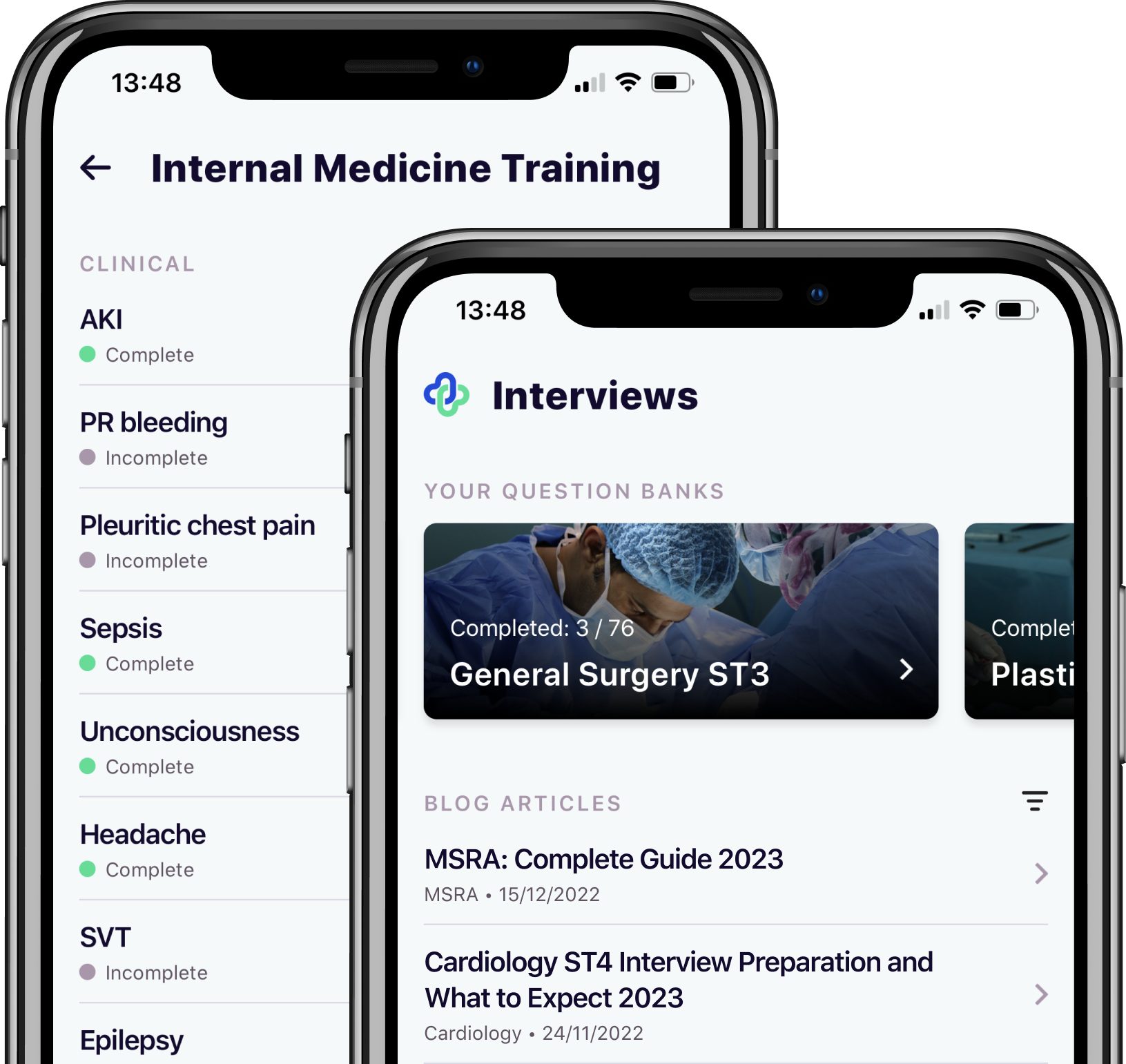
Our mobile app allows you to access your interview and exam question banks wherever you are.