Close
Close

 25th June 2026
Complete Guide to Immunology ST3 Application and Recruitment (2026)
This guide covers every stage of the Immunology ST3 Application process for the 2026 UK round, walking you through it step by step. Immunology ST3 Application sits within higher specialty training entered through the Allergy, Clinical and Laboratory Immunology (ACLI) pathway, a five-year programme overseen by the JRCPTB with national recruitment run by NHS England through Oriel. We cover eligibility, the application timeline, the new five-application cap for Round 1, self-assessment scoring and the portfolio evidence you’ll need to gather. The interview itself is summarised briefly here and broken down in full on the Immunology ST3 Interview Question Bank page. Let’s start with the headline facts.
Key Facts at a Glance
- Competition ratio (2025): 7.4:1 (37 applications, 5 posts)
- Training length: 5 years indicative (ST3 to ST7, leading to CCT)
- Key entry requirement: Full MRCP(UK) or MRCPCH by the offer date
- Recruitment platform: Oriel, coordinated nationally by PHST/JRCPTB
- 2026 interview date: 12 February 2026 (England, Scotland, Wales)
- First offers: by 31 March 2026 under Round 1 timelines
Table of Contents
- What Is Immunology ST3 Higher Specialty Training?
- Is Immunology ST3 Competitive and What Is the Lifestyle Like?
- Immunology ST3 Eligibility Criteria and Entry Requirements
- How to Apply for Immunology ST3 National Recruitment
- Immunology ST3 Recruitment Timeline and Key Dates (2026)
- Immunology ST3 Competition Ratios and Application Trends
- How Immunology ST3 Applications Are Scored (2026)
- Immunology ST3 Self-Assessment and Portfolio: How to Maximise Your Score
- The Immunology ST3 Interview: A Brief Overview
- Immunology ST3 Offers, Preferencing and What Happens Next
- Frequently Asked Questions About Immunology ST3 Application
- Immunology ST3 Useful Resources
What Is Immunology ST3 Higher Specialty Training?
Immunology ST3 is the UK higher specialty training programme that takes you from senior medical trainee to consultant Clinical Immunologist, with trainees holding the formal NHS grade of Specialty Registrar (StR). Since August 2021, the specialty has been delivered under a refreshed GMC-approved curriculum called Allergy, Clinical and Laboratory Immunology (ACLI), sitting alongside its sibling pathway Allergy and Clinical Immunology (ACI). For now, the specialty is still advertised as “Immunology” for recruitment, though a formal name change is pending Department of Health sign-off.
Training is overseen by the Joint Royal Colleges of Physicians Training Board (JRCPTB) in partnership with the Royal College of Pathologists (RCPath), with national recruitment coordinated through NHS England via Oriel. You’ll enter at ST3 after completing Internal Medicine Stage 1 (or equivalent, such as legacy CMT or ACCS Acute Medicine) with full MRCP(UK), or via the paediatric route with MRCPCH. From there, the indicative programme runs five years (ST3–ST7), blending clinical immunology clinics (primary and secondary immunodeficiency, allergy, autoimmune disease) with diagnostic laboratory training. You’ll also sit FRCPath Part 1 and Part 2 in Immunology, including a case book submission, alongside workplace-based assessments and annual ARCPs.
The curriculum is built around Capabilities in Practice (CiPs), grouped into generic, shared and specialty-specific outcomes. Successful completion leads to a Certificate of Completion of Training (CCT) and entry onto the GMC Specialist Register in Immunology, the gateway to a substantive NHS consultant post.
Entry standards and end-point competencies are nationally consistent across England, Scotland, Wales and Northern Ireland, but rotation structures vary by deanery (North Western, Yorkshire & Humber, East Midlands and NIMDTA all run their own local programmes), so it’s worth looking closely at where you’d actually be working day-to-day.
Is Immunology ST3 Competitive and What Is the Lifestyle Like?
Immunology is a small, niche specialty, and that shapes both how competitive it feels and what life inside training looks like. National post numbers are tiny. Northern Ireland advertised just one ST3 immunology post in a recent round, and the East Midlands and Yorkshire/Humber schools hold only nine National Training Numbers between them. Formal competition ratios aren’t routinely published for this specialty, but with so few posts each year, geographical flexibility matters as much as raw competitiveness.
The lifestyle is one of the strongest draws. Immunology ST3 is widely regarded as one of the more lifestyle-friendly physician specialties: predominantly outpatient and laboratory-based work, typical hours around 9–5 Monday to Friday, and little or no general medical on-call once you’re in a pure immunology rotation. The British Society for Immunology notes that consultants are rarely required in hospital out of hours. Less-than-full-time training is well established and routinely accommodated. One caveat from community sources: Specialty Registrars on the Allergy and Clinical Immunology (ACI) pathway may pick up some pro-rata on-call depending on local rotation design, so it’s worth asking deaneries directly.
Pay follows the standard NHS resident doctor scale rather than anything specialty-specific. ST3 sits at nodal point 4 (around £61,825–£65,048 basic depending on pay year), rising to roughly £73,992 at ST6, with London weighting and any additional duties on top.
After the 4–5 year programme, most CCT holders become consultants combining clinic-based care of immunodeficiency, allergy and autoimmune patients with running a diagnostic immunology laboratory: a genuinely dual clinical-scientific identity, with strong research and academic options through OOP-PhD routes.
Immunology ST3 Eligibility Criteria and Entry Requirements
Eligibility for Immunology ST3 is set out in an annual person specification published by NHS England (Workforce, Training and Education), which applies across England, Northern Ireland, Scotland and Wales. The framework is underpinned by the GMC-approved 2021 curricula (Allergy and Clinical Immunology, and Allergy, Clinical and Laboratory Immunology) hosted by the JRCPTB, with oversight from the Royal College of Pathologists’ Immunology SAC. Exact wording can change year to year, so always cross-check the current handbook on the NHS England person specifications page before you apply.
Here’s what you’ll need to meet the 2026 essential criteria:
- Medical degree: MBBS or equivalent primary medical qualification, plus full GMC registration with a licence to practise by the post start date.
- Foundation competences: completion of a UK Foundation Programme or demonstrable equivalence (CREST or comparable sign-off for non-UK applicants).
- Core training: completion of Internal Medicine Training (typically two years of IM stage 1), or completion of paediatric training to a level equivalent to ST3 of the RCPCH Progress+ curriculum, or completion of Irish Basic Specialty Training.
- Postgraduate exams: MRCP(UK) Part 1 by the application date and full MRCP(UK) by the offer date for the physician route; full MRCPCH by the offer date for the paediatric route; full MRCPI accepted via the Irish route. Note that surgical exams like the MRCS are not part of the Immunology pathway. This is a physician-stream specialty.
- Competence sign-off: evidence of satisfactory ARCP outcomes from your core stage, confirming you’ve met the relevant capabilities in practice.
- English language: if your primary medical qualification wasn’t taught and examined in English, an academic IELTS at 7.5 overall (7.0 in each sub-skill) or OET Medicine grade B in each sub-skill, in line with GMC rules.
- Right to work: confirmed by the post start date, usually via a Skilled Worker visa for international applicants. Watch this space: the prioritisation rules are changing from 2027 under the Medical Training (Prioritisation) Bill.
There’s no formal upper cap on years of post-foundation experience, but candidates already holding a CCT (or within six months of CCT) in the same specialty are typically excluded. The FRCPath/ACICE Part 1 sits within training, not before it, so you don’t need it to apply.
How to Apply for Immunology ST3 National Recruitment
Immunology ST3 is recruited nationally through the Physician Higher Specialty Training (PHST) office, with the London region coordinating longlisting, shortlisting and interviews on behalf of all four UK nations. As always, check the current applicant handbook and NHS England person specification for any updates before you apply. What follows is the typical shape of the process for the 2026 round.
Step-by-step: applying for Immunology ST3
- Register on Oriel. All UK specialty training applications go through Oriel, the single national recruitment portal. Create your account well before the window opens and complete your personal profile.
- Confirm you’re eligible. You’ll need MRCP(UK) Part 1 (or equivalent) passed by the application submission deadline, with the full MRCP(UK) diploma, or full MRCPCH for paediatric-route applicants, completed by the offer date. There’s no specialty-specific written exam for Immunology ST3.
- Submit during the Round 1 window. For the 2026 intake, Round 1 opened at 10:00 on 23 October 2025 and closed at 16:00 on 20 November 2025, with interviews in December 2025 and offers expected by 31 March 2026. A Round 2 typically follows in summer for any unfilled posts.
- Complete each form section. The Oriel application covers personal details, eligibility declarations, employment history, fitness to practise, programme/location preferences and, crucially, the self-assessment domains (qualifications, presentations, publications, teaching, leadership and other achievements) that drive your shortlisting score.
- Nominate your referees. You’ll list referees (usually three, including your current or most recent clinical supervisor) inside the form. References are normally taken up after offers rather than verified pre-shortlisting.
- Mind the five-application cap. From 2026, NHS England limits candidates to a maximum of five specialty applications in Round 1 (Round 2 is uncapped). ACF applications are separately capped at three. Use those slots strategically.
- Prepare your supporting documents. You don’t usually upload everything with the initial form, but you’ll need certificates, publication evidence, teaching logs and qualification proofs ready for verification at interview. Scores can go up or down at verification, so only claim what you can evidence.
- Pay nothing, yet. There’s no Oriel application fee. Costs come later: MRCP examination fees, interview travel, and JRCPTB enrolment (around £890 across ST3–ST8) once you’re appointed.
If you’re unsuccessful
You can reapply in a future cycle. There’s no lifetime cap on attempts. Feedback is available, and PHST runs a formal complaints and appeals process, though appeals are restricted to procedural grounds rather than challenges to selectors’ scoring judgements. Coming back stronger usually means rebuilding the self-assessment evidence, which the next section breaks down.
Immunology ST3 Recruitment Timeline and Key Dates (2026)
Immunology higher specialty training is recruited centrally through the Physicianly Higher Specialty Training (PHST) office via Oriel, with Allergy and Immunology interviewing jointly in Round 1. Because the cohort is small (just a handful of national posts), every date matters. Missing the evidence upload window is one of the easiest ways to lose points before you’ve even started.
Here are the headline dates for the 2026 round:
| Stage | Date (2026 round) |
|---|---|
| Applications open (Oriel) | 23 October 2025 |
| Main HST recruitment window | 5 January – 10 April 2026 |
| Immunology ST3 interview date (England, Scotland, Wales) | 12 February 2026 |
| Initial offers released | From 20 January 2026 |
| Offer response window | 48 hours per offer (accept / hold / decline) |
| First offers deadline (PHST) | 14 April 2026 |
| Hold deadline | 22 April 2026 |
| Upgrade deadline | 23 April 2026 |
Dates vary slightly each year and Northern Ireland (NIMDTA) runs separately, sometimes with a Round 2 post. The evidence upload deadline sits separately from the application submission date: anything not on the self-assessment portal by that cut-off won’t be scored, so treat it as a hard deadline. Check the PHST Immunology specialty page and the NHS England Specialty Recruitment Interview Schedule before you plan around any single date.
A specialty-specific quirk to flag: if you’re coming in from paediatrics, the September/March rotation pattern means start-date exceptions are sometimes granted.
Immunology ST3 Competition Ratios and Application Trends
Immunology is one of the smallest pathology training programmes in the UK, which makes competition look volatile on paper. With only a handful of posts each year, even modest changes in applicant numbers swing the ratio sharply. Here’s how recent rounds have looked, using figures published on the NHS England Medical Hub competition ratios pages:
| Round | Applications | Posts | Ratio | Fill |
|---|---|---|---|---|
| 2019 | 19 | 6 | 3.17:1 | n/a |
| 2024 | 38 | 12 | 3.17:1 | n/a |
| 2025 | 37 | 5 | 7.40:1 | 4/5 (80%) |
The headline trend is that interest in Immunology ST3 has climbed since 2020, while post numbers have not expanded to match: a pattern flagged in the Royal College of Pathologists’ 2025 Clinical Immunology workforce report. The 2025 round saw 37 candidates chasing just 5 posts, more than double the 2024 ratio of 3.17:1, and broadly in line with the wider rise in UK specialty training competition.
What this means for you in practice: the ratio in any given year tells you less than the underlying reality, which is that there are typically only five to twelve national posts on offer. Northern Ireland (via NIMDTA) often advertises a single ST3 post in round 2, so geographic flexibility matters. You’re not competing in a huge cohort, but every self-assessment point counts more when the numerator is small.
How Immunology ST3 Applications Are Scored (2026)
Immunology ST3 recruitment is run nationally by Physician Higher Specialty Training (PHST) recruitment through Oriel, with the London region acting as the lead recruiter. It uses a formal, points-based framework: you’re longlisted against the 2026 person specification, shortlisted on a verified self-assessment score, and then interviewed across two stations made up of four scored questions. Because Immunology is a micro-specialty (only 5 posts in 2025), the margins between offer and no offer can be tiny. Every scoring decision matters.
The headline weighting
Based on the published PHST Immunology scoring breakdown, which should be confirmed in the current applicant handbook, the final score is out of 100 and combines two components:
| Component | Raw score | Weighting | Contribution to final score |
|---|---|---|---|
| Interview (eight component scores, 1–5 each) | /40 | ×2 | /80 |
| Application self-assessment (verified) | /40 | ×0.5 | /20 |
| Total | /100 |
So the interview carries 80% of the final mark and the self-assessment 20%. That said, the self-assessment isn’t just a fifth of your score. It’s also what gets you through shortlisting in the first place. A weak self-assessment means you never reach interview, where the bulk of the marks actually sit.
Progression thresholds
PHST also applies pass/fail safety nets at interview. You can’t score 1/5 on any question, you can’t have more than two scores of 2/5, and you need a raw interview score of at least 24/40 to be appointable (confirm the current figure against the PHST Applicant Handbook). Strong performance on one question doesn’t rescue a very weak one.
How the self-assessment feeds in
The self-assessment is a domain-scored form covering postgraduate qualifications, publications, presentations and posters, teaching, quality improvement and audit, and other achievements. You self-score against published descriptors, then upload evidence for every claimed point. Anything unverifiable is struck out at interview, and scores can’t be amended after submission. We unpack each domain, the evidence rules and where candidates typically lose marks in the next section.
Notably, eligibility instead rests on full MRCP(UK) or MRCPCH by the offer date rather than any centralised written exam.
Immunology ST3 Self-Assessment and Portfolio: How to Maximise Your Score
With only around five posts nationally and roughly 7.4 applications per post in the 2025 round (specialty-applications.co.uk), a single self-assessment point can be the difference between an offer and the reserve list. Immunology ST3 recruitment runs through the Physician Higher Specialty Training (PHST) office via Oriel, and the self-assessment is your main lever to control your score.
What the form actually scores
The Immunology ST3 (ACLI route) self-assessment uses the standard PHST eight-domain structure, producing a Ranked Index Score between 8 and 40, with each domain scored 1–5. The domains in recent years have included postgraduate degrees, additional qualifications, presentations and posters, publications, teaching experience and qualifications, quality improvement, leadership and management, and a commitment-to-specialty/supporting statement. Confirm the exact 2026 banding in the PHST Immunology scoring matrix, as descriptors can shift between rounds.
There is no operative or procedural logbook, and no separate score for breadth of rotations. Clinical readiness is gated through MRCP(UK) (or MRCPCH for the paediatric route) plus IMT stage 1 completion or the alternative certificate of capabilities.
Where the easy points sit
- Higher degrees and teaching qualifications: a completed PGCert/PGDip/MA in Medical Education sits in a higher band than a “Training the Trainers” short course. Incomplete qualifications usually need a signed letter from the course organiser to count.
- Publications: scoring favours first-author, PubMed-indexed papers over abstracts and letters. Have the PMID/DOI ready.
- QI: by analogy with other PHST physician specialties (confirm against the current Immunology ST3 scoring matrix), completed cycles with measurable change typically score above one-off audits, so get the project signed off before applications open.
- Commitment to specialty: an immunology-specific taster, lab attachment, or audit anchors the supporting statement and is harder to fake at interview.
Where candidates lose easy points
Evidence is everything. PHST is explicit that no evidence equals no shortlisting for that domain. The most common avoidable losses:
- Don’t rely on poster certificates without the conference programme listing.
- Don’t claim a teaching domain point without dated feedback or a supervisor letter naming you, the sessions, and the audience.
- Don’t upload screenshots of submitted (not accepted) abstracts.
- Do name every file clearly and match it to the domain it evidences.
- Do chase signed confirmation letters now. Supervisors take weeks.
Concrete actions before applications open
If you’re applying in the next round, audit your evidence against each domain this month. Book the MRCP sittings you still need, pin down a QI project you can finish and present, and arrange an immunology taster or laboratory attachment to underpin your supporting statement. The PHST evidence-upload window for the 2026 cycle opened on 23 October 2025. Late or wrongly formatted documents aren’t accepted, so build your evidence folder long before that.
The Immunology ST3 Interview: A Brief Overview
Allergy and Immunology recruit jointly, so if you’re applying for Immunology ST3 you’ll sit the same panel interview as Allergy candidates, run nationally through the Physician Higher Specialty Training (PHST) recruitment office via Oriel. For the 2026 round, interviews are held online as a two-station panel, with each station lasting around 20 minutes and splitting into two questions, and the full interview running roughly 45–50 minutes including transitions between stations.
Your final score combines this interview performance with your scored self-assessment, so both halves of the process genuinely matter.
We’ve kept this section deliberately short because the interview deserves its own deep dive: station content, what assessors are looking for, and worked examples.
Preparing for the interview itself? The Immunology ST3 Interview Question Bank gives you the full station-by-station breakdown, scenario questions and model answers written by trainees who scored highly at national selection.
Immunology ST3 Offers, Preferencing and What Happens Next
Once you’ve interviewed, the offers stage is where ranking, preferences and a bit of nerve all meet. Here’s how it generally works for Immunology ST3 in the UK:
- Ranking. PHST ranks candidates nationally based on interview scores, and offers are released through Oriel in rank order against the preferences you submitted earlier in the round.
- Responding to your offer. You’ll have a 48-hour window per offer in Oriel to accept, hold or decline. Holding lets you keep one offer live while you wait to see if something higher up your list opens up, useful given how few Immunology posts exist (around 5 nationally in 2025, with some deaneries advertising just a single post).
- Opting into upgrades. When you accept or hold, tick the upgrade option. If a candidate above you declines a post you preferenced higher, Oriel automatically upgrades you. Upgrades run until a published deadline (for the 2026 round, PHST set this at 4pm on 23 April 2026), then the window closes.
- Pre-employment checks and start date. Your allocated deanery handles occupational health, DBS and contracts. Standard start dates are early August or February, though paediatric applicants finishing ST3 paediatrics sometimes get exceptions to align with the September/March paediatric rotations.
- Curriculum badging. Expect your post to sit under the 2021 ACLI curriculum, with the formal specialty name change still pending Department of Health sign-off.
Always cross-check exact dates against the current PHST timeline.
Frequently Asked Questions About Immunology ST3 Application
How competitive is Immunology ST3 in the UK?
Immunology ST3 is a very small programme, so ratios swing on a tiny denominator. The 2025 round recorded 37 applications for 5 posts (7.4:1) according to NHS England’s competition data, up sharply from roughly 3.2:1 in 2019 (19 applications for 6 posts). Only 4 of the 5 posts were filled in 2025, so even popular programmes can leave seats vacant.
Who is eligible to apply for Immunology ST3?
You need MBBS or equivalent plus one of three routes: Internal Medicine Training stage 1 with MRCP(UK) Part 1 at application and full MRCP(UK) by the offer date; eligibility for the GIM specialist register; or paediatric training to RCPCH Progress+ ST3 equivalent with full MRCPCH by the offer date. Irish Basic Specialty Training plus MRCPI also counts. The full criteria sit in the NHS England 2026 person specification.
Do I need to pass MRCP before applying?
Not in full. For physician applicants, you need MRCP(UK) Part 1 at the point of application, with the complete MRCP(UK) diploma (Part 1, Written and PACES) achieved by the offer date. Paediatric applicants must hold full MRCPCH by the offer date. If you’re mid-MRCP, plan PACES sittings so the full diploma is banked before offers are issued.
How does the Immunology ST3 application process work?
Applications are centralised through the Oriel national portal, coordinated by the JRCPTB Physician Higher Specialty Training (PHST) recruitment office on behalf of all four UK nations. You complete a self-assessment on Oriel, upload evidence, and London region runs national longlisting and shortlisting. Eligible candidates above the self-assessment threshold are invited to interview, with offers made in rank order.
What scores well on the Immunology ST3 self-assessment?
Points are awarded across postgraduate qualifications (MD, PhD, relevant MSc), peer-reviewed publications with PubMed IDs, oral and poster presentations, prizes, audit and quality improvement, teaching delivery and teaching qualifications, and leadership or management roles. Immunology-relevant work (laboratory experience, allergy clinic exposure, immunodeficiency or autoimmunity research) strengthens the verification stage, where self-declared scores can be adjusted up or down against your evidence.
How many Immunology ST3 posts are available each year?
Post numbers are in single digits in most rounds. NHS England’s published figures show 5 posts in 2025 and 12 posts in 2024, with applicant numbers in the high thirties. Because Immunology is a small specialty distributed across a handful of deaneries, geographic flexibility matters when you rank preferences on Oriel.
Can I reapply if I’m not successful?
Yes. There’s no limit on reapplications to Immunology ST3, provided you continue to meet the person specification. Many candidates use a further year in Internal Medicine, a clinical fellow post or a research role to strengthen self-assessment scoring, particularly publications, presentations and teaching qualifications.
How does the offer and upgrade process work?
Offers are released through Oriel in rank order once interviews close (first offers by 31 March 2026 for the upcoming round). When you accept or hold an offer, you can opt in to upgrades. If a higher-preferenced post becomes available because someone declines, your offer moves automatically. The 2026 upgrade deadline is 4pm on 23 April 2026, after which the window closes.
Immunology ST3 Useful Resources
When you’re pulling your application together, going straight to the official sources saves you a lot of second-guessing. Here’s a categorised list of what we’d keep bookmarked.
Official recruitment and person specification
- NHS England Immunology ST3 2026 person specification: the definitive entry criteria document
- PHST Recruitment – Immunology specialty page: process, timeline and curriculum links
- PHST application scoring guidance: how self-assessment and shortlisting work
- Oriel: the national application portal
Curriculum, exams and clinical learning
- RCPath Immunology examinations: FRCPath framework
- Federation ’Rough Guide’ to the 2021 ACI and ACLI curricula: essential for understanding the dual-pathway structure
- British Society for Immunology – clinical training and BSI/ACP Clinical Immunology Training Days
- UKPIN: UK Primary Immunodeficiency Network
Medibuddy resources
- Immunology ST3 Interview Question Bank: scenario questions with model answers for the interview stage
Immunology ST3 is a small, specialised round, so a careful application really does pay off. If you’ve mapped your evidence against the PHST self-assessment domains, kept your portfolio aligned to the ACLI curriculum, and used the NHS England person specification as your checklist, you’re already in good shape. The interview is where shortlisted candidates separate themselves, and that’s worth dedicated practice. When you’re ready, the Immunology ST3 Interview Question Bank has scenario questions with model answers put together by high-scoring trainees. Take it one step at a time. You’ve got this.
Take your subscriptions with you
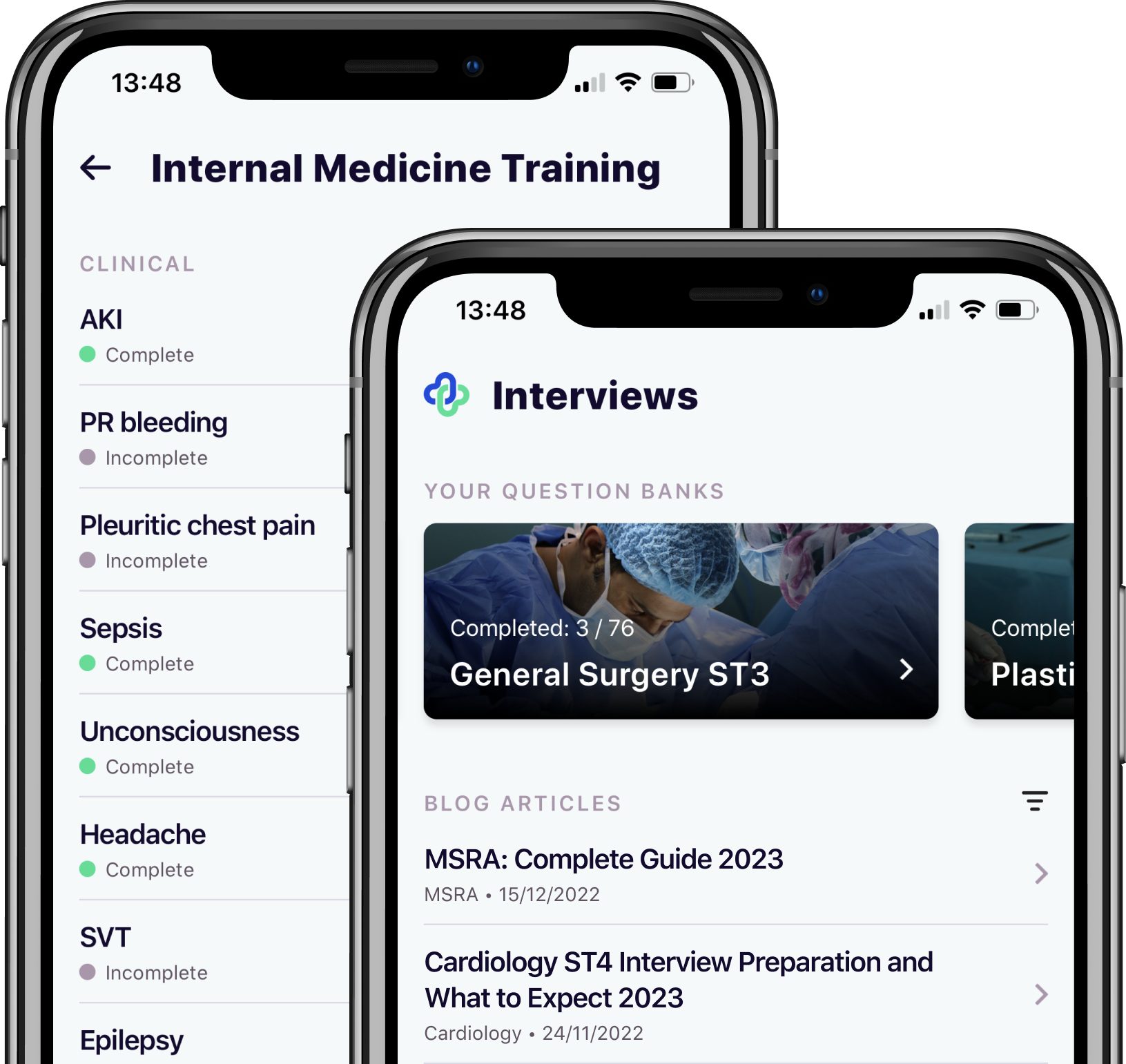
Our mobile app allows you to access your interview and exam question banks wherever you are.