Close
Close

 7th August 2026
Complete Guide to Geriatric Medicine ST4 Application and Recruitment (2026)
The Geriatric Medicine ST4 Application is one of the more competitive higher specialty training routes into UK medical practice, and if you’re thinking about applying in the 2026 round, you’ll want to plan early. This guide is written for UK-based internal medicine trainees who’ve completed (or are finishing) IMT or an equivalent route, hold MRCP(UK), and are ready to enter higher specialty training via national recruitment through Oriel. We’ll walk you through eligibility, the ST4 person specification, the new five-application cap across specialties, self-assessment scoring and portfolio evidence. The interview itself is summarised briefly here and covered in depth on the Geriatric Medicine ST4 Interview Question Bank page. Let’s start with the headline facts.
Key Facts at a Glance
- Competition ratio (2025): 2.06:1 (323 applications for 157 posts, NHS England)
- Training length: Four years (ST4–ST7), leading to dual CCT in Geriatric Medicine and GIM
- Entry requirement: Full MRCP(UK) by offer date, plus completion of IMT stage 1
- Recruitment platform: Oriel, via the Physician Higher Specialty Training (PHST) process
- Shortlisting: Verified self-assessment score on the application form
- 2026 interviews: 10–12 February 2026, with first offers by 31 March 2026
Table of Contents
- What Is Geriatric Medicine ST4 Higher Specialty Training?
- Is Geriatric Medicine ST4 Competitive and What Is the Lifestyle Like?
- Geriatric Medicine ST4 Eligibility Criteria and Entry Requirements
- How to Apply for Geriatric Medicine ST4 National Recruitment
- Geriatric Medicine ST4 Recruitment Timeline and Key Dates (2026)
- Geriatric Medicine ST4 Competition Ratios and Application Trends
- How Geriatric Medicine ST4 Applications Are Scored (2026)
- Geriatric Medicine ST4 Self-Assessment and Portfolio: How to Maximise Your Score
- The Geriatric Medicine ST4 Interview: A Brief Overview
- Geriatric Medicine ST4 Offers, Preferencing and What Happens Next
- Frequently Asked Questions About Geriatric Medicine ST4 Application
- Geriatric Medicine ST4 Useful Resources
What Is Geriatric Medicine ST4 Higher Specialty Training?
Geriatric Medicine higher specialty training is the four-year UK programme you enter at ST4, after completing three years of Internal Medicine Training (IMT stage 1) or an approved equivalent and passing full MRCP(UK). It’s an uncoupled specialty, so you apply competitively through Oriel once you’ve built the required core medicine foundation, and posts run from ST4 through to ST7.
The curriculum in force is the GMC-approved 2022 Geriatric Medicine curriculum, delivered by the Joint Royal Colleges of Physicians Training Board (JRCPTB) on behalf of the three UK Royal Colleges of Physicians. Recruitment is coordinated nationally by NHS England, with equivalent arrangements delivered by NES (Scotland), HEIW (Wales) and NIMDTA (Northern Ireland). Programmes are dual-accredited with General Internal Medicine (GIM), meaning you’ll continue to build GIM competencies and on-call experience alongside your geriatrics training.
Key facts at a glance:
- Programme name: Higher Specialty Training in Geriatric Medicine (ST4–ST7)
- Entry point: ST4, after IMT stage 1 (or equivalent) plus MRCP(UK)
- Duration: Four years full-time (some deaneries advertise five years to reflect additional GIM or sub-specialty time)
- End qualification: CCT in Geriatric Medicine and General Internal Medicine, plus GMC Specialist Register entry
- Required exit exam: Specialty Certificate Examination (SCE) in Geriatric Medicine
- Oversight: JRCPTB (curriculum and ePortfolio); GMC (curriculum approval); NHS England/NES/HEIW/NIMDTA (delivery)
Once you’ve got your CCT, you can pursue consultant posts across acute, community and sub-specialty geriatrics, including stroke medicine (a formally recognised sub-specialty needing an extra six months), orthogeriatrics, perioperative medicine, front-door frailty, falls, movement disorders and oncogeriatrics. For the latest year-specific detail, always cross-check the current ST4 person specification and 2022 curriculum documents.
Is Geriatric Medicine ST4 Competitive and What Is the Lifestyle Like?
Geriatric Medicine sits in an interesting spot. It’s the largest physician specialty in the UK by consultant numbers, demand is growing with an ageing population, and competition at ST4 has historically been more manageable than glamour specialties like cardiology or GI. That doesn’t mean it’s a soft option. Recruiters are looking for genuine commitment to older people’s care, not candidates using it as a fallback.
Lifestyle and on-call: Because ST4 entry is a Group 1 dual programme with General Internal Medicine, you’ll carry the medical registrar bleep alongside your geriatrics work. Expect a substantial acute take, with rotas typically around 1-in-7 to 1-in-8 based on consultant job plans, though registrar rotas vary by trust and are not formally published for ST4 specifically. Outside acute shifts, the work is comparatively predictable: ward rounds, comprehensive geriatric assessment, MDT meetings and clinics in falls, memory, movement disorders, orthogeriatrics or stroke. Trainee accounts (BGS TPD surveys, 2023 and 2025) flag workload and the GIM take as the main pressure points, rather than the geriatrics side itself.
LTFT is genuinely accessible: The 2022 curriculum confirms every competency can be achieved less-than-full-time, and in some regions over a third of registrars train LTFT, one of the higher rates across medicine.
Salary: On the 2024/25 resident doctor scales, ST4 sits at nodal point 4 (~£65,048 basic), rising to ~£73,992 at ST6–ST8, plus London weighting and on-call supplements.
Career trajectory: Higher training runs four years (five with full stroke sub-specialty), leading to CCT in Geriatric Medicine and GIM. Consultant posts remain plentiful, with sub-specialty options in stroke, orthogeriatrics, community geriatrics, perioperative medicine and more.
Geriatric Medicine ST4 Eligibility Criteria and Entry Requirements
Geriatric Medicine is a Group 1 specialty that recruits at ST4, so eligibility is built around completing Internal Medicine Training (IMT) and demonstrating your progress through MRCP(UK). Exact criteria are set out in the annual Person Specification published by NHS England (Workforce, Training and Education), which applies across England, Scotland, Wales and Northern Ireland. Worth cross-checking against the current-year handbook before you apply.
Here’s what you’ll need to be eligible for entry in 2026:
- Medical degree: MBBS or an equivalent primary medical qualification.
- Registration: Full GMC registration with a current licence to practise at the time of application. International medical graduates typically achieve this via PLAB or an accepted postgraduate qualification, plus evidence of English (IELTS 7.5 overall with 7.0 in each component, or OET grade B).
- Postgraduate exams: MRCP(UK) Part 1 by the time of application and the full MRCP(UK) diploma by the offer date. Equivalent routes include eligibility for the GIM Specialist Register, or completion of Irish Basic Specialty Training with the full MRCPI diploma by offer.
- Prior training: Successful completion of three years of Internal Medicine Training (or equivalent), including Foundation training or an equivalent internship at the start of your career.
- Competence sign-off: Evidence of achievement of Internal Medicine capabilities. UK trainees will use their IMT ARCP outcome; IMGs and those outside the standard route must submit the JRCPTB Alternative Certificate of Core Competence signed by a suitable clinical supervisor.
- Right to work: Valid right to work in the UK at appointment; the Skilled Worker route (including the Health and Care Visa) is available with a Certificate of Sponsorship from your employing trust.
There’s no upper cap on prior experience, and no separate specialty aptitude test. Geriatric Medicine relies on the MRCP(UK) and IMT competencies. If you’re an IMG without a UK IMT ARCP outcome, plan the Alternative Certificate of Core Competence early, as gathering supervisor sign-off retrospectively can be the slowest part of the process.
How to Apply for Geriatric Medicine ST4 National Recruitment
Applications for Geriatric Medicine ST4 are run centrally through Physician Higher Specialty Training (PHST) on the Oriel portal, with the same person specification used across England, Scotland, Wales and Northern Ireland. The steps below reflect the 2026 Round 1 process. Always cross-check the PHST 2026 Applicant Handbook and your national recruitment office (NHS England, ScotMT, NIMDTA or Wales) for the definitive detail before you submit anything.
- Register on Oriel: Set up your account well before applications open (Round 1 applications for August 2026 posts opened on 20 November 2025 and closed in mid-December 2025). One profile carries across all your specialty applications.
- Check eligibility against the 2026 person spec: You’ll need MBBS, GMC registration with a licence to practise, MRCP(UK) Part 1 held at the point of application, and three years of Internal Medicine Training (or accepted equivalent). Full MRCP(UK) must be evidenced by the offer date.
- Understand the five-application cap: For 2026, NHS England has limited applicants to a maximum of five specialty applications across Oriel in a single round. Geriatric Medicine ST4 counts as one of those five, so choose deliberately.
- Complete the application form: Sections cover personal details, immigration and right-to-work status, qualifications, employment history, fitness to practise declarations, referees, and, critically, the self-assessment domains (qualifications, publications, presentations, teaching, quality improvement, leadership). This self-assessment score drives shortlisting.
- Nominate three referees: Referees should cover your last two years of clinical work, with one being your current or most recent consultant or educational supervisor. References are usually requested later in the process rather than at submission.
- Prepare supporting documents: You’ll be asked for evidence of identity, MBBS, MRCP(UK) progress, GMC registration and IMT Stage 1 completion (or equivalent). Have digital copies ready to upload.
- Rank your programmes: Within your single Geriatric Medicine ST4 application, you can preference all available regional programmes across the UK in order. This is separate from the five-application cap.
- Submit before the deadline: There’s no application fee for Oriel itself, though JRCPTB enrolment fees (~£356 initial, plus a further ~£178 instalment) and RCP collegiate membership apply once you’re in post.
If you’re reapplying after leaving or being unsuccessful from within a UK training programme, you’ll need a signed Support for Reapplication form from your Training Programme Director or Head of School. There’s no lifetime cap on attempts, and appeals are available on procedural grounds only, not against clinical scoring judgements.
Geriatric Medicine ST4 Recruitment Timeline and Key Dates (2026)
Geriatric Medicine ST4 is a Round 1 physician higher specialty training post recruited nationally through Oriel, coordinated by Physician Higher Specialty Training (PHST) for England, Wales and Northern Ireland, with Scotland running its own parallel timeline. The evidence upload step happens in a discrete window after applications close, so the dates below aren’t a single continuous block. Put them all in your calendar now.
Here’s what the 2026 cycle looks like for August 2026 posts:
| Stage | Date (2026 round) |
|---|---|
| Applications open (Round 1, Oriel) | 20 November 2025, 10:00 |
| Applications close | Mid-December 2025 |
| Evidence / self-assessment upload window | Published on the PHST Geriatric Medicine page; in 2025 this ran 30 May–6 June |
| Shortlisting outcomes & interview invitations | No later than 7 days before your interview date |
| Interviews (Geriatric Medicine) | 10–12 February 2026 |
| Initial offers released | By 31 March 2026 |
| Offer hold deadline | 13:00, Thursday 2 April 2026 |
| Upgrade deadline | 16:00, Thursday 9 April 2026 (per ScotMT key dates, always confirm on Oriel) |
| First offers deadline (cascade) | 17:00, Tuesday 14 April 2026 |
A couple of things worth flagging. Scotland recruits separately: in 2025 its ST4 Geriatric Medicine advert opened on 15 May, so if you’re targeting Scottish posts, track the ScotMT timeline alongside PHST. Academic Clinical Fellowship posts (like Leeds ACF) close much earlier, sometimes by 31 October. Dates for 2026 are drawn from NHS England, ScotMT and PHST publications. Check the PHST specialty page closer to the round for the definitive Geriatric Medicine timings.
Geriatric Medicine ST4 Competition Ratios and Application Trends
Geriatric Medicine sits among the less competitive higher specialty entries in the UK, and the numbers back that up. According to NHS England’s Medical Hub competition ratios, the 2025 round attracted 323 applications for 157 UK posts, giving a national ratio of roughly 2.06:1. That’s a slight rise from 2024, when 281 applicants competed for 161 posts (about 1.75:1).
| Year | Applications | Posts | Ratio |
|---|---|---|---|
| 2024 | 281 | 161 | 1.75:1 |
| 2025 | 323 | 157 | 2.06:1 |
Source: NHS England competition ratios.
The headline ratio only tells half the story. Despite more applicants in 2025, the specialty remained under-recruited: NHS England’s fill-rate data show only 107 of 133 English posts were accepted, an overall fill rate of around 80%. The British Geriatrics Society has flagged persistent under-fill for several years running (roughly 83% in 2023 and 73% in 2024).
Regional variation is striking. In 2023, BGS reported that Peninsula filled only about 29% of its posts at Round 1 and Kent, Surrey and Sussex around 38%, even while London and other flagship rotations were far more sought after. If you’re geographically flexible, this matters: your realistic odds of landing a training number are much better than the national ratio suggests, but competition for the most popular deaneries is meaningfully tougher than the 2.06:1 headline.
How Geriatric Medicine ST4 Applications Are Scored (2026)
Geriatric Medicine ST4 recruitment runs through Physician Higher Specialty Training (PHST), and the scoring framework has two distinct stages that feed into your final ranking. It’s important to understand that these two stages are separate scoring pools (they aren’t added together) and they reward quite different things.
Stage 1: Self-assessment for shortlisting only
Once you’ve cleared the eligibility check (MRCP(UK), completion of Internal Medicine Training or equivalent, and the other essential criteria on the 2026 NHS England person specification), your Oriel application is scored against a self-assessment grid. According to PHST, roughly 38 points are available across the portfolio self-assessment domains, and this verified self-assessment score is used solely to decide who is shortlisted for interview. It does not carry forward into your final ranked score.
The self-assessment domains are:
| Self-assessment domain | What it captures |
|---|---|
| Postgraduate qualifications | Higher degrees (PhD, MD, Masters), diplomas |
| Presentations and posters | Local, national and international; oral vs poster |
| Publications | Peer-reviewed vs non-peer-reviewed, authorship position |
| Teaching experience | Sessions delivered, feedback, teaching qualifications, programme design |
| Quality improvement and audit | Completed cycles, leadership role, methodology |
| Leadership and management | Formal roles, project leadership |
| Commitment to specialty | Geriatrics-specific experience, courses, taster weeks |
PHST publishes historical shortlist score distributions for Geriatric Medicine, so you can benchmark where a competitive score has typically sat. The detailed rules for each domain, including how to evidence claims and where candidates most often lose easy marks, are in the next section.
Stage 2: Interview scoring drives final ranking
Once you’re shortlisted, the final ranking is driven by the interview alone. This is a completely separate scoring pool from the self-assessment above. For Geriatric Medicine ST4, PHST uses ten scored stations, each marked 1 to 5, giving a Raw Interview Score (RIS) between 10 and 50. Weighting is then applied on top of the raw score to produce a Weighted Interview Score out of 80, which determines your rank order for offers. PHST doesn’t publish the exact per-domain multipliers for 2026.
To be appointable, you need to hit three thresholds:
- No station scored 1/5
- No more than two stations scored 2/5
- A total RIS of at least 30
Because the interview carries the ranking weight, this is where offers are effectively decided. We keep the interview detail out of this guide. The Geriatric Medicine ST4 Interview Question Bank walks through the stations, scoring descriptors and worked model answers. Below, we focus on where you can bank the most self-assessment points in the months before applications open.
Geriatric Medicine ST4 Self-Assessment and Portfolio: How to Maximise Your Score
Shortlisting for Geriatric Medicine ST4 is driven by a Physician Higher Specialty Training (PHST) self-assessment form scored across around ten domains, each rated on a 1–5 scale and combined into a Ranked Index Score. With historical shortlist score distributions published by PHST going back to 2013, you can see exactly where the competitive threshold has sat, which makes targeted portfolio-building genuinely worthwhile.
The domains that actually score
In recent PHST rounds, the self-assessment for Geriatric Medicine ST4 has covered:
- Additional qualifications (intercalated degrees, MSc, MD, PhD, PGCert in Medical Education)
- Publications (peer-reviewed, PubMed-indexed, with DOIs)
- Presentations and posters (international > national > regional)
- Teaching experience and training in teaching
- Quality improvement and audit
- Leadership and management
- Commitment to specialty (evidence of sustained engagement with geriatric medicine)
There is no operative logbook or procedural count. Those competencies sit inside the Internal Medicine Training stage 2 curriculum and your ARCP, not the ST4 form. Similarly, there is no scored domain for elective duration or taster weeks in geriatrics; eligibility rests on 24 months in medical specialties including 12 months of acute unselected take.
Where candidates lose easy points
Every claim you make must be backed by uploaded documentary evidence at the time of application via Oriel. Unverifiable evidence gets scored down to zero at verification. Common self-inflicted losses include:
- Do upload signed educational supervisor letters for teaching, QI and leadership claims, not just your own reflection
- Do include the DOI and full citation for every publication; verifiers check PubMed
- Do hold acceptance emails and programmes for every presentation you claim
- Don’t over-claim a domain band you can’t fully evidence: one dropped domain can cost you an interview
- Don’t count in-house departmental teaching as “training in teaching”. That domain wants a course certificate or PGCert-level qualification
Build evidence before applications open
Treat the summer before applying as your evidence-gathering window. Get a QI project written up and presented regionally, submit a case report or review to a peer-reviewed journal, complete a recognised “training the trainers” course if you haven’t already, and ask your educational supervisor for a signed teaching log now rather than in December. The British Geriatrics Society trainee events are a straightforward way to demonstrate commitment to specialty in a domain that’s otherwise hard to evidence on paper. If you’re still working on the exam side, the Medibuddy MRCP guides cover how to time your PACES attempt around the application window.
The Geriatric Medicine ST4 Interview: A Brief Overview
Once you’ve cleared longlisting and shortlisting, the next stage is the national selection interview, coordinated by the Physician Higher Specialty Training (PHST) office on behalf of JRCPTB. For Geriatric Medicine ST4, this is run online as a structured, multi-station panel rather than a single sit-down interview.
Expect a total interview time of 40 minutes, split across stations with different pairs of interviewers scoring different domains (clinical and non-clinical), and a separate mark for communication. Because it’s remote, you’ll need a quiet, well-lit space and a stable connection on the day. Exact station numbers and timings can shift year to year, so always check the current PHST guidance closer to your interview date.
We’ve kept this section deliberately short because the full station-by-station breakdown, domain scoring and practice questions live on a dedicated page.
Preparing for the interview? Head to the Geriatric Medicine ST4 Interview Question Bank for the full format, worked scenarios and model answers from high-scoring trainees.
Geriatric Medicine ST4 Offers, Preferencing and What Happens Next
Once interviews are done, the offers stage runs through Oriel and is coordinated by the Physician Higher Specialty Training (PHST) recruitment office on behalf of JRCPTB. Here’s what generally happens from your interview to your ST4 start date:
- Appointability decision: Your interview score is combined with the panel’s judgement, and if you’re deemed appointable you enter the ranked pool for Geriatric Medicine ST4.
- Preference ranking: After the interview, appointable candidates rank deaneries (across England, Scotland and Wales; Northern Ireland runs its own process via NIMDTA). You don’t pre-rank regions before knowing you’re appointable.
- Initial offer: Offers are released via Oriel based on your rank against your preference list. You’ll typically have a short response window to accept, accept with upgrades, hold, or decline.
- Hold-down and upgrades: Choosing “accept with upgrades” means Oriel will automatically move you to a higher-ranked preference if one becomes available before the upgrade deadline. The ScotMT key-dates page cites 4pm on Thursday 9 April 2026 for the 2026 round, while some PHST cascade documents reference a later date. Always confirm the current deadline on Oriel.
- Post-upgrade window: After the upgrade deadline, offers become fixed, and any late offers from the reserve list no longer carry the hold-with-upgrades option.
- Pre-employment checks and start: Your allocated deanery picks up onboarding, and most ST4 posts start in early August.
Worth knowing: around half of ST4 geriatric trainees train less-than-full-time in reporting deaneries (BGS data), so LTFT conversations with your deanery are genuinely well-trodden.
Frequently Asked Questions About Geriatric Medicine ST4 Application
How competitive is Geriatric Medicine ST4?
Geriatric Medicine ST4 remains one of the less competitive medical specialties. NHS England figures show the 2025 round had 323 applications for 157 posts, a ratio of 2.06:1, up slightly from 1.75:1 in 2024 (281 applications, 161 posts). Not all posts were filled in 2025, so the specialty is currently undersubscribed relative to workforce demand.
Who is eligible to apply for Geriatric Medicine ST4?
You need MBBS or equivalent, full GMC registration with a licence to practise, and completion of Foundation training plus three years of Internal Medicine Training (or an equivalent certificate of competence). MRCP(UK) Part 1 is required at the point of application, with the full MRCP(UK) diploma held by the offer date. Alternative routes include Irish Basic Specialty Training with full MRCPI, or GIM specialist register eligibility.
Do I need full MRCP(UK) to apply?
You need MRCP(UK) Part 1 at the time of application, but the full MRCP(UK) diploma must be held by the offer date, not the application deadline. This matters for timing: candidates sitting PACES in the winter or spring diet can still apply, provided they’ll have the full diploma before offers are released. The requirement is set in the NHS England Person Specification.
How does the Geriatric Medicine ST4 application process work?
Applications run through Oriel, the national NHS recruitment portal, under the Physician Higher Specialty Training (PHST) process on behalf of JRCPTB. You submit one application and preference regions rather than applying trust-by-trust. Eligible applicants are ranked on a verified self-assessment score, and the highest-ranked candidates are invited to interview. Scotland and Northern Ireland (NIMDTA) run coordinated regional recruitment within the same framework.
What counts in the Geriatric Medicine ST4 self-assessment?
The self-assessment scores domains including postgraduate degrees, additional qualifications, teaching experience and training in teaching, quality improvement, research and publications, presentations, prizes, and leadership. Formal teaching qualifications (from short accredited courses up to a PGCert or Masters in Medical Education) are recognised as desirable but not essential. Every score you claim must be backed by verifiable evidence, or it will be adjusted down at verification.
How many Geriatric Medicine ST4 posts are available?
Post numbers are set annually and published by NHS England on the Medical Hub, with indicative regional splits on the PHST Recruitment site. In 2025 there were 157 UK-wide posts (133 in England), and 2024 had 161 posts. Numbers reflect ongoing workforce expansion in geriatric medicine but vary by deanery each cycle.
Can I upgrade my Geriatric Medicine ST4 offer to a higher preference?
Yes. When you accept or hold an offer, you can opt to “hold with upgrades”. If a higher-ranked preference becomes available before the upgrade deadline, your offer is moved to it automatically with no action needed from you. The published 2026 upgrade deadline (per ScotMT) is 4pm on Thursday 9 April 2026. Always confirm the current deadline on Oriel. Once the deadline passes, upgrades stop.
Can I reapply if my Geriatric Medicine ST4 application is unsuccessful?
Yes, there’s no lifetime cap on how many times you can apply. However, if you’re reapplying after an unsuccessful attempt from within a UK training programme, or after prematurely leaving one, you’ll need to submit a Support for Reapplication to a Specialty Training Programme form signed by your Training Programme Director or Head of School. Appeals against the recruitment process itself are only possible on procedural grounds (i.e. evidence that published processes weren’t followed), not against selection scores or clinical judgement. Feedback on interview performance is usually released via Oriel after the round closes.
Geriatric Medicine ST4 Useful Resources
When you’re pulling your application together, it helps to have the authoritative sources bookmarked in one place. Here are the ones we’d point every ST4 applicant towards.
Official recruitment and person specification
- NHS England Geriatric Medicine ST4 2026 Person Specification: the definitive entry criteria
- PHST Recruitment Geriatric Medicine page: the national lead recruiter’s specialty hub
- Oriel: where you actually apply
- Scottish Medical Training ST4 Geriatric Medicine Applicant Guide: if you’re applying in Scotland
Specialty body and curriculum
- British Geriatrics Society ST application FAQs
- BGS Trainees Council and @bgstrainees social channels
- BGS Silver Book II: flagship reference on urgent care for older people
- JRCPTB Geriatric Medicine curriculum (linked from the PHST page)
Peer discussion
- r/doctorsUK on Reddit runs recurring ST4 offer and cycle threads each round
Medibuddy guides
- Geriatric Medicine ST4 Interview Question Bank: scenario questions with model answers
Applying for higher specialty training in older people’s medicine is a big step, but it’s absolutely doable when you approach it methodically. Get familiar with the NHS England ST4 person specification early, build your self-assessment evidence around the domains that actually score, and treat the portfolio as an ongoing project rather than a last-minute scramble. When you’re ready to shift focus to the interview, the Geriatric Medicine ST4 Interview Question Bank has scenario questions with model answers put together by high-scoring trainees, so you can walk in feeling prepared. Good luck, we’re rooting for you.
Take your subscriptions with you
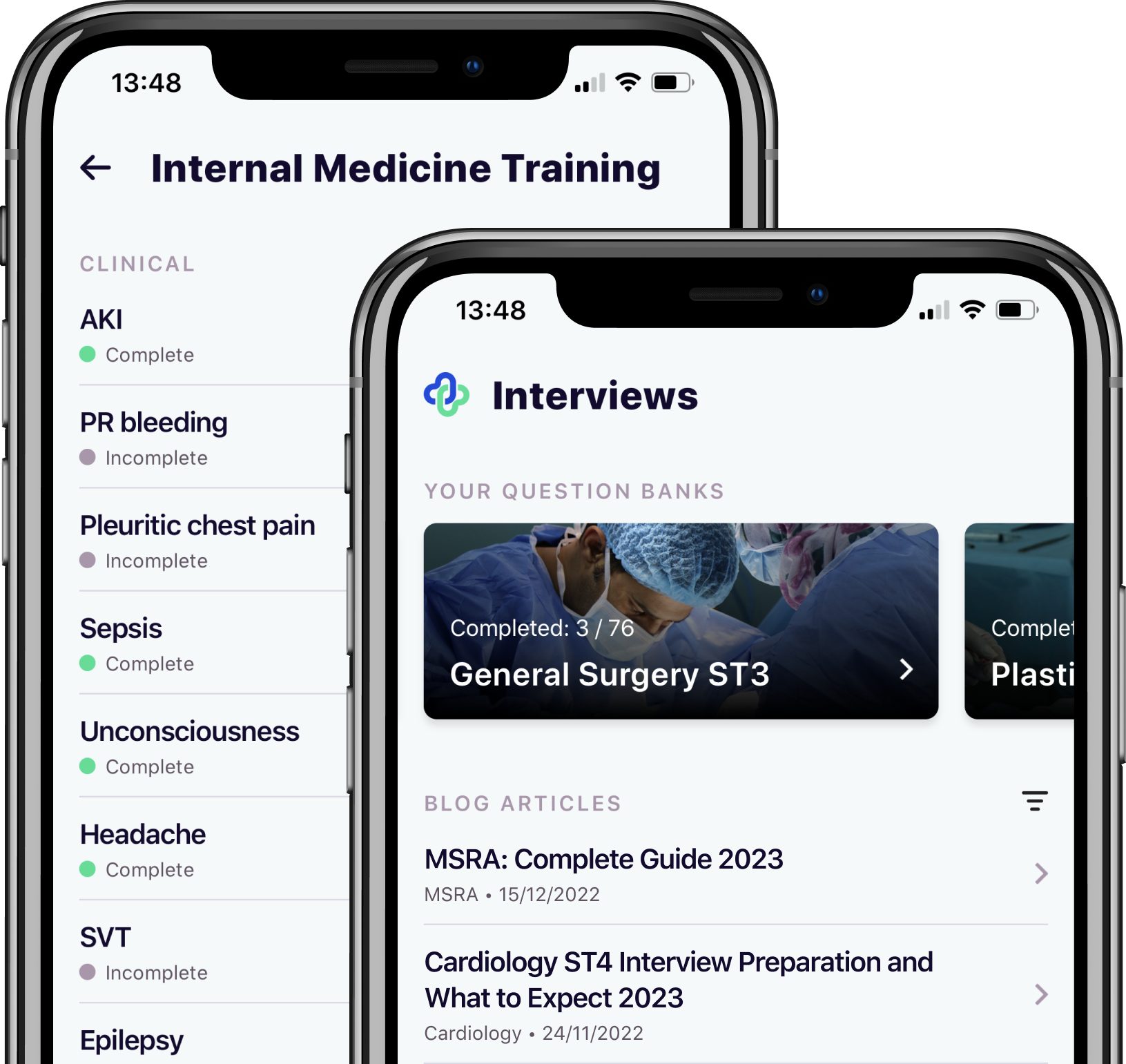
Our mobile app allows you to access your interview and exam question banks wherever you are.