


 Close
Close
 30th July 2026
Diagnosis
Definition
- SJS: <10% TBSA (total body surface area) affected
- SJS/TEN overlap: 10%-30% TBSA (total body surface area) affected
- TEN: >30% body surface area TBSA (total body surface area) affected
Classification may change as the presentation evolves in the earlier phases.
Routine drug testing is not recommended but may be considered in circumstances where the trigger is unknown, or accidental exposure to the drug is possible.
Clinical manifestations
Diagnosis is largely clinical and with presentation evolving in the initial phases of the disease.
Non-specific symptoms include sore throat, fever, headache, arthralgia, vomiting/diarrhoea, and lethargy. These are followed by mucocutaneous disease which peaks at 4 days.
Skin lesions include erythema, blistering which coalesces to form large areas of skin detachment, and macules or purpuric spots.
Mucosal lesions may cause conjunctivitis, oral ulceration and crusted lips, genital ulceration and urinary symptoms, dysphagia and diarrhoea (due to GI tract ulceration), and respiratory symptoms.
Investigations
- Full blood count: anaemia, leucopenia
- Urea and electrolytes
- Liver function tests: mildly raised liver enzymes
- Coagulation profile
- Skin biopsy: histopathology shows epidermal necrosis, keratinocyte necrosis, minimal lymphocytic infiltrate in the dermis.
- Serum granulysin: elevated in initial phase
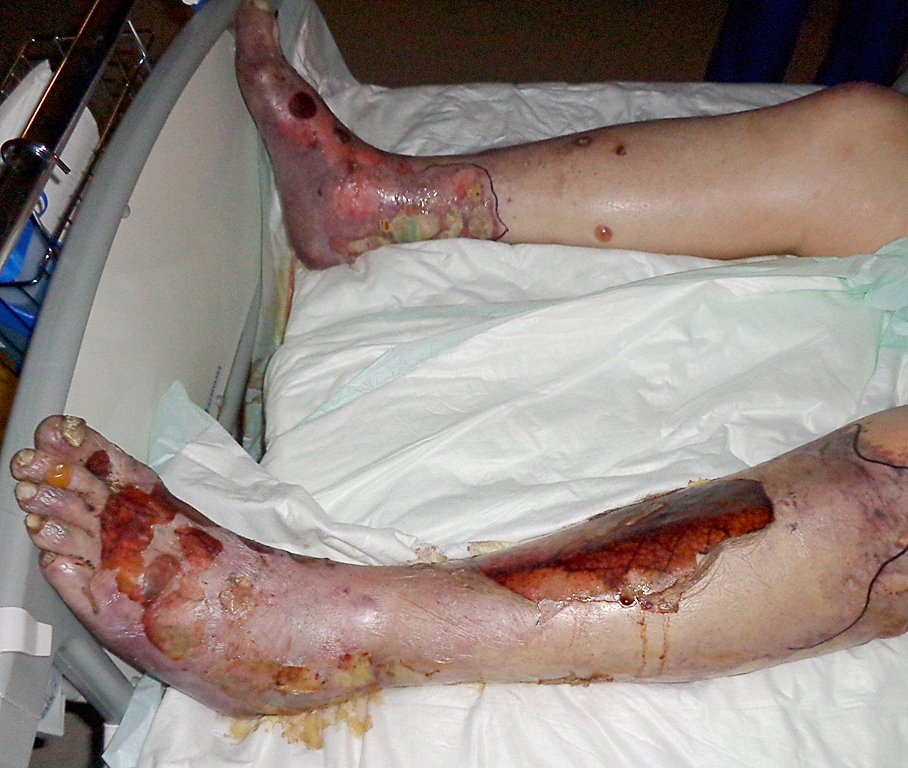
Skin detachment in the lower limbs secondary to TEN.
Image Source: Wikimedia Commons (2017). Necrolysis Epidermalix Toxica, Licensed under a creative commons licence. Available for free at: https://commons.wikimedia.org/wiki/File:Necrolysis_epidemalis_toxica_02.JPG (Accessed 19 May 2025).
Prognostic criteria
Two prognostic models exist, the SCORTON (SCORe of Toxic Epidermal Necrolysis) score and the ABCD 10 score. Both scores predict in-hospital risk of mortality.
SCORTON score
A score of 1 point is given for each of the following criteria:
- Age > 40 years
- Malignancy
- Heart rate > 140 beats per minute
- Body surface area detachment is > 10% at presentation
- Serum urea level > 10mmol/L
- Serum glucose > 14mmol/L
- Serum bicarbonate < 20mmol/L
| Score | Percentage risk of mortality (%) |
|---|---|
| 0 – 1 | 3.2 |
| 2 | 12.1 |
| 3 | 35.3 |
| 4 | 58.3 |
| 5 | > 90 |
Table 4: SCORTON scoring and associated mortality
ABCD 10 score
Points are allocated based on the following criteria:
- A: age > 50 years (1 point)
- B: bicarbonate > 20mmol/L
- C: cancer present and active (2 points)
- D: dialysis prior to admission (3 points)
- 10: epidermal detachment > 10% of BSA (1 point)
| Score | Percentage risk (%) |
|---|---|
| 0 | 2.3 |
| 1 | 5.4 |
| 2 | 12.3 |
| 3 | 25.5 |
| 4 | 45.7 |
| 5 | 67.4 |
| 6 | 83.6 |
Table 5: ABCD10 score and associated risk mortality
Complete Guide to Clinical Genetics ST3 Application and Recruitment (2027)
Written by Medibuddy. Last updated: October 2026. Clinical Genetics is

Complete Guide to Clinical Radiology ST3 Application and Recruitment (2027)
Recruitment paused: NHS England is not running Clinical Radiology ST3+ recru

Complete Guide to Paediatric Surgery ST3 Application and Recruitment in United Kingdom (2026)
Written by Medibuddy. Last updated: October 2026. If you’re planning


Take your subscriptions with you
Our mobile app allows you to access your interview and exam question banks wherever you are.

