Close
Close

 5th August 2026
Complete Guide to Oral and Maxillofacial Surgery ST1 Application and Recruitment (2026)
If you’re putting together your Oral and Maxillofacial Surgery ST1 application for 2026 entry, you’re stepping into one of the UK’s most distinctive surgical pathways: the only specialty that requires dual qualification in both medicine and dentistry. This guide walks you through what you need to know about the application itself: eligibility, National Recruitment for OMFS ST1 on Oriel, self-assessment scoring, portfolio evidence, and how the run-through ST1 route sits alongside the traditional Core Surgical Training into ST3 pathway. We’ll also touch briefly on the interview, but for a full station-by-station breakdown and practice questions with model answers, head to the Oral and Maxillofacial Surgery ST1 Interview Question Bank. First, here’s what the process looks like at a glance.
Key Facts at a Glance
- Competition ratio (2025): 3.5:1 (77 applications for 22 posts)
- Training length: ST1–ST7 run-through, around 72 months to CCT
- Core entry requirement: both a medical (MBBS) and dental (BDS) degree
- Registration: full GMC registration with a licence to practise
- Shortlisting (2026): none. All eligible applicants invited to interview
- Interview: virtual, scheduled for 2 February 2026 (verify on Oriel)
Table of Contents
- What Is Oral and Maxillofacial Surgery ST1 Higher Specialty Training?
- Is Oral and Maxillofacial Surgery ST1 Competitive and What Is the Lifestyle Like?
- Oral and Maxillofacial Surgery ST1 Eligibility Criteria and Entry Requirements
- How to Apply for Oral and Maxillofacial Surgery ST1 National Recruitment
- Oral and Maxillofacial Surgery ST1 Recruitment Timeline and Key Dates (2026)
- Oral and Maxillofacial Surgery ST1 Competition Ratios and Application Trends
- How Oral and Maxillofacial Surgery ST1 Applications Are Scored (2026)
- Oral and Maxillofacial Surgery ST1 Self-Assessment and Portfolio: How to Maximise Your Score
- The Oral and Maxillofacial Surgery ST1 Interview: A Brief Overview
- Oral and Maxillofacial Surgery ST1 Offers, Preferencing and What Happens Next
- Frequently Asked Questions About Oral and Maxillofacial Surgery ST1 Application
- Oral and Maxillofacial Surgery ST1 Useful Resources
What Is Oral and Maxillofacial Surgery ST1 Higher Specialty Training?
Oral and Maxillofacial Surgery (OMFS) is the UK surgical specialty dealing with disease, injury and reconstruction of the mouth, jaws, face and neck. It’s genuinely unique among surgical specialties because it requires dual qualification in both medicine and dentistry before you can enter training, a long road, but one that opens the door to a remarkable breadth of practice.
ST1 is the run-through entry point into the OMFS programme. Following the GMC’s approval of run-through training from August 2017, ST1 posts are increasingly the main route in, with recent JCST and NHS England guidance signalling a shift away from the older ST3 direct-entry model. During ST1 and ST2 you complete the Core Surgical Training curriculum competencies (including the opportunity to sit the MRCS) before progressing seamlessly into higher specialty years.
The programme is set by the Intercollegiate Surgical Curriculum Programme (ISCP) (curriculum updated in 2021), overseen by the Joint Committee on Surgical Training (JCST) via its OMFS Specialty Advisory Committee under the four UK Royal Colleges of Surgeons. Recruitment is coordinated nationally by NHS England through Oriel, with BAOMS providing professional guidance alongside.
Rotations vary meaningfully by region (Kent, Surrey and Sussex, West Midlands and North West England each run their own placement structures) even though eligibility and curriculum are set nationally.
Is Oral and Maxillofacial Surgery ST1 Competitive and What Is the Lifestyle Like?
OMFS sits in a genuinely unusual position on the competitiveness map. BAOMS notes it has one of the more favourable application-to-appointment ratios of any UK surgical specialty at ST and consultant level, and direct ST3 entry has historically been undersubscribed. The real bottleneck is earlier: securing a “controlled” shortened second-degree place (in medicine if you’re a dentist, or vice versa) has been reported with ratios anywhere from around 5:1 to 29:1. ST1 run-through posts are also reported as oversubscribed compared with ST3, so competition depends heavily on which door you enter through.
Lifestyle at ST1 is demanding. Trainees join a three-tier non-resident on-call rota covering facial trauma alongside clinics and theatre, with reported frequencies varying between roughly 1 in 5 and 1 in 9 depending on unit. A GMC-commissioned review characterised long hours and heavy on-call as typical of the specialty. Less than full-time training is available at 50% or above, with the programme extended pro rata.
Career trajectory: ST1 is a shorter feeder stage (usually 12 months, up to 24) into the substantive 5-year higher training that traditionally begins at ST3. From ST1, total training is around 7 years; from a medicine-first background, the whole route can take around 11 years post-medical degree, leading to CCT and consultant practice across trauma, head and neck oncology, orthognathic, reconstructive and skin surgery.
Salary (2025/26): ST1–2 basic pay sits at around £52,656, rising to roughly £65,048 at ST3–5 and £73,992 at ST6–8 on the NHS resident doctor scale, before on-call supplements and London weighting.
Oral and Maxillofacial Surgery ST1 Eligibility Criteria and Entry Requirements
One caveat worth flagging up front: the exact wording of each domain can shift between rounds, so always cross-check against the current year’s Person Specification on Oriel before you submit. That’s the single reference document that governs everything below.
OMFS is unusual: it’s the only UK surgical specialty that requires you to be dual-qualified in both medicine and dentistry before you even apply at ST1. That single fact shapes almost everything about eligibility. The formal criteria are set out in the nationally agreed 2026 Person Specification published by NHS England (with matching versions from Scotland MDRS and HEIW in Wales), and you’ll be checked against it before your application is shortlisted.
Here’s what you need in place to be eligible for ST1 in the 2026 round:
- A primary medical qualification (MBBS/BMBS or equivalent) with full GMC registration and a licence to practise at the point the post starts.
- A registrable dental qualification (BDS or equivalent) with full GDC registration (or a UK-registerable dental qualification by the post start date). This is the defining OMFS requirement and the most common stumbling block for overseas applicants, whose dental degrees may need separate GDC recognition.
- Evidence of Foundation Programme competences, typically completion of F1 plus demonstration of F2-level competences, or an equivalent 12 months of post-registration medical experience. You’ll need a signed Certificate of Readiness to Enter Specialty Training (or equivalent) from your Foundation Programme Director or educational supervisor. See our Foundation Programme guide if you’re mapping your evidence.
- English language competence to GMC/GDC standards, usually IELTS Academic 7.5 overall (7.0 in each domain) or OET Grade B, unless you qualify for an alternative evidence route.
- Eligibility to work in the UK, or a valid sponsorship route (usually the Skilled Worker/Health and Care Visa).
- Good Medical Practice standards: no unresolved fitness-to-practise concerns.
A quick note on what you don’t need at ST1: MRCS is not required at this stage (it’s an ST3 entry requirement in many surgical specialties), and there’s no separate national aptitude exam like the MSRA for OMFS. Membership exams such as MFDS, MJDF and MRCS can still earn you self-assessment points, but they’re not gatekeepers.
How to Apply for Oral and Maxillofacial Surgery ST1 National Recruitment
National Recruitment for OMFS ST1 runs as a single annual round through Oriel, coordinated by NHS England. A phased shift in OMFS recruitment has been flagged from October 2025 onwards, so it’s worth verifying the specifics in the current OMFS ST1 applicant handbook before you submit.
- Confirm eligibility before you start: You’ll need both medical and dental primary qualifications (BDS and MBBS or equivalents), GMC and GDC registration, achievement of Foundation Programme competences, and evidence of English language proficiency. Helpfully, the second degree only needs to be held at post commencement, not at application, so you can apply during your final year.
- Register on Oriel: Applications are submitted at oriel.nhs.uk, free of charge. There’s no application fee for OMFS ST1, though budget for interview travel and evidence-gathering.
- Note the national five-application cap: For 2026 Round 1, NHS England has introduced a maximum of five specialty applications per candidate across all specialties. Academic Clinical Fellowship applications are separately capped at three per round. Choose deliberately.
- Complete the form sections: The Oriel application covers personal details, qualifications, employment history, GMC/GDC registration, foundation competences, referee details (references are sought later; you can amend referees via the “My Applications” tab), and the OMFS-specific supporting information and self-assessment section aligned to the person specification.
- Prepare supporting documents: You don’t upload references at submission, but you’ll need originals of your medical and dental degree certificates, GMC/GDC registration, evidence of foundation competences, ID and right-to-work documents ready for verification at interview.
- Submit before the deadline: The 2026 Round 1 window opened at 10:00 GMT on 23 October 2025 and closed at 16:00 GMT on 20 November 2025 (Scotland’s timings vary slightly).
- Rank programme preferences: Within the OMFS ST1 vacancy on Oriel, you rank deaneries in order of preference. First offers across Round 1 are expected by 31 March 2026, with posts starting 5 August 2026.
Reapplication: There’s no published cap on the number of times you can reapply in future cycles. Individual feedback is released via Oriel after the round. If you’ve previously held or resigned from a specialty training post, you must submit a signed Reapplication to Specialty Training form. Formal appeals go through the lead recruiting deanery’s published complaints policy.
Once your form is in, attention shifts to the interview, covered in the next section.
Oral and Maxillofacial Surgery ST1 Recruitment Timeline and Key Dates (2026)
Because OMFS ST1 is a small national round with a dual-qualification applicant pool, the timeline moves quickly and there’s very little slack once applications close. NHS England runs recruitment through Oriel as part of Round 1, so the shape of the year follows the standard national schedule, with interviews sitting in early February and offers landing by the end of March.
From October 2025 a phased change to the OMFS recruitment model is being introduced, so a couple of the intermediate dates below are indicative rather than confirmed. If in doubt, the live Oriel vacancy always trumps everything else. Set an alert for the OMFS ST1 vacancy the moment applications open and track your Oriel messages daily during offer and upgrade weeks.
Here are the key dates for the 2026 cycle (August 2026 posts):
| Stage | Date (2026 cycle) |
|---|---|
| Applications open (Oriel) | 23 October 2025 |
| Applications close | 20 November 2025 |
| Evidence upload window | 2–9 January 2026 (indicative, confirm on Oriel) |
| Interview invitations issued | January 2026 |
| National interview (virtual) | 2 February 2026 |
| First offers released | By 31 March 2026 |
| Offer upgrade deadline (Scotland-published) | 4pm, 9 April 2026 |
| Reserve-list offers may continue | Up to ~3 months post-round |
| Post start date | August 2026 |
Dates are drawn from NHS England, ScotMT and Oriel-linked sources for the 2026 round. No official NHS England or BAOMS source has published an OMFS ST1-specific evidence-upload window; the 2–9 January dates above are drawn from third-party sources and should be confirmed via Oriel when applications close.
For 2026 there’s no shortlisting (all eligible candidates are invited to interview) so once applications close, the next thing you’re waiting on is your Oriel invitation in January.
Oral and Maxillofacial Surgery ST1 Competition Ratios and Application Trends
OMFS ST1 has long been one of the less competitive surgical entry points in the UK, largely because of the dual medicine-and-dentistry requirement rather than any lack of enthusiasm for the specialty. That said, the picture is shifting, and the most recent cycle shows a noticeable jump in applicant numbers.
Here’s how the last few rounds have looked, drawn from NHS England’s published competition ratios and the 2024 BJOMS review by Dennis et al.:
| Year | Applications | Posts | Ratio |
|---|---|---|---|
| 2022 | 34 | 14 | 2.43:1 |
| 2023 | ~57 | 18 | 3.17:1 (91% fill rate) |
| 2024 | 34 | 18 | 1.89:1 |
| 2025 | 77 | 22 | 3.5:1 |
The headline figure for 2025 (77 applications for 22 posts) is a marked step up from 2024’s 1.89:1. Across recent rounds, the BJOMS review reports ST1 ratios ranging between roughly 2.4:1 and 6.3:1, so year-to-year fluctuation is normal when national post numbers are small.
For the August 2026 intake, around 17 OMFS ST1 vacancies have been indicated nationally. With such small numbers, a handful of extra applicants moves the ratio significantly, and competitiveness can vary sharply between deaneries even though NHS England only publishes national totals. In practical terms: don’t be lulled by the low headline ratio. Every self-assessment and portfolio point still matters. The Oral and Maxillofacial Surgery ST1 Interview Question Bank has scenario practice you can use to push each domain further.
How Oral and Maxillofacial Surgery ST1 Applications Are Scored (2026)
OMFS ST1 selection uses a national scored framework run through Oriel against the NHS England person specification. Two components drive your overall score: a self-assessment portfolio (verified by a consultant panel) and the interview. Notably, OMFS ST1 does not use the MSRA, which shifts a lot of weight onto your evidenced portfolio and interview performance. There’s also no shortlisting for 2026 (all eligible candidates are interviewed) so the self-assessment score doesn’t gatekeep the interview, but it does contribute to your final ranking.
The scored domains
You self-score each domain on Oriel and upload evidence during the January 2026 window. Within a domain you can generally only claim your single highest-scoring achievement (the exceptions being OMFS educational activity and commitment to specialty, where multiple entries are allowed).
| Domain | What it captures | Top-scoring evidence looks like |
|---|---|---|
| Additional degrees | PhD/MD by research, Masters, intercalated | PhD or MD by research (beyond your primary medicine/dentistry degrees) |
| Publications | Peer-reviewed papers, PubMed-indexed | First-author, peer-reviewed original research |
| Presentations | Oral and poster, local to international | Oral presentation at an international meeting |
| Prizes and awards | Academic and clinical | National-level prize relevant to surgery/OMFS |
| Audit and QIP | Cycle completion, leadership | Led project with completed re-audit demonstrating change |
| Teaching | Delivery, design, feedback | Designed and ran a structured programme with formal feedback |
| Commitment to OMFS | Courses, meetings, taster experience | Sustained, documented specialty-specific engagement |
How the domains are weighted
The exact percentage split between portfolio and interview isn’t published in the current OMFS ST1 person specification, and community sources map the domains but don’t confirm 2026 weightings. Third-party guidance suggests individual questions may be worth up to around 6 points each, but confirm this against the official scoring rubric when applications open.
Because the primary medicine and dentistry degrees are entry requirements rather than scored items, and because run-through means this is your single competitive entry point up to ST7, the domains above are effectively where you differentiate yourself. We go through each in detail in the next section.
Oral and Maxillofacial Surgery ST1 Self-Assessment and Portfolio: How to Maximise Your Score
OMFS ST1 is unusual in UK surgical recruitment: you’ve already cleared a high bar just to be eligible (both MBBS and BDS, plus GMC registration and foundation-level competence), and unlike ST3 you don’t need MRCS or the MSRA at this stage. That means the self-assessment score does a lot of the heavy lifting. Exact weightings are confirmed in the applicant handbook released when applications open. Check that once, then get on with the evidence. If you want to pressure-test how your portfolio reads out loud, the Oral and Maxillofacial Surgery ST1 Interview Question Bank includes portfolio-verification style questions with model answers.
The domains that actually score points
- Additional degrees and qualifications: Beyond the mandatory MBBS/BDS, additional degrees (intercalated BSc, MSc, PhD) score tiered points, with higher research degrees scoring more. This is often where dual-qualified applicants pick up easy separation from the pack.
- Publications: PubMed-indexed original research typically scores highest, with case reports and non-indexed work lower. You’ll need to upload the PDF with the PMID visible.
- Presentations: International > national > regional, with oral presentations usually outscoring posters. Bring the programme and a certificate.
- Prizes and distinctions: National and specialty-relevant prizes score more than local ones. OMFS or surgical prizes carry particular weight for commitment to specialty.
- Audit and quality improvement: Closed-loop audits (completed cycle with re-audit) score more than one-off data collection. Your role, presentation and any resulting change need to be evidenced.
- Teaching experience and training in teaching: Regular, organised teaching with feedback scores; a Postgraduate Certificate in Medical Education (or a Diploma/Masters) sits at the top tier. Ad-hoc bedside teaching won’t cut it.
- Commitment to OMFS: Documented substantive OMFS/oral surgery exposure, relevant courses (the BAOMS MSP checklist is a good roadmap), and evidenced clinical activity such as extractions.
How evidence is verified
After applications close, you upload evidence into Oriel within a defined window (usually around a week). Independent assessors then verify your self-assessed score against the documents. The format rule matters: one consolidated PDF per self-assessment question, containing all the evidence for that domain in order. If you upload too many separate items, assessors will typically only score the first. Nothing submitted late or in the wrong format gets scored, no exceptions.
Where candidates lose easy points
Do:
- Get supervisor sign-off on audit and teaching evidence before the window opens.
- Include the PMID on the first page of every publication PDF.
- Screenshot presentation programmes with your name highlighted.
- Complete the loop on at least one audit and have the re-audit slides ready.
Don’t:
- Rely on acceptance emails alone where a certificate is expected.
- Submit multiple loose PDFs per question. Consolidate.
- Claim a domain you can’t evidence; assessors will downgrade to zero and you may be flagged.
- Confuse this with the separate Oral Surgery ST1 (dental) pathway: different form, different Hub.
What to do before applications open
Map your current evidence against each domain now. Two areas typically move the needle for OMFS applicants with time to prepare: enrolling on a PGCert in Medical Education (or equivalent accredited course), and getting a case report or audit into a PubMed-indexed OMFS journal. Both take months, not weeks. If you’re still building foundation-level evidence, our Foundation Programme guide has pointers on QIP and teaching that translate directly into scored domains here.
The Oral and Maxillofacial Surgery ST1 Interview: A Brief Overview
Once your self-assessment and portfolio evidence are in, selection moves to a virtual interview held on 2 February 2026 for the current round. There’s no shortlisting this year (every eligible applicant is invited to interview) so the interview itself does a lot of the work in ranking candidates.
The format is a four-station virtual panel run over Oriel, covering:
- Training Pathway in OMFS
- QIP, Audit and Research
- Clinical Scenario and Situational Judgement
- Communication (with an actor)
Portfolio verification happens inside the interview process rather than as a separate stage, so the evidence you’ve uploaded needs to line up with what you say on the day. Total duration and per-station marks are not published in the 2026 national materials; confirm via your Oriel invitation.
Preparing for the interview? For a full station-by-station breakdown, sample scenarios and model answers from high-scoring trainees, work through the Oral and Maxillofacial Surgery ST1 Interview Question Bank.
Oral and Maxillofacial Surgery ST1 Offers, Preferencing and What Happens Next
Once interviews are done, OMFS ST1 offers are handled through Oriel, the national recruitment portal. With only around 17 ST1 posts nationally, the cohort is small, so understanding the mechanics matters.
Here’s how it generally works from interview to start date:
- Rank your preferences on Oriel: Before the preferencing deadline, list every deanery/post you’d genuinely accept, in true order of preference. Posts you don’t rank can’t be offered to you.
- Receive your initial offer: NHS England allocates offers by combining your interview rank with your preference list. You’ll be offered the highest-ranked post available to you at the time of release.
- Opt in to the automatic upgrade process: If you accept but would still prefer a higher-ranked post, opt in on Oriel. If a higher preference frees up before the national upgrade deadline (4pm on Thursday 23 April 2026 for the 2026 round), Oriel moves you automatically. No emails, no action needed.
- Hold, accept or decline within the hold-down period: You’ve generally got 48 hours from offer release to make a decision, so check Oriel and your emails daily during offer week.
- Final acceptance and pre-employment checks: After the upgrade deadline closes, your post is fixed. The employing trust then picks up occupational health, DBS and referencing ahead of an August start.
Frequently Asked Questions About Oral and Maxillofacial Surgery ST1 Application
How competitive is Oral and Maxillofacial Surgery ST1?
OMFS ST1 is one of the least competitive UK surgical pathways on paper. NHS England’s 2025 figures show 77 applications for 22 posts, a ratio of 3.5:1. Historical ratios sit roughly between 2.4:1 and 6.3:1. The low numbers reflect the demanding dual medicine-and-dentistry entry requirement, not lack of interest. The earlier second-degree places that feed the pipeline are much more competitive (5:1 to 29:1).
Who is eligible to apply for OMFS ST1 in 2026?
You need both a primary medical degree (MBBS/BMBS or equivalent) and a registrable dental qualification (BDS or equivalent), plus full GMC registration with a licence to practise. You must also evidence achievement of Foundation Programme competences, meaning completed Foundation training or 12 months of equivalent post-registration medical experience. The dual-qualification requirement is what makes OMFS unique among UK surgical specialties.
Do I need MRCS to apply for OMFS ST1?
No. MRCS is not required at ST1 for OMFS. That’s a key difference from ST3 entry into higher surgical training, where the MRCS is expected. At ST1 the focus is on your dual medical and dental qualifications, Foundation-level competences, and evidence in your self-assessment. MRCS can still strengthen your portfolio, but it’s not an eligibility gate.
How do I apply for OMFS ST1?
Applications are handled centrally through the Oriel online portal, coordinated across the four UK nations. You submit a single national application against the NHS England person specification, rather than applying to individual hospitals or deaneries. For the 2026 round, applications opened in November 2025, with interviews scheduled around early February 2026 and first offers expected by 31 March 2026.
Is OMFS ST1 shortlisted or does everyone interview?
For the 2026 round, NHS England confirmed there is no shortlisting for OMFS ST1: all candidates who meet the eligibility criteria in the national person specification are invited to interview. You still complete a scored self-assessment with uploaded evidence, verified by a consultant panel, but it doesn’t filter you out before interview. OMFS ST1 does not use the MSRA.
What counts in the OMFS ST1 self-assessment scoring?
The self-assessment mirrors the wider surgical framework: additional degrees and postgraduate qualifications, teaching experience and formal teaching qualifications (a PGCert in Medical Education typically scores), quality improvement and audit with closed loops, presentations and publications, prizes, and leadership. Every claim needs uploaded evidence; unverified points are removed. Consult the specific scoring rubric issued when applications open, as point values can shift between rounds.
Can I reapply if I’m unsuccessful?
Yes. There’s no national cap on OMFS ST1 reapplications provided you continue to meet the person specification. Many successful candidates apply more than once. Use the intervening year to strengthen weaker self-assessment domains (often publications, formal teaching qualifications, or leadership roles) and request feedback via Oriel to see exactly where you lost marks.
How does the OMFS ST1 offer and upgrade process work?
Offers go through Oriel. If you accept an offer and opt into upgrades, Oriel automatically moves you to a higher-ranked preference if one becomes available. No action needed from you. For the 2026 round, the upgrade deadline is 4pm on Thursday 23 April 2026. After that, upgrades stop and you keep whatever post you hold.
Oral and Maxillofacial Surgery ST1 Useful Resources
We’d recommend bookmarking these before you start pulling your application together. Official sources first, then trainee communities, then Medibuddy guides that go deeper.
Official recruitment and curriculum
- NHS England OMFS ST1 2026 Person Specification: the definitive eligibility document
- Oriel: the national application portal
- Yorkshire and Humber Deanery OMFS page: the national lead recruiter
- JCST Selection and Recruitment: national selection standards
- ISCP OMFS Curriculum: what you’ll be assessed against once in post
Professional body and trainee community
- BAOMS OMFS Specialty Training and its Junior Trainees’ Group (JTG)
- JTG Online: trainee-run webinars and ST recruitment Q&As
- r/doctorsUK: cycle chatter and competition ratios
Medibuddy guides
- Oral and Maxillofacial Surgery ST1 Interview Question Bank: station breakdown, scenario questions and model answers
- MRCS guide, Core Surgical Training guide and Foundation Programme guide for wider context on the surgical pathway
Applying for OMFS is a real commitment, but the good news is that most of the hard work is front-loaded into evidence you can start building today. Keep the NHS England person specification open as you go, log your portfolio evidence against the self-assessment domains, and treat MRCS and dual-degree milestones as anchors in your timeline rather than last-minute worries.
When you’re ready to turn a strong application into a strong interview performance, work through the Oral and Maxillofacial Surgery ST1 Interview Question Bank for scenario questions with model answers written by high-scoring OMFS trainees. You’ve got this.
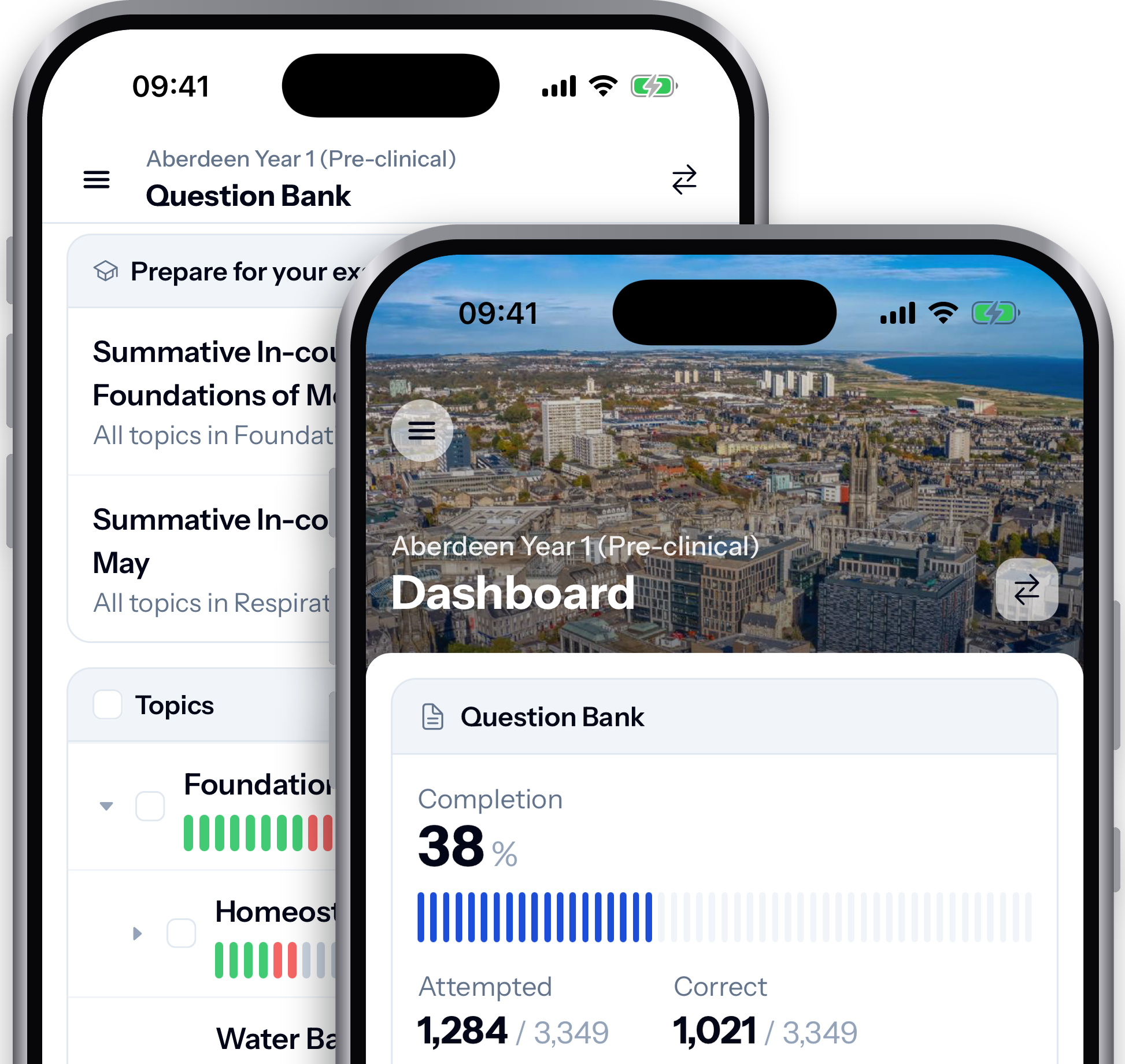
Take your subscriptions with you
Our mobile app allows you to access your interview and exam question banks wherever you are.