


 Close
Close
The Medibuddy IMT Question Bank includes over 80 structured scenarios that cover both interview stations you'll face, and each has a model answer written/edited by high-scoring candidates who sat the IMT interview in 2026.
However, knowing a strong answer isn't the same as delivering it well under pressure, which is why we provide:
- Study Groups
- Unlimited Live Mocks with other candidates
- Peer Feedback on your mocks from a wide range of candidates
80+ scenarios across both stations, each with a model answer from a high-scoring candidate who sat this interview in 2026.
Most people only ever practise with one or two friends. Study Groups connect you with candidates right across the country sitting the same interview.
Arrange or get matched on demand with other candidates and work through real scenarios out loud under interview conditions. Those who practise with the widest range of people tend to score the highest.
Submit your recorded mocks to candidates across the platform and get honest, varied feedback. Reviewing other people's mocks teaches you just as much.
Gain access to over 80 scenarios, learn how to structure model answers, and collaborate with other candidates through Study Groups, Live Mocks and Peer Feedback.
Get Instant AccessIf you're interviewing well, panels tend to push past your first few answers to see how far your knowledge actually goes. These questions are unpredictable, and the only way to do well is to truly understand the topic. That's where you see the benefit of adding the IMT Knowledge Course to your subscription. With 14 video lectures to work through, you'll gain a real understanding of the acute presentations that Station 2 is built around. Add the Knowledge Course to your revision platform purchase and save £30.
Add the Knowledge CourseScored well, ranked high, got their first choice

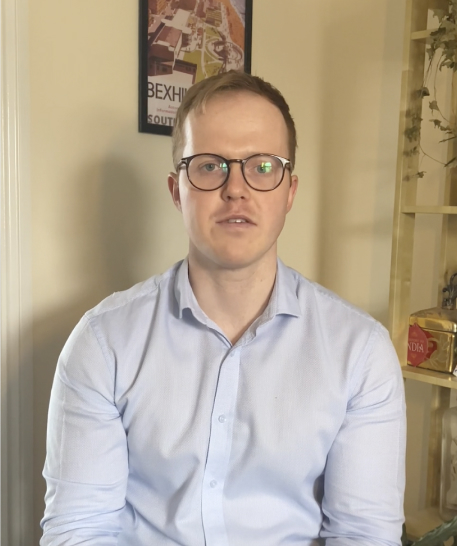
“Medibuddy was very useful in preparing for interview. It helped to give me a systematic approach for questions within the different stations.”
 Watch video
The Medibuddy 2027 IMT Interview Question Bank
Each station lasts around 11 minutes, so you only have a narrow window to deliver the high-scoring answers you need to progress. That means every point you make has to land, and knowing how to structure each answer is vital for that. That's why each of our 80-plus scenarios comes with a model answer, written by candidates who scored highly in the 2026 IMT interview, so you know exactly how to approach every question the panel puts to you.
What's included in the IMT Interview Question Bank
There's nothing worse than getting to the interview and being handed a scenario you've never seen before. The panel has a huge range of topics to draw on, so the safest approach is to revise across all of them. We provide scenarios for both stations, including the common ones and the more unusual cases that have come up before, so you don't get caught out.
| Section | What you'll practise |
|---|---|
| Application & Suitability | Drill the two-minute presentation and follow-up questions, with worked answers that link your achievements to what the panel is looking for. |
| Ethics, Professionalism & Governance | Realistic questions on capacity, DNACPR, confidentiality, patient safety and colleague conflicts, with structured model answers. |
| Clinical Scenarios & Handover | Short acute-medicine scenarios that train assessment, prioritisation and safe escalation, each with a worked answer, plus SBAR handover practice. |
| Communication | Scored in both stations, so these target the marks candidates most often lose, then let you rehearse them live and submit them for Peer Feedback. |
Added for 2027: 8 clinical & handover, 8 ethics & governance, and 2 communication scenarios.
Try an example IMT interview question
You are the IMT 2 in a general respiratory clinic assessing Mrs Bruth, a 65-year-old woman referred with a productive cough, wheeze and shortness of breath on exertion. 30-year smoking history; hypertension on amlodipine; 2-3 kg weight loss over 12 months.
Take a history and consider what investigations would help with her diagnosis.
Example answerWhat questions would help when considering her cough, wheeze and shortness of breath?
I would start with general questions (duration, progression, infective episodes), then focus on each complaint: cough (productive/dry, sputum colour, haemoptysis), wheeze (triggers, duration), and dyspnoea (rest vs exertion, positional, episode length).
Example answerIs there anything else from her history you would want to know?
Her weight loss (intentional or not), a full past medical history and medications, and a detailed social history: smoking pack-years, occupation and exposures (e.g. asbestos), pets, living environment and pollution, TB exposure. Plus family history of respiratory or cardiac disease (including alpha-1 antitrypsin), a systems review, and her ideas, concerns and expectations.
Example answerWhat investigations would help make a diagnosis?
On the day: pulse oximetry, sputum sample, ECG, and bloods (FBC, renal function, CRP). A chest x-ray (hyperinflation, flattened diaphragm). Later, more specialised tests discussed with my supervisor: spirometry, serial peak flow, echocardiogram, and a CT chest given the weight loss.
Example answerWhat is your differential diagnosis?
Top differential is COPD given her age and smoking history. Others: asthma, bronchiectasis, lung cancer, TB. Non-respiratory: congestive heart failure, medication-induced, GORD.
Example answerCommunicate a new diagnosis of COPD to the patient in language she can understand.
(One of your interviewers will play the part of the patient)
Set the scene, ask if she needs anyone with her, use plain language, and give her time. You're being assessed on communication, not on listing COPD treatment steps.
I would explain that the results show the reason for her symptoms, name the diagnosis (COPD, sometimes called emphysema or chronic bronchitis), and pause to let her take it in. I would then check she'd like an explanation, describe COPD simply (airway damage making it harder to move air, progressive and not fully reversible), cover the main cause (smoking) and management (inhalers, stopping smoking, exercise), mention exacerbations, and check her understanding and questions before offering written information and a respiratory CNS referral.
Example answerGive a one-minute handover of this patient to your consultant (prior to the diagnosis being confirmed).
S: Mrs Bruth, 65, with chronic cough, wheeze and shortness of breath.
B: 30 pack-year history, hypertension, and 2-3 kg weight loss over the last year.
A: Most likely COPD; I've arranged straightforward tests (bloods, chest x-ray) to support this.
R: I'd bring her back to clinic to review the results, arrange a CT chest if there's diagnostic uncertainty given the weight loss, refer to the Respiratory CNS for inhaler review, and safety-net around exacerbations via her GP.
NoteHow this scenario can vary, and what you're assessed on
Most scenarios ask for a handover; some ask you to discuss a result with a patient. You're assessed on communication: clear language, checking understanding, giving the patient time, and answering their questions.
That's one scenario. There are over 80 more.
Includes every scenario in the Question Bank, and access to Study Groups, Live Mocks with other candidates and Peer Feedback.
Get Instant AccessScoring the highest marks in the clinical station requires a deep understanding of each acute presentation, and our video lectures give you the knowledge to handle those challenging follow-up questions. Add the Knowledge Course now and save £30.
Add the Knowledge CourseHow we keep our Question Banks up to date
The interviews change every year, and the biggest fear for any candidate is getting to interview day and realising you've revised with a question bank that's totally outdated. That's why we review and update every Question Bank twice a year, so you can rest assured you're revising with scenarios that are likely to come up. We do this in April after the previous year's interviews, and again in October when the new recruitment guidance is published.
For 2027 we added 18 new scenarios: 8 clinical and handover, 8 ethics and governance, and 2 communication.
Updated for 2027 Interviews
The only interview resource where you can practise with other candidates from across the country
Our IMT Question Bank tells you exactly how to answer real interview scenarios. But how you practise with them will determine how many marks you score. Simply reading answers off a screen won't prepare you for the intense scrutiny you'll face in the interview. And only practising with the same few colleagues or friends limits the amount of feedback you'll get. Medibuddy gives you unique access to IMT candidates across the country, so you can learn from a variety of perspectives and hear a far wider range of feedback than your own circle could ever give you.
Study Groups
When you prepare in isolation, you're relying on your own interpretation of the interview process, which is one of the quickest ways to get found out on the day. Study Groups connect you with other doctors across the country who are also applying to IMT, so you can engage and network with people preparing for the same interview as you. Everyone brings different experience from different hospitals and deaneries, meaning you won't ever miss out on the key bits of information that could swing the interview in your favour.
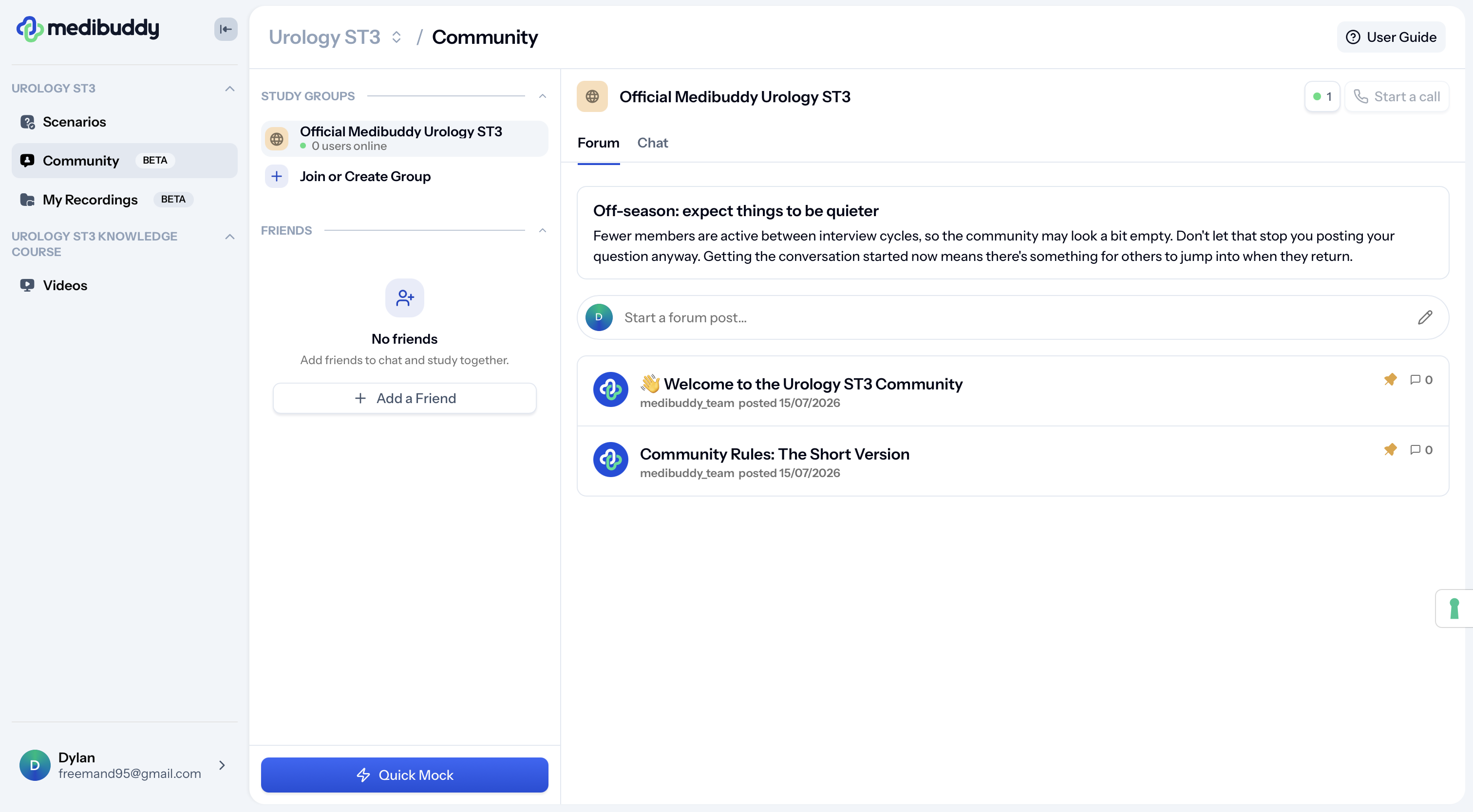
Study Groups: connect and prepare with IMT candidates from across the country.
Unlimited Live Mocks with other candidatesBeta
Candidates who don't take part in mocks often struggle to adapt to the pressure of the interview. Your knowledge might be correct, but without convincing delivery the interviewers will score you poorly. The best way to improve your delivery is to take as many live mocks as possible, which is why we haven't put a limit on how many you can do. You can practise with other people in your study group, or, if no one you know is available, just join the waiting room, and we'll randomly match you with another IMT candidate each time. Take turns as both the interviewer and candidate on real Question Bank scenarios, so you can see exactly how other candidates perform in real time, while refining your own interview technique.
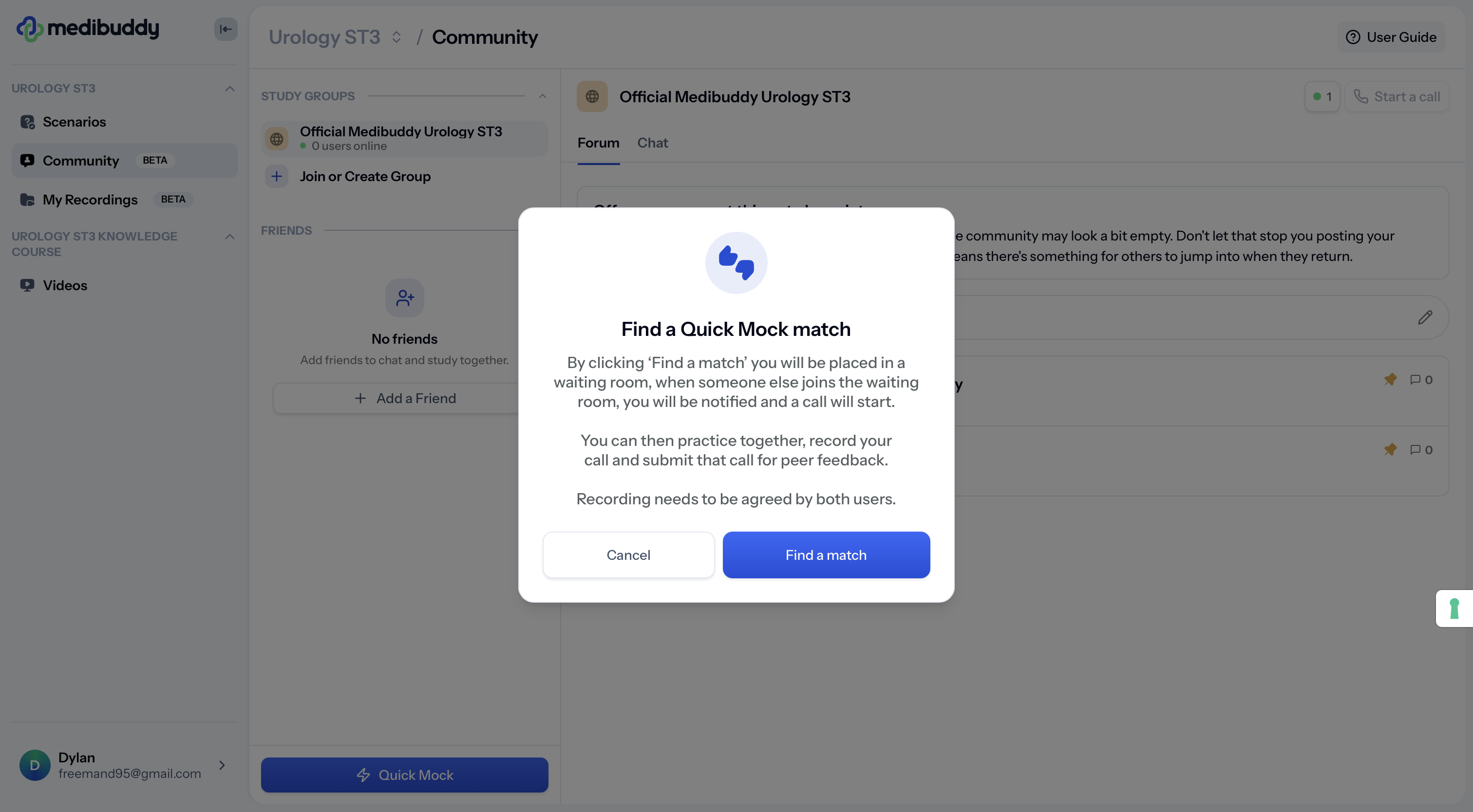
Unlimited Live Mocks: practise with a wide variety of different candidates.
Peer FeedbackBeta
Preparing alone means you won't know how you're coming across during the interview. And preparing with the same few candidates means you'll miss opportunities to improve, which is why it's so important to get as many opinions as possible on your technique. With Medibuddy, you can record a mock and submit it for feedback from other candidates on the platform, so you receive a wider range of feedback and refine your answers with each person you practise with. Reviewing other people's mocks is just as valuable, as it shows you how strong candidates handle the same scenarios, which is one of the fastest ways to improve.
Peer Feedback: reviews from candidates across the platform, not the same few friends.
Choose the IMT Revision Platform, the Knowledge Course, or both
The Revision Platform gives you access to the Question Bank and the chance to practise alongside other candidates, providing the foundation for your interview preparation. However, when you're doing well, interviewers will often throw in curve-ball questions to test the depth of your clinical knowledge. If you can't answer these questions, you won't get the top marks and your final ranking will suffer. The thing is, you can only answer them well if you really understand the topics, which is why we recommend adding our IMT Knowledge Course to your subscription (£30 saved if you buy both together).
What the IMT Knowledge Course covers
14 video lectures, over 8 hours, taught by six specialty registrars who've been through IMT selection.
- Adrenal insufficiency
- Anaphylaxis
- Chest pain
- Delirium
- Dizziness
- Deep vein thrombosis
- Epilepsy
- Flank pain
- Headache
- Overdose
- Pulmonary oedema
- Sepsis
- Supraventricular tachycardias
- Unconsciousness
Every lecture covers:
- Core clinical understanding
- Presentation and recognition
- Investigation and management principles
- Safety considerations and complications
Watch a lecture before you buy
This is the headache lecture: how to assess a headache, the red flags that change your management, and how to work through primary and secondary causes.
Linda Lei, Neurology/GIM SpR. Free to watch, no sign-up.
| IMT Revision PlatformBuy • £85 | IMT Knowledge CourseBuy • £85 | Best value • save £30IMT BundleBuy • £140 | |
|---|---|---|---|
| 80+ unique scenarios across both stations | |||
| Clinical, ethics, professionalism & governance scenarios | |||
| Study Groups & Live Mocks with other candidates | |||
| Peer Feedback from a wide range of candidates | |||
| Written by high-scoring candidates | |||
| 14 video lectures, over 8 hours of clinical teaching | |||
| Acute medicine topics taught in depth | |||
| Created by specialty SpRs | |||
| Be prepared for curve-ball clinical follow-ups |
Instant access on web and the Medibuddy app. The Revision Platform and the Bundle both include Study Groups, Live Mocks and Peer Feedback.
What to expect from the IMT interview
Internal Medicine Training is one of the most challenging recruitment processes of a physician's career, and it's only getting more competitive. In 2024, there were 6,273 applicants for 1,698 posts. By 2025, that had risen to 8,841 applicants for 1,677 posts, which is more than five candidates competing for every place.
The interview consists of two 11-minute stations and is marked by two interviewers. You'll also be assessed on your communication skills across both stations.
Application, Suitability and Ethics
This station requires you to open with a two-minute presentation on the achievements most relevant to your application. You'll then be assessed on your suitability for IMT, before receiving an ethics, professionalism and governance question you don't see in advance.
Clinical Scenario and Handover
A short clinical scenario is read to you at the start of the station, which you can take notes on. You'll then face 10 minutes of questions on investigations, diagnosis, and management, plus a 1-minute handover.
What the panel is looking for
Interviewers score seven areas across the two stations. Both interviewers mark each area from 1 to 5. To be considered for an offer, none of those marks can be a 1, no more than two can be 2s, and your raw score must reach at least 42 of 70.
How to prepare for the IMT interview
1. Start with the IMT Question Bank
Work through 80+ scenarios across both stations. Each scenario includes model answers from candidates who scored well in the 2026 interview. Start by reading how a strong answer is formed, then think about how you might deliver it.
2. Talk the hard ones through in Study Groups
Study groups are your biggest opportunity to network and connect with other candidates sitting the same interview as you. Everyone on the platform is in the same boat as you, so don't be scared to get involved and ask questions. After all, someone in your study group might just help you work through a scenario you've been struggling with.
3. Rehearse out loud in Live Mocks
Live mocks are where you begin to put everything you've learned into practice, and we know from experience that those who practise with a wide range of candidates usually do the best. So organise mocks with people from one of your study groups, or get matched with a random IMT candidate, then take turns as interviewer and candidate using real scenarios until answering out loud under pressure feels normal.
4. Get reviewed with Peer Feedback
Once you've recorded a mock, you can have other community members review it. This allows you to see how you come across to other people, and gives you time to refine your delivery as you revise, rather than being caught out on the day. Reviewing other people's mocks is just as crucial, as you can see how other candidates navigate the same scenarios as you.
5. Build the clinical depth behind your answers
Your initial delivery might be perfect. However, without a deep clinical understanding of the acute presentations, you won't be able to answer those tricky follow-up questions, and the interviewers won't give you the top marks. By adding the IMT Knowledge Course to your subscription, you'll gain access to 14 lectures that provide the in-depth knowledge needed to answer the most challenging curve-ball questions in the clinical station.
Frequently asked questions
What does the IMT interview involve?
The IMT interview has two stations, each lasting around 11 minutes, and is marked by two interviewers. Station 1 covers application and suitability as well as an ethics question, while Station 2 is a clinical scenario with a one-minute handover. Communication is scored in both.
How competitive is the IMT interview?
The IMT interview has a track record of becoming more competitive each year. In 2024, there were 6,273 applicants for 1,698 posts, and in 2025, there were 8,841 applicants for 1,677 posts.
Who writes the model answers?
High-scoring candidates who sat the IMT interview in 2026 review and update all of our scenarios.
Can I practise with other candidates?
Yes. Every Medibuddy Revision Platform purchase gives you the opportunity to connect with other candidates through Study Groups, Live Mocks and Peer Feedback.
How do the Live Mocks work?
All you have to do is join the waiting room, and we match you with another IMT candidate. You can then take turns as an interviewer and candidate on real Question Bank scenarios, allowing you to gain experience answering out loud to other candidates before you ever sit in front of the panel.
What are Study Groups and how do they help?
Study groups are community forums for doctors across the country preparing for the same IMT interview. You can ask questions, share what you're struggling with, and compare how you'd approach a scenario.
Can I get feedback on my interview performance?
Yes. After you've recorded a mock, you can ask other members to review it, helping you identify which parts of your answer need fine-tuning.
How do you keep the IMT Question Bank up to date?
We update the question bank twice a year. In April, after that year's interviews, we review the scenarios and model answers against what candidates actually encountered on the day. We then review the question bank later in the year when the new recruitment guidance is published. For 2027, that meant 18 new scenarios were added.
Why use Medibuddy over other interview question banks?
We've spent 10 years preparing doctors for interviews, and the question bank is updated every year by editors who recently scored well in this interview. That means the scenarios always reflect this year's IMT interview. And it doesn't just stop at a question bank. Every purchase includes access to Study Groups, Live Mocks and Peer Feedback, so you can revise alongside candidates across the country.
What's the difference between the Question Bank and the Knowledge Course?
The Question Bank includes 80+ scenarios with worked answers and all the live practice features. The Knowledge Course teaches the clinical depth behind your answers. We find the most successful candidates at interview use both, and the Bundle saves you £30.
How long do I get access for?
Access runs for 12 months from the purchase date.
Start preparing for the IMT interview
The Revision Platform allows you to practise and refine over 80 interview scenarios with other candidates through Study Groups, Live Mocks and Peer Feedback.
Most candidates add the Knowledge Course, which contains 14 video lectures on the acute presentations the panel follows up on hardest. It's the natural add-on if you want to score top marks in the interview.