


 Close
Close
 5th January 2024
Asthma
Background
Epidemiology
Asthma affects over 8 million people, approximately 12% of the population in the UK. As the incidence of asthma is higher in children than in adults, some ‘grow out’ of the condition. In adulthood, the ratio between males and females is equal.
Occupational asthma is the most common industrial lung disease in the developed world.
Pathophysiology
Asthma is a complex disease with multigene association interacting with environmental exposure.
Pathophysiology of asthma involves two major elements: inflammation and airway hyper-responsiveness. The large airways and small airways of <2 micrometres are the sites of inflammation and airway obstruction.
Airway inflammation is secondary to interaction of inflammatory cell mediators and cells in the airways. An initial trigger causes release of inflammatory mediators, which leads to activation and migration of inflammatory cells. This inflammatory reaction is a T-helper type2 lymphocytic response. Other white cells involved are eosinophils, basophils, mast cells, macrophages, neutrophils, and natural killer cells. Neutrophils are important in near-fatal exacerbation of asthma. These cells cause changes in airways’ epithelium, tone, autonomic neuronal control and hypersecretion of mucus. They also alter the mucocilliary function and increase smooth muscle responsiveness.
Products of the inflammatory response induce smooth muscle contraction and airway hyper-responsiveness. Finally, airway smooth muscle in asthmatic people is increased in mass due to hypertrophy and hyperplasia.
Risk factors
Factors that may contribute to airway hyperresponsiveness and asthma may include the following:
- Environmental allergens
- Family history
- Viral respiratory infections
- Exercise, hyperventilation
- Gastroesophageal reflux disease
- Chronic sinusitis or rhinitis
- Aspirin or nonsteroidal anti-inflammatory drug (NSAID) hypersensitivity, sulphate sensitivity
- Obesity
- Tobacco smoke
- Occupational exposure: Insects, plants, latex, gums, diisocyanates, anhydrides, wood dust, and fluxes
- Irritants (e.g., household sprays, paint fumes)
- Emotional stress
- Perinatal factors such as prematurity and increased maternal age; maternal smoking, and prenatal exposure to tobacco smoke
Presentation
Symptoms
Symptoms of asthma may include cough, wheeze, chest tightness, shortness of breath, with daily and seasonal variation in symptoms. Symptoms can be absent for weeks or months and then be triggered by any of the above risk factors. In acute exacerbations, patients can be continuously short of breath and may be in respiratory distress. Wheeze is a musical, high-pitched sound that is produced by airflow turbulence, and it is one of the most common symptoms. In mild asthma, wheeze is only end-expiratory. However, as severity increases, it lasts throughout expiration. In severe asthma, wheeze could be present throughout inspiration and expiration. Furthermore, in severe episodes in which there is severe limitation of airflow due to airway narrowing and respiratory muscle fatigue, wheeze may be absent.
Cough may be the only symptom of asthma, especially in chronic or exercise-induced asthma. Usually, cough is non-productive in asthma.
Chest tightness is most common in acute exacerbation of asthma.
Occupational asthma
Adults with new-onset asthma should be assessed for occupational asthma. High-risk occupations include laboratory work, welding, painting, baking and animal handling.
References
- Asthma Clinical Presentation: History, Physical Examination, Nonpulmonary Manifestations [Internet]. Medscape.com. 2019. Available from: https://emedicine.medscape.com/article/296301-clinical
- Asthma: Background information [Internet]. NICE. 2015. Available from: https://cks.nice.org.uk/topics/asthma/background-information/
- BMJ Best Practice [Internet]. bestpractice.bmj.com. Available from: https://bestpractice.bmj.com/topics/en-gb/44/aetiology
- Asthma: Practice Essentials, Background, Anatomy. eMedicine [Internet]. 2020 Dec 6; Available from: https://emedicine.medscape.com/article/296301-overview#a5
Diagnosis
Diagnosis of asthma requires careful assessment of symptoms and investigations. A structured clinical history in patients with suspected asthma should be taken and recorded for later review, focusing on the following points:
Symptoms of asthma, as mentioned above, are generally episodic and diurnal and triggered or exacerbated by viral infections, exposure to cold air, exercise, or any of the risk factors. These triggers or exacerbating factors should be identified.
Presence of family or personal history of atopic conditions such as eczema, dermatitis or allergic rhinitis might point towards diagnosis of asthma.
Investigations of asthma in people aged 17 and over
There is no single diagnostic test to confirm diagnosis of asthma. Rather, clinical judgment should be used to determine the probability of asthma based on history and investigation findings.
Full blood count
- FBC may be normal or show raised eosinophils and/or Neutrophils. It is indicated in the first presentation and in acute exacerbations depending on history and examination findings.
Chest X-ray
- Chest X-ray could be normal or show hyperinflation of the lungs. It is often indicated in the first presentation to exclude other pathologies and in acute exacerbations.
Peak expiratory flow
- 20% variability or more after monitoring twice daily for 2-4 weeks is considered a positive result. A positive result supports the diagnosis of asthma.
- Peak flow variability should be offered in adults with normal spirometry or in obstructive spirometry with positive BDR with FeNO level of 39 ppb or less. Consider monitoring in people with obstructive spirometry and negative BDR and FeNO level between 25 and 39 ppb.
Fractional exhaled nitric oxide (FeNO) testing
- FeNO testing may support asthma diagnosis in people aged 17 and over by confirming eosinophilic airway inflammation. FeNO level of 40 parts per billion or higher is considered a positive result in steroid-naive adults.
- FeNO testing should be considered in people aged 5 to 16 if there is diagnostic uncertainty after initial assessment or in case of normal spirometry or obstructive spirometry with negative bronchodilator reversibility test (BDR). A FeNO level of 35 parts per billion is a positive result in this group.
Spirometry
- All symptomatic people above the age of 5 years should be offered spirometry. Any value of FEV1/FVC less than 80% is abnormal and suggests airflow limitation. However, asthma cannot be ruled out when spirometry is normal in a symptomatic person.
Bronchodilator reversibility
- It should be offered to people aged 17 and above and considered in people aged 5 to 16 years with FEV1/FVC ratio less than 70%.
- Positive result in adults is an improvement of 12% or more in FEV1 with at least 200 ml increase in volume following administration of Beta-2 agonist or corticosteroids.
- Positive result in children is an improvement in FEV1 of 12%.
Bronchial challenge test with histamine or methacholine
- This test should be offered if the diagnosis is not clear after normal spirometry and either FeNO level of 40 ppb or more and no variability in peak flow readings or if FeNO level is 39 ppb or less with variability in peak flow values.
Diagnostic criteria in symptomatic patients
Patients aged 17 years and above
Diagnose asthma in the following conditions:
- FeNO level of 40 ppb or above with either positive BDR, positive peak flow variability, or bronchial hyperactivity.
- FeNO level between 25-39 ppb and positive bronchial challenge test
- Positive BDR and peak flow variability (irrespective of FeNO level)
Patients aged between 5 and 16 years
Diagnose asthma in the following conditions:
- FeNO level of 35 ppb or more with peak flow variability
- Obstructive spirometry with positive BDR
Children under the age of five
Clinical judgment should be based on any positive objective test and signs and symptoms.
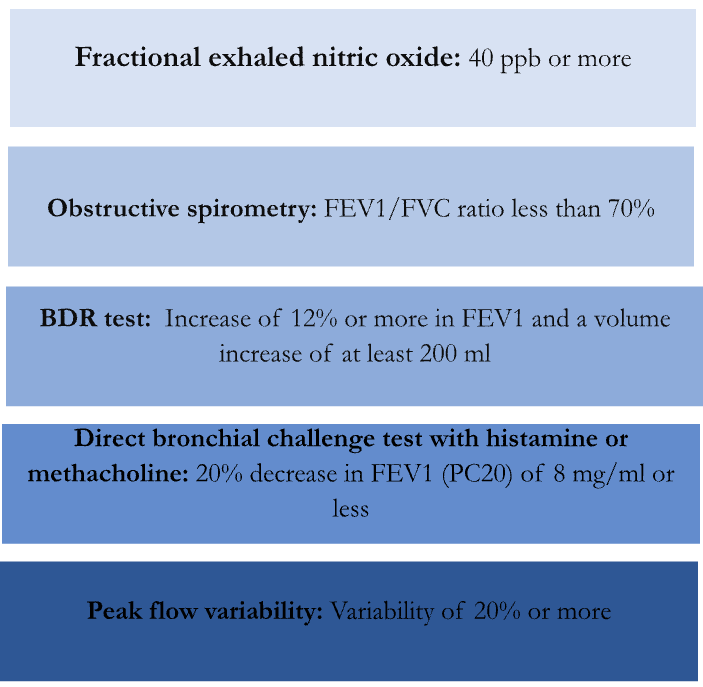
Adapted from: Recommendations | Asthma: diagnosis, monitoring and chronic asthma management | Guidance | NICE [Internet]. Nice.org.uk. NICE; 2017. Available from: https://www.nice.org.uk/guidance/ng80/chapter/Recommendations#diagnostic-summary
References
- Asthma: When should I suspect asthma? [Internet]. NICE. 2021. Available from: https://cks.nice.org.uk/topics/asthma/diagnosis/diagnosis/
- Recommendations | Asthma: diagnosis, monitoring and chronic asthma management | Guidance | NICE [Internet]. Nice.org.uk. NICE; 2017. Available from: https://www.nice.org.uk/guidance/ng80/chapter/Recommendations#pharmacological-treatment-pathway-for-adults-aged-17-and-over
Differential diagnoses
- Vocal cord dysfunction or paradoxical vocal cord dysfunction – abnormal adduction of vocal cords during inspiration. Vocal cord dysfunction might exist alone or co-exist with asthma. Patients with chronic asthma symptoms, normal spirometry and poor response to asthma medications and frequent evaluations should be assessed for vocal cord dysfunction using direct laryngoscopy either during an exacerbation or post-exercise.
- Tracheal and bronchial lesions- Various airway tumours such as endobronchial carcinoid, tracheal hamartoma, bronchogenic cysts and mucoepidermoid tumours are reported to present similarly to asthma.
- Foreign bodies- aspiration of foreign bodies may cause localised or generalised wheeze. Foreign bodies in peripheral airways cause localised one-sided wheeze or collapse in distal lung tissue.
- Congestive heart failure- lung compliance is reduced secondary to engorged pulmonary vessels and interstitial oedema in congestive heart failure, which will contribute to breathlessness and wheeze.
- Gastroesophageal reflux- GORD is associated with cough, wheeze and may manifest similarly to asthma.
- Sinus disease- chronic sinusitis may present with nocturnal cough and dysnpnea due to post-nasal discharge.
- COPD- COPD and asthma can be differentiated based on history and examination findings such as history of smoking and hyper-resonance to percussion or barrel chest on examination. Chest X-ray in COPD may show hyper-inflation of the lungs. Pulmonary function tests show obstructive pattern, increase in total lung capacity and elevated residual volume. FEV1/Forced vital capacity is <70%.
- Bronchiectasis- severe bronchiectasis presents with recurrent respiratory infections. High-resolution CT of chest will show dilated airways and bronchial wall thickening.
- Other differential diagnoses
- Aspergillosis
- Churg-Strauss syndrome
- Pulmonary eosinophilia
References
- BMJ Best Practice [Internet]. bestpractice.bmj.com. [cited 2022 Apr 3]. Available from: https://bestpractice.bmj.com/topics/en-gb/44/differentials
- Asthma Differential Diagnoses [Internet]. Medscape.com. 2019. Available from: https://emedicine.medscape.com/article/296301-differential
Management
Management of chronic asthma in adults (Aged 17 years or above)
Principles of Pharmacological Management
- Consider alternative diagnosis or possible reasons for uncontrolled asthma before adjusting treatment.
- Review response to treatment 4-8 weeks after starting or adjusting medicines.
- Offer regular daily inhaled corticosteroids ( ICS) instead of intermittent ICS.
- Aim for the lowest required dose of ICS for effective asthma control.
- Offer a self-management plan consisting of a written personalised action plan and education.
- Consider the possible reasons for uncontrolled asthma before adjusting medications, such as lack of adherence, occupational exposures, psychological factors, alternative diagnosis, and smoking.
- Ensure proper technique of inhaler devices.
Pharmacological treatment pathway for adults (age 17 and above)
Pharmacological management of adults (17 years and over) with newly diagnosed asthma or uncontrolled asthma on their current treatment in a stepwise fashion:
- Short-acting Beta2 agonist (SABA) as reliever therapy alone for people with infrequent and brief periods of wheeze and normal lung function.
- Low-dose ICS as maintenance therapy for people with:
- Uncontrolled asthma with SABA alone.
- Symptoms at presentation indicating need for maintenance therapy such as: nocturnal symptoms or symptoms three times a week.
- Leukotriene receptor antagonist (LTRA) in addition to the above.
- Long-acting beta2 agonist ( LABA) in addition to low dose ICS and review response to LTRA.
- Change low-dose ICS and LABA to MART (Maintenance and reliever therapy combines ICS and fast-acting LABA and is used as both maintenance and reliever therapy).
- Increase ICS dose from low to moderate maintenance dose as a MART regimen or moderate dose ICS + LABA + SABA.
- Increase ICS to high dose (as part of fixed regimen);
- or trial of long-acting muscarinic antagonist or theophylline SIGN 158.
Decreasing maintenance therapy
Consider decreasing therapy when asthma symptoms are controlled with current treatments for at least 3 months.
Management of acute asthma exacerbation in adults
Determining severity
The severity of asthma is graded as follows:
| Moderate | Acute severe | Life-threatening | Near-fatal |
|---|---|---|---|
| PEFR > 50-70 best or predicted Normal speech |
PEFR 33-50% best or predicted or RR >= 25/min or HR >= 110/min Inability to complete sentences or Accessory muscle use SpO2 > 92% |
In a patient with severe asthma with any of the following: PEFR less than 33% or SpO2 <92% or Altered consciousness or Confusion or Exhaustion or Cardiac arrythmia or Hypotension or Cyanosis or Poor respiratory effort or Silent chest or Poor respiratory effort |
Raised Carbon dioxide partial pressure or Requiring mechanical ventilation |
Table1. Asthma severity classification
SIGN Asthma Guideline Quick Reference Guide 2019 [Internet]. British Thoracic Society; 2019. Available from: https://www.brit-thoracic.org.uk/document-library/guidelines/asthma/btssign-asthma-guideline-quick-reference-guide-2019/
Assess the need for hospital admission
All patients with life-threatening asthma should be admitted to hospital. All patients with features of severe asthma persisting after initial bronchodilator therapy should be admitted. Patients with moderate asthma with worsening symptoms after initial treatment, or those who have had previous life-threatening attacks should be admitted.
Treatment of acute asthma
- Maintain a saturation of 94-98% with supplemental oxygen if required
- Beta 2 agonist bronchodilator (Salbutamol) via nebuliser. In patients with acute severe or life-threatening asthma, nebuliser should be oxygen-driven. Use intravenous Beta 2 agonist if inhaled therapy cannot be used reliably.
- Nebulised Ipratropium bromide (0.5 mg 4-6 hourly) for acute severe or life-threatening exacerbation or for those with inadequate response to initial Beta 2 agonist.
- Steroid to all patients with asthma exacerbation. Continue with prednisolone (40-50 mg daily) until recovery or minimum of 5 days.
- Single dose of intravenous magnesium sulphate (1.2-2 g infusion over 20 minutes) can be given in acute severe or life-threatening asthma who have had inadequate response to initial bronchodilators.
- Antibiotics should only be given in case of bacterial infection.
Any patient with one of the following features should be referred to critical care:
- Any patient who is requiring ventilatory support.
- Patients with severe or life-threatening asthma who fail to respond to therapy as:
- Worsening PEF
- Worsening hypoxia
- Hypercapnia
- Acidosis on ABG
- Exhaustion
- Respiratory arrest
- Confusion or altered consciousness
References
- Recommendations | Asthma: diagnosis, monitoring and chronic asthma management | Guidance | NICE [Internet]. Nice.org.uk. NICE; 2017. Available from: https://www.nice.org.uk/guidance/ng80/chapter/Recommendations#pharmacological-treatment-pathway-for-adults-aged-17-and-over
- Asthma: Scenario: Newly-diagnosed asthma [Internet]. NICE. 2021. Available from: https://cks.nice.org.uk/topics/asthma/management/newly-diagnosed-asthma/
- Asthma: Scenario: Acute exacerbation of asthma [Internet]. NICE. Available from: https://cks.nice.org.uk/topics/asthma/management/acute-exacerbation-of-asthma/
- SIGN Asthma Guideline Quick Reference Guide 2019 [Internet]. British Thoracic Society; 2019. Available from: https://www.brit-thoracic.org.uk/document-library/guidelines/asthma/btssign-asthma-guideline-quick-reference-guide-2019/
Complete Guide to Clinical Genetics ST3 Application and Recruitment (2027)
Written by Medibuddy. Last updated: October 2026. Clinical Genetics is

Complete Guide to Clinical Radiology ST3 Application and Recruitment (2027)
Recruitment paused: NHS England is not running Clinical Radiology ST3+ recru

Complete Guide to Paediatric Surgery ST3 Application and Recruitment in United Kingdom (2026)
Written by Medibuddy. Last updated: October 2026. If you’re planning


Take your subscriptions with you
Our mobile app allows you to access your interview and exam question banks wherever you are.

