


 Close
Close
 26th January 2024
Sjogren’s Syndrome
Background
Sjogren’s syndrome is a chronic autoimmune inflammatory disorder characterised by dryness of the eyes and mouth, fatigue and musculoskeletal pain that is the result of diminished lacrimal and salivary gland function.
Epidemiology
The overall incidence is 7 per 100,000 people per year. The prevalence is highest in the Asian population and lowest in the African population. It is ten times more common in women and is usually diagnosed during middle age (40s) or after menopause. Older adults tend to have more severe symptoms of dry eyes and dry mouth; however, this is due to confounding factors such as adverse effects of medications, age-related fibrosis, and atrophy of secreting tissues.
Pathophysiology
The pathophysiology of SS is thought to be a multifactorial process. Autoantibodies in genetically predisposed individuals are triggered by environmental factors such as viral infection, which result in B-cell stimulation and chronic inflammation of the salivary and lacrimal glands.
Multiple polymorphisms are associated with SS, the most common haplotype being HLA-DR3, but there are also associations with HLA-B8 and HLA-DQ2. The most common viral association is Epstein-Barr virus (EBV). However, HTLV-1, HIV and Hepatitis C have also been noted to have associations with SS. The presence of autoantibodies such as Anti-Ro/SSA and Anti-La/SSB are found in 60-80% of individuals affected with SS.
Presentation
- Systemic Autoimmunity: Thyroid dysfunction and/or other co-existing autoimmune conditions are found in approximately 45% of patients with primary SS.
- Fatigue: Extreme fatigue despite getting more rest, occurs in approximately 50% of patients and is sometimes caused or made worse due to underlying hypothyroidism.
- Cutaneous manifestations: Approximately 55% of patients complain of skin dryness, which is a main characteristic feature of SS. Some patients complain of a rash that is vasculitic in nature and sometimes may be due to underlying vasculitis. Raynaud phenomenon may be observed in about 30% of cases. However, it is usually very mild.
- Pulmonary manifestations: Up to 30% of patients have subclinical pulmonary disease, and lung function tests may show small airway obstruction. Other pulmonary complications include lymphocytic alveolitis, lymphocytic interstitial pneumonitis and fibrosis, and pseudolymphoma.
- Gastrointestinal manifestations: Oesophageal dysmotility is the most common GI presentation and is treated symptomatically with prokinetic drugs. Rarely, mild pancreatitis or autoimmune hepatitis may occur.
- Renal manifestations: Some patients with SS may have tubulointerstitial involvement and glomerular lesions leading to symptoms such as haematuria, proteinuria and renal insufficiency.
- Neurological involvement: The most common significant manifestation is sensory peripheral neuropathy, which is found in approximately 22% of patients.
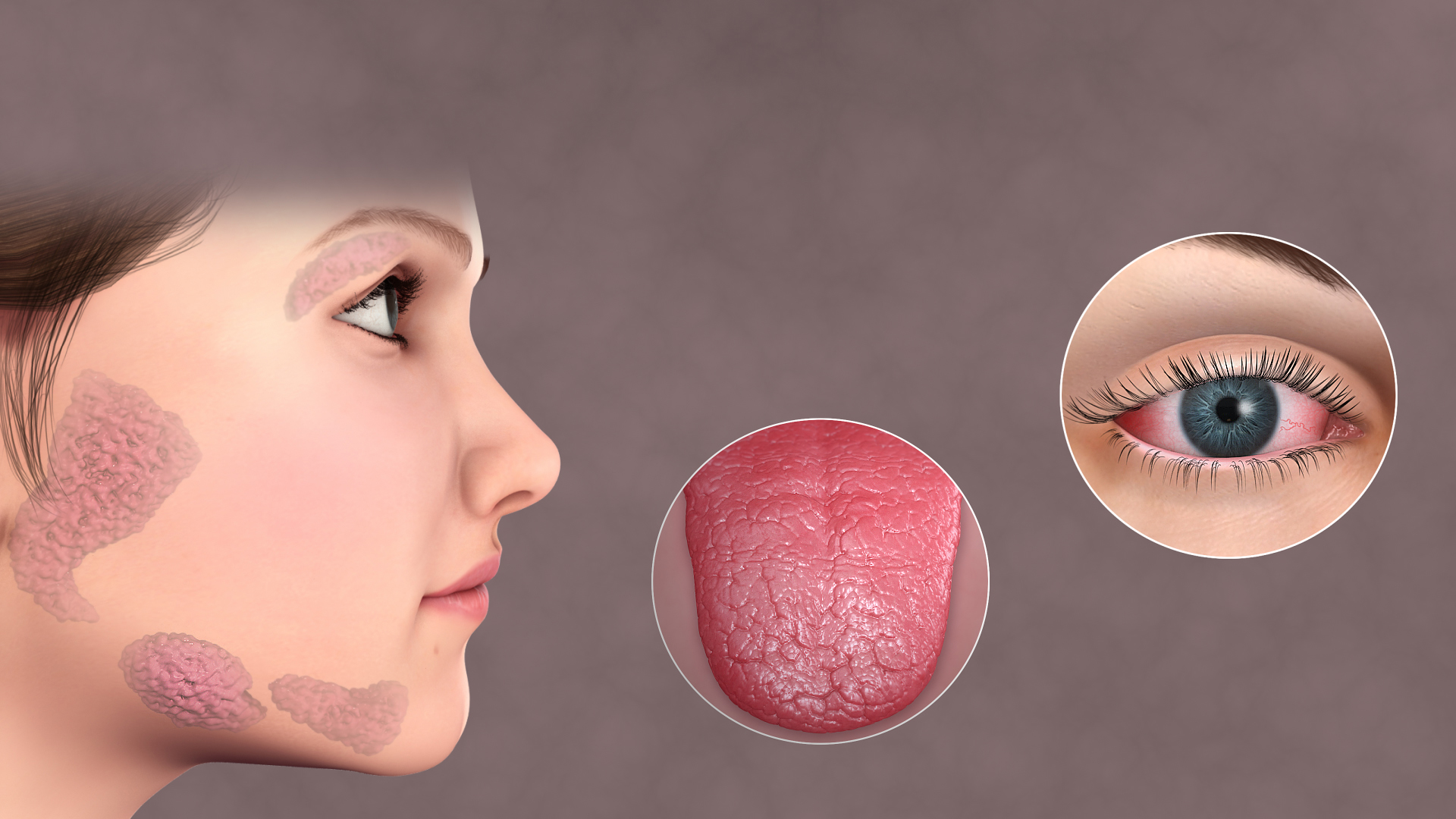
Image Source: Wikimedia Commons (2022). Sjogrens Syndrome, Licensed under a creative commons licence. Available for free at: https://upload.wikimedia.org/wikipedia/commons/5/54/Sjogrens_Syndrome.jpg (Accessed: 10 July 2022).
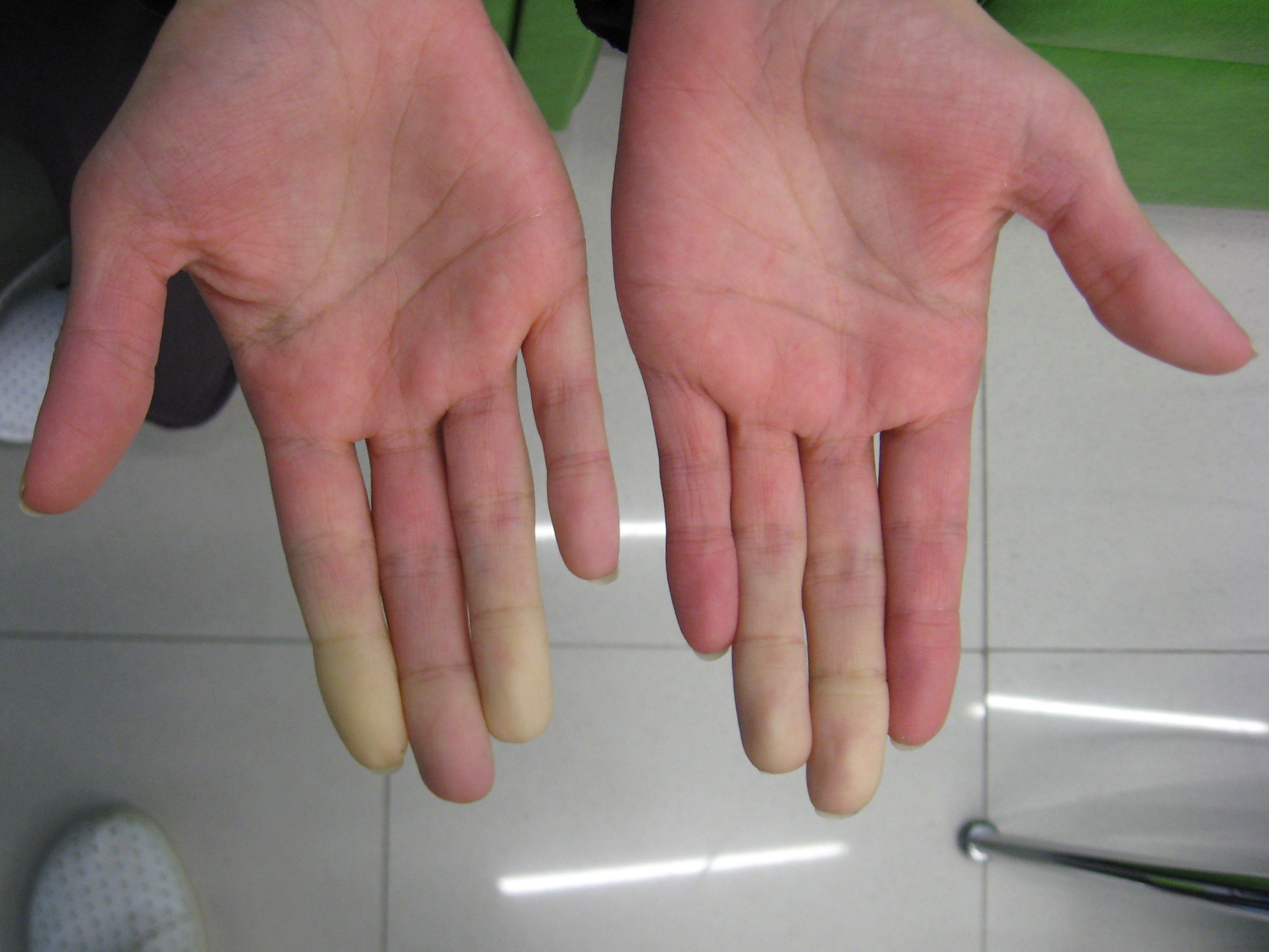
Image Source: Wikimedia Commons (2022). Secondary Raynaud’s in Sjögren’s syndrome 1, Licensed under a creative commons licence. Available for free at: https://upload.wikimedia.org/wikipedia/commons/8/8b/Secondary_Raynaud%27s_in_Sj%C3%B6gren%27s_syndrome_1.JPG (Accessed: 10 July 2022).
Diagnosis
The diagnosis of primary SS can be made in patients with objective findings of ocular and/or oral dryness and evidence of autoimmune exocrine glandular dysfunction. These clinical features, in combination with serological and in some cases, histopathological or radiological findings, assist in making a diagnosis of SS.
- Ophthalmological tests used to investigate for dry eyes include the Schirmer test, tear break-up time and ocular surface staining.
- Evaluation of salivary hypofunction: On physical examination, lack of salivary pooling under the tongue may be found, and testing such as whole sialometry (also called Saxon test) may be done. Imaging such as US may show characteristic salivary gland parenchymal changes, including a hypoechoic linear band, cysts and calcifications. MRI may show a nodular pattern of parenchymal changes such as fatty infiltration, fibrosis, and ductal dilatation.
- Serological testing: Positive testing for Anti-Ro/SSA antibodies with or without Anti/La/SSB antibodies. Positive ANA and Rheumatoid factor, in combination with other clinical features, may also support a diagnosis of SS.
- Salivary gland biopsy: A labial salivary gland biopsy is taken from the lower lip, and the key histological feature is focal collections of tightly aggregated lymphocytes (lymphocytic foci).
Diagnostic criteria
The 2016 ACR/EULAR classification criteria for diagnosis of primary SS are based on a weighted scoring system. They can only be applied to an individual with at least one symptom of ocular or oral dryness or suspicion of SS based on glandular enlargement or the presence of characteristic extra-glandular involvement. An individual can be classified as having primary SS if the total score is four or more. The domains include labial salivary gland with focal lymphocytic sialadenitis, Anti-SSA/Ro positivity (each one 3 points), ocular staining score >5 in at least one eye, Schirmer’s test <5mm/5minutes in at least one eye and an unstimulated whole saliva flow rate <0.1ml/minute (each one is 1 point).
Differential Diagnosis
Most differential diagnoses of SS can be excluded by taking an in-depth history, physical examination and serological testing.
- Age-related sicca syndrome: Age-related ocular and oral dryness may mimic features of SS. However, patients with sicca syndrome would not have positive autoantibodies (Anti-Ro/SSA and Anti-la/SSB), which are present in 60-80% of patients with SS.
- Sarcoidosis: Sarcoidosis may share some extra-glandular features similar to SS, including arthritis and interstitial nephritis. However, biopsy findings and serology for autoantibodies would help in differentiating both conditions.
- Rheumatoid Arthritis: RA may have similar features to SS, such as arthritis and serological testing in both cases may show positive ANA autoantibodies and Rheumatoid factor positive antibodies. However, symptoms such as oral and ocular dryness would make a diagnosis of SS more likely.
Management
The goals of management necessitate a multi-disciplinary team approach through pre-treatment evaluation, which allows tailored treatment to individual patients and their particular disease manifestations.
Non-pharmacologic interventions
- Self-management of sicca symptoms using artificial tears and artificial saliva.
- Immunisations: Appropriate immunisations should be received prior to the start of immunosuppressive therapy, for example, COVID-19, herpes zoster and pneumococcal vaccinations.
- Smoking cessation: This is of particular importance as smoking cigarettes or cannabis can cause worsening symptoms of dry eyes and mouth, increase the risk of dental complications and reduce the efficacy of medications such as hydroxychloroquine.
Pharmacological Interventions:
- Lubricating ocular ointments such as topical Cyclosporine or Lifitegrast and oral secretagogues such as Pilocarpine or cevimeline may be used to treat moderate to severe sicca symptoms.
- Glucocorticoids can be used to treat systemic manifestations of SS in a similar way to other autoimmune disease. However, weaning of steroids is necessary as long-term corticosteroid use is associated with many adverse effects.
- Immunosuppressive and DMARDs:
- Hydroxychloroquine can be used to improve symptoms such as arthralgias and myalgias.
- Methotrexate is effective in controlling dry mouth and eyes, arthralgias, arthritis and musculoskeletal pain.
- Azathioprine at high dose can be used to manage extra-glandular manifestations such as interstitial pneumonitis, myelopathy and autoimmune hepatitis.
- Mycophenolate mofetil has been shown to lead to a reduction in hypergammaglobulinemia and rheumatoid factor and an increase in complement and white blood cell count, making it effective in treating agranulocytosis as a result of primary SS.
References
- Baer A, Deshmukh U. UpToDate. Pathogenesis of Sjogren’s Syndrome [Internet] 2021. [cited 2022 May 12]. Available from: https://www.uptodate.com/contents/pathogenesis-of-sjogrens-syndrome
- Baer A. UpToDate. Diagnosis and Classification of Sjogren’s Syndrome [Internet] 2021. [cited 2022 May 12]. Available from: https://www.uptodate.com/contents/diagnosis-and-classification-of-sjogrens-syndrome?source=history_widget
- Kassan SS, Moutsopoulos HM. Clinical Manifestations and Early Diagnosis of Sjögren Syndrome. Arch Intern Med. 2004;164(12):1275–1284.
- Baer A, Vivino F. UpToDate. Treatment of Sjögren’s syndrome: Constitutional and non-sicca organ-based manifestations [Internet] 2022. [cited 2022 May 21]. Available from: https://www.uptodate.com/contents/treatment-of-sjogrens-syndrome-constitutional-and-non-sicca-organ-based-manifestations?source=history#H2606837497
Complete Guide to Clinical Genetics ST3 Application and Recruitment (2027)
Written by Medibuddy. Last updated: October 2026. Clinical Genetics is

Complete Guide to Clinical Radiology ST3 Application and Recruitment (2027)
Recruitment paused: NHS England is not running Clinical Radiology ST3+ recru

Complete Guide to Paediatric Surgery ST3 Application and Recruitment in United Kingdom (2026)
Written by Medibuddy. Last updated: October 2026. If you’re planning


Take your subscriptions with you
Our mobile app allows you to access your interview and exam question banks wherever you are.

