


 Close
Close
 26th January 2024
Diagnosis
Laboratory Investigations
- Full Blood Count (FBC): may show anaemia, leukopenia, thrombocytopenia
- Renal function: elevated creatinine may be a sign of renal dysfunction
- ANA: positive in almost all patients with SLE
- Anti-dsDNA: highly specific and sensitive for SLE – seen in approximately 70% of patients
- Anti-Sm antibodies: highly specific but lacks sensitivity – seen in approximately 30% of patients
- Anti-Ro and Anti-La: more commonly associated with Sjogren’s syndrome but are present in approximately 20-30% of patients with SLE
- Anti-U1 RNP antibodies: are almost always found in high levels in patients with mixed connective tissue disease; however, it occurs in approximately 25% of patients with SLE.
Imaging
- X-rays of the hands may show evidence of Jaccoud’s arthropathy, which includes soft tissue deformities and the absence of erosions.
- MRI or Ultrasound: These may reveal synovial effusions which are usually small and can be used to guide aspiration of the joint that typically shows low protein and white cell counts.
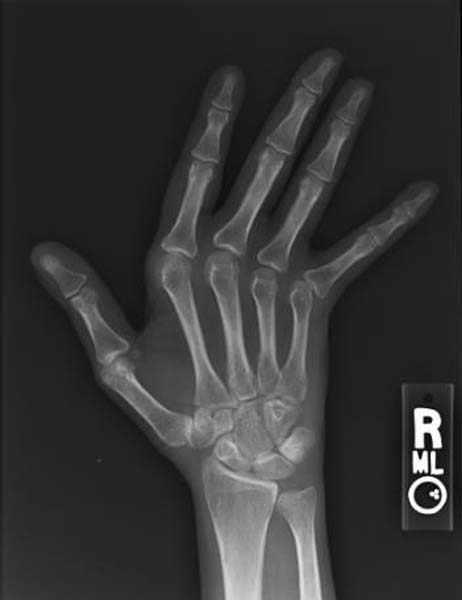
Image Source: Wikimedia Commons (2022). Jaccoud arthropathy hand x-ray front, Licensed under a creative commons licence. Available for free at: https://upload.wikimedia.org/wikipedia/commons/7/71/Jaccoud_arthropathy_hand_x-ray_front.jpg (Accessed: 10 July 2022).
Diagnostic Criteria
SLICC (Systemic Lupus International Collaborating Clinics) Criteria – 2012
Using the SLICC criteria, SLE is diagnosed if the patient has either of the following over time:
- Four criteria including ≥ one clinical criterion and ≥ one immunological criterion
- Biopsy-proven lupus nephritis and anti-nuclear antibodies or anti-double-stranded DNA antibodies
The clinical criteria include features such as cutaneous lupus, alopecia, oral or nasal ulcers, joint disease, serositis, neurological manifestations and laboratory findings such as anaemia, leukopenia, thrombocytopenia and proteinuria. The immunological criteria include positive ANA, Anti-ds DNA, Anti-Sm, Antiphospholipid and low complement (C3 and C4). A positive Direct Coombs Test can be considered in the absence of haemolytic anaemia.
| Clinical Criteria | Immunological criteria |
|---|---|
| Acute cutaneous lupus (lupus malar rash) | ANA |
| Chronic cutaneous lupus (discoid rash) | Anti-ds DNA |
| Alopecia | Anti-Sm |
| Oral or nasal ulcers | Antiphospholipid |
| Joint disease (synovitis or tenderness) | Low complement |
| Serositis | Direct Coombs Test |
| Renal (proteinuria, red cell casts) | |
| Neurological (seizures, psychosis) | |
| Haemolytic anaemia | |
| Leukopenia | |
| Thrombocytopenia |
Table 1: The SLICC classification criteria for systemic lupus erythematosus.
Table 1: UpToDate. Classification criteria for systemic lupus erythematosus [Internet]. 2022 [cited 2022 July 12]. Available from: https://www.uptodate.com/contents/image?imageKey=RHEUM%2F86633
EULAR/ACR (European Alliance of Associations for Rheumatology/American College of Rheumatology) Criteria – 2019
This criterion consists of 7 clinical and 3 immunological categories, each of which are weighted 2 – 10. Patients with a score of 10 points or more are classified as having SLE.
The clinical domains include constitutional, haematological, neuropsychiatric, mucocutaneous, serosal, musculoskeletal and renal. The immunological domains include antiphospholipid antibodies, complement proteins and SLE-specific antibodies.
| Clinical Criteria | Immunological criteria |
|---|---|
| Malar rash | ANA |
| Photosensitivity | Anti-ds DNA OR Anti-Sm OR Anti Phospholipid |
| Discoid rash | |
| Oral ulcers | |
| Arthritis | |
| Serositis | |
| Renal (proteinuria, cellular casts) | |
| Neurological (seizures or psychosis) | |
| Haematological (haemolytic anaemia, leukopenia, lymphopenia, thrombocytopenia) |
Table 2: The ACR classification criteria for systemic lupus erythematosus.
Table 2: UpToDate. Classification criteria for systemic lupus erythematosus [Internet]. 2022 [cited 2022 July 12]. Available from: https://www.uptodate.com/contents/image?imageKey=RHEUM%2F86633
Complete Guide to Clinical Genetics ST3 Application and Recruitment (2027)
Written by Medibuddy. Last updated: October 2026. Clinical Genetics is

Complete Guide to Clinical Radiology ST3 Application and Recruitment (2027)
Recruitment paused: NHS England is not running Clinical Radiology ST3+ recru

Complete Guide to Paediatric Surgery ST3 Application and Recruitment in United Kingdom (2026)
Written by Medibuddy. Last updated: October 2026. If you’re planning


Take your subscriptions with you
Our mobile app allows you to access your interview and exam question banks wherever you are.

