


 Close
Close
 20th February 2024
Nucleic acid hybridisation
Hybridisation detects mutations using single-stranded DNA probes to detect specific DNA/RNA sequences within the genetic material.
Several methods utilise hybridisation to detect mutations:
- Southern blotting – DNA samples are broken down into smaller fragments, and electrophoresis is employed to separate DNA fragments based on size. DNA probes with a marker are applied to allow hybridisation, and chemiluminescence or X-rays are used to detect the probes. This only detects significant mutations or DNA sequences that PCR cannot amplify.
- Fluorescence in-situ hybridisation (FISH) – Single-stranded DNA probes are exposed to denatured chromosomes within the interphase, prophase or metaphase stage of cell division, and fluorescence is used to detect its bonding to sample DNA. FISH occasionally detect aneuploidies, translocations, and microdeletions/duplications.
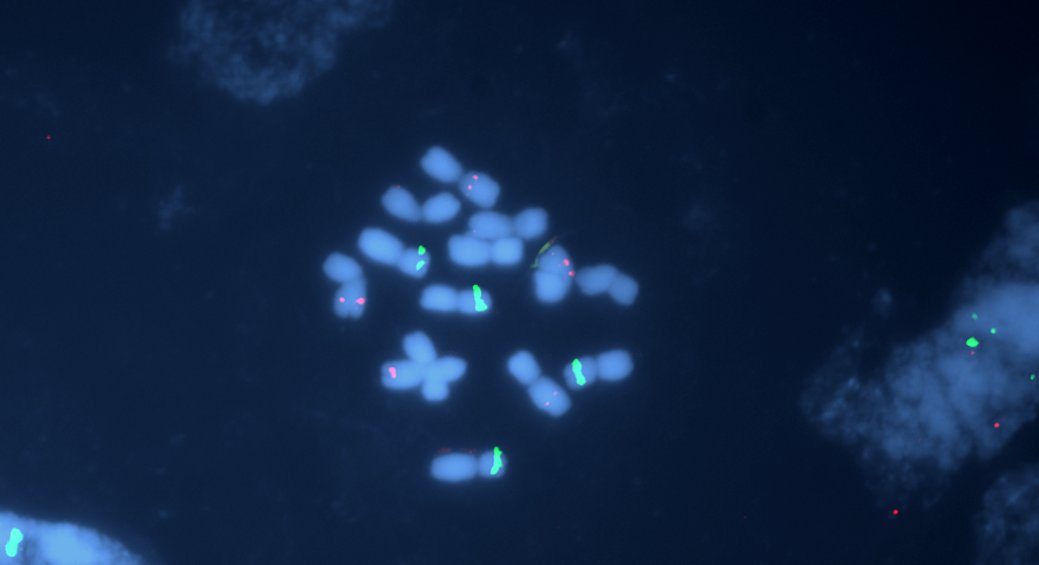
Image Source: Wikimedia Commons (2009). Hordeum vulgare stained by fluorescent in situ hybridization, Licensed under a creative commons licence. Available for free at: https://commons.wikimedia.org/wiki/File:Hordeum_vulgare_stained_by_fluorescent_in_situ_hybridization.jpg (Accessed: 4 January 2024).
- Array comparative genomic hybridisation (aCGH) – A microarray containing thousands to millions of oligonucleotide probes is exposed to a sample and a control DNA sample. Both DNA samples are marked with a fluorescent dye and are compared under a fluorescence microscope. This method detects aneuploidy, deletions, duplications (both large and small) and unbalanced translocations. It is possible to detect single nucleotide polymorphism with different probes. aCGH rarely detects balanced translocation as no excess genetic material exists within the sample DNA.

Image Source: Wikimedia Commons (2012). Array-CGH protocol, Licensed under a creative commons licence. Available for free at: https://commons.wikimedia.org/wiki/File:Array-CGH_protocol.svg (Accessed: 4 January 2024).
Complete Guide to Clinical Genetics ST3 Application and Recruitment (2027)
Written by Medibuddy. Last updated: October 2026. Clinical Genetics is

Complete Guide to Clinical Radiology ST3 Application and Recruitment (2027)
Recruitment paused: NHS England is not running Clinical Radiology ST3+ recru

Complete Guide to Paediatric Surgery ST3 Application and Recruitment in United Kingdom (2026)
Written by Medibuddy. Last updated: October 2026. If you’re planning


Take your subscriptions with you
Our mobile app allows you to access your interview and exam question banks wherever you are.

