


 Close
Close
 1st August 2023
Diagnosis
The World Health Organisation (WHO) defines osteoporosis as a Dual Energy X-ray Absorptiometry (DEXA) scan T-score of less than -2.5 or a geriatric patient presenting with a low trauma fracture. DEXA scans are the only diagnostic investigation. This uses low dose x-rays to measure BMD, typically of the vertebra, pelvis, and femur. T-scores on a DEXA scan are a standard deviation of the BMD compared to that of an average healthy 30-year-old adult. The Z-score on a DEXA scan is a standard deviation of the BMD adjusted to the patient’s age and gender.
Tools can be used to predict the risk of a patient suffering from an osteoporotic fracture, such as the Fracture Risk Assessment Tool (FRAX®) or Q Risk (fracture risk) calculator. These tools consider a person’s risk factors to calculate their 10-year probability of having a major osteoporotic or hip fracture.
NICE recommends DEXA scans for those over 50 years with a history of a fragility fracture or those <40 years with a high-risk factor for osteoporosis (as the FRAX® tool is not used in those <40 years). Those >40 years with risk factors (without a fragility fracture) require a FRAX® score, for which a fracture risk of greater than 10% would indicate the need for a DEXA scan.
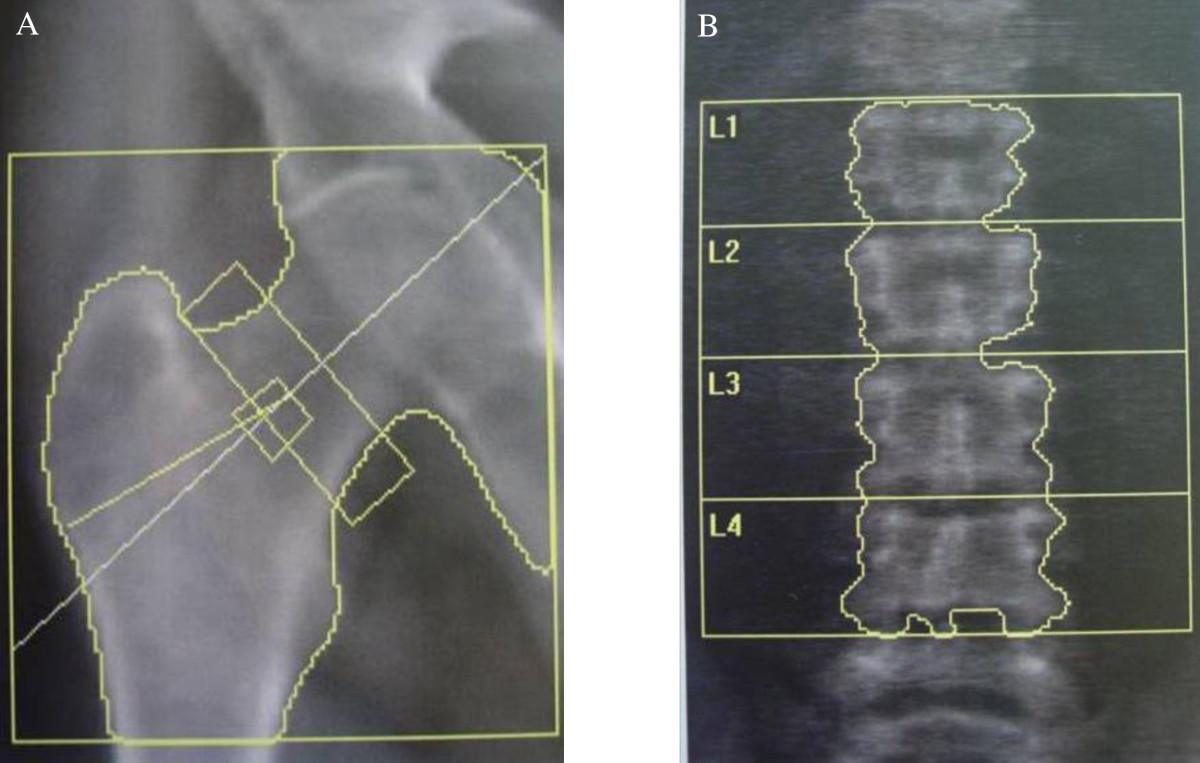
DEXA scan images of pelvic and L1-L4 vertebrae
Image Source: Wikimedia Commons (2011). Morbus Fabry DXA 01, Licensed under a creative commons licence. Available for free at: https://commons.wikimedia.org/wiki/File:Morbus_Fabry_DXA_01.jpg (Accessed: 17 February 2022).
Due to the potential differential diagnoses and secondary causes of osteoporosis, it is important to conduct a full history, physical examination, and blood tests in addition to the above.
Blood tests would be unremarkable in osteoporosis in primary osteoporosis.
Complete Guide to Clinical Genetics ST3 Application and Recruitment (2027)
Written by Medibuddy. Last updated: October 2026. Clinical Genetics is

Complete Guide to Clinical Radiology ST3 Application and Recruitment (2027)
Recruitment paused: NHS England is not running Clinical Radiology ST3+ recru

Complete Guide to Paediatric Surgery ST3 Application and Recruitment in United Kingdom (2026)
Written by Medibuddy. Last updated: October 2026. If you’re planning


Take your subscriptions with you
Our mobile app allows you to access your interview and exam question banks wherever you are.

