


 Close
Close
 7th February 2024
Cardiac cycle
Summary
A cardiac cycle describes all physiological events in the heart in a heartbeat. It broadly consists of two periods – systole and diastole.
In our discussion of the cardiac cycle, it is helpful to correlate the following:
- ECG (overall electrical events of the heart)
- Volume changes in different heart chambers
- Pressure changes in different heart chambers, vena cava (jugular venous pressure, JVP), and aorta
- Heart sounds
The cardiac cycle can be subdivided into five discrete phases:
- Atrial contraction
- Isovolumetric ventricular contraction
- Ventricular ejection
- Isovolumetric ventricular relaxation
- Passive ventricular filling
Atrial contraction
- The mitral valve and tricuspid valve open due to passive ventricular filling.
- The sinoatrial node depolarises spontaneously, and action potential is transmitted throughout the atria. (p wave on ECG)
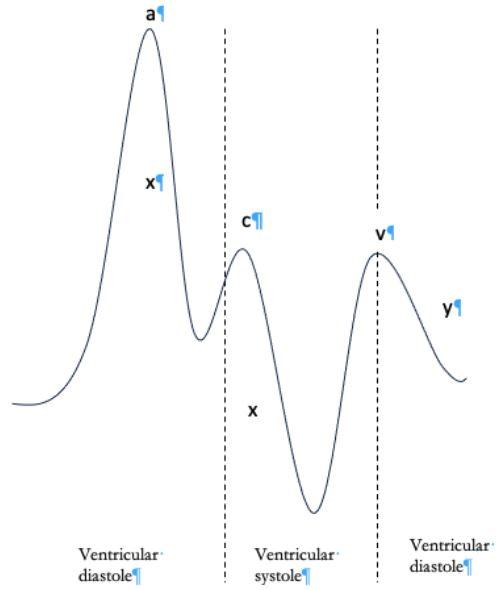
- Atrial contraction produces an ‘atrial kick’. This is responsible for 10% of ventricular filling. The pressure generated during atrial contraction causes an increase in JVP (represented by a wave on the JVP waveform), which also causes an increase in ventricular pressure.
- The blood volume in the ventricle at the end of atrial contraction is the end-diastolic volume.
Isovolumetric ventricular contraction
- As both atria relax, the pressures in the atria start to fall. This allows some passive filling of the right atrium, causing the x descent on the JVP waveform.
- The action potential travels through the atrioventricular node (AV node) via the bundle of His and Purkinje fibres into the ventricles. (QRS on ECG)
- Ventricular contraction results in a rapid rise in intraventricular pressure.
- When intraventricular pressure exceeds atrial pressure, mitral and tricuspid valves close. (First heart sound, S1). Aortic and pulmonary valves remain closed at this stage. Intraventricular volume remains the same.
- Contraction of the right ventricle against a closed tricuspid valve results in a transient rise in atrial pressure transmitted up the SVC, resulting in the c wave on the JVP waveform.
Ventricular ejection
- Intraventricular pressure continues to rise.
- When intraventricular pressure exceeds the pressure in the aortic and pulmonary arteries, aortic and pulmonary valves open, and blood is ejected.
- Initially, intraventricular pressure exceeds aortic pressure, and intraventricular volume and pressure decrease over time as blood in the ventricles is ejected.
- At the end of ventricular contraction, the contracted right ventricle means increased space in the pericardial sac. This allows the right atrium to fill with blood and drops the pressure within the SVC and IVC, producing the x’ descent on the JVP waveform.
- Ventricular myocytes start relaxing after the ejection of blood. Intraventricular pressure falls below the pressure in the aortic and pulmonary arteries, and the aortic and pulmonary valves close (Second heart sound, S2)
Isovolumetric ventricular relaxation
- After aortic and pulmonary valve closure, ventricular relaxation is short before intraventricular pressure falls below atrial pressure. Hence, mitral and tricuspid valves remain closed, and intraventricular volume remains the same.
- Since the late phase of ventricular ejection, there is ongoing venous return into the atria, and volume and pressure in the atrial rise slowly. (Correspond to v wave in JVP waveform)
Passive ventricular filling
- When atrial pressure exceeds ventricular pressure, the mitral and tricuspid valves open, and blood flows down the pressure gradient from the atria into the ventricles.
- The fall in atrial pressure corresponds to y-descent in the JVP waveform.

Image Source: Wikimedia Commons (2016). Wiggers Diagram 2, Licensed under a creative commons licence. Available for free at: https://upload.wikimedia.org/wikipedia/commons/9/91/Wiggers_Diagram_2.svg (Accessed: 4 January 2024).
References
Pollock, J. D., & Makaryus, A. N. (2023). Physiology, Cardiac Cycle. In StatPearls. StatPearls Publishing. http://www.ncbi.nlm.nih.gov/books/NBK459327/
Complete Guide to Clinical Genetics ST3 Application and Recruitment (2027)
Written by Medibuddy. Last updated: October 2026. Clinical Genetics is

Complete Guide to Clinical Radiology ST3 Application and Recruitment (2027)
Recruitment paused: NHS England is not running Clinical Radiology ST3+ recru

Complete Guide to Paediatric Surgery ST3 Application and Recruitment in United Kingdom (2026)
Written by Medibuddy. Last updated: October 2026. If you’re planning


Take your subscriptions with you
Our mobile app allows you to access your interview and exam question banks wherever you are.

