


 Close
Close
 4th February 2024
Cell Cycle
Cell Cycle
Phases
The cell division cycle is divided into two types, dependent on the purpose of cell division.
General phases (interphase)
All cells undergoing cell division will undergo several similar phases during interphase. These are the G1, S and G2 phases.
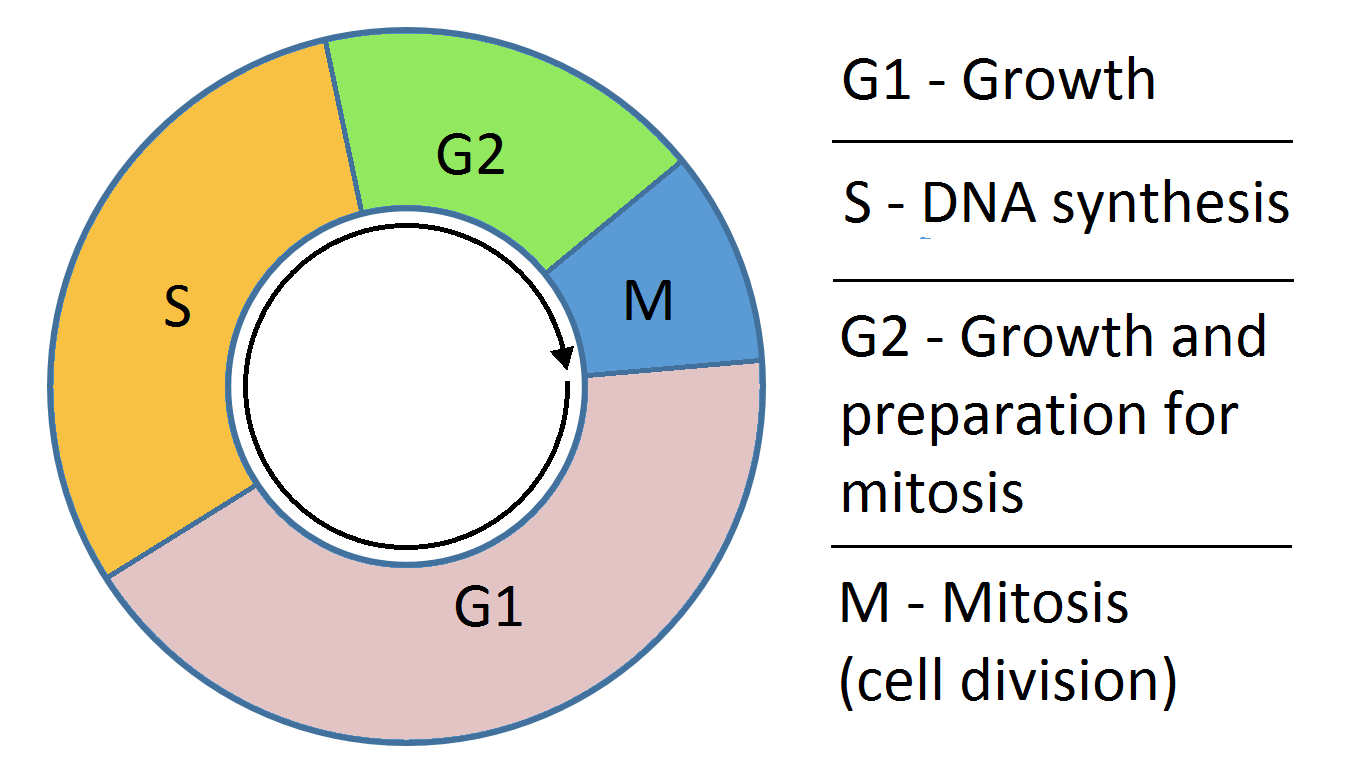
Image obtained from: Simon Caulton, CC BY-SA 3.0
Image Source: Wikimedia Commons (2013). Cell cycle simple, Licensed under a creative commons licence. Available for free at: https://upload.wikimedia.org/wikipedia/commons/f/f7/Cell_cycle_simple.png (Accessed: 21 December 2023)
The G1 phase is the phase where the cells prepare for cell division. In this phase, cells carry out protein and mRNA synthesis to prepare the cell for the subsequent cell division process. Cells in this phase can also enter the dormant phase (G0 phase) if it is signalled to remain undivided. Cells destined to enter the G0 phase will not enter the S phase.
If the cell is signalled to enter the cell division cycle, the cell will enter the S phase. DNA replication and histone synthesis take place during this phase. DNA replication checks also occur during this phase.
The G2 phase allows for rapid cell growth and further protein synthesis in preparation for the cell to enter cell division.
DNA replication
DNA replication begins with the unwinding of the DNA double helix. Topoisomerase aids in this process by relaxing DNA supercoils to allow access to the DNA structure. It also allows temporary breaks in the DNA phosphate backbone to allow the unwinding of the DNA molecule.
Helicase acts to separate the DNA strands into two single strands of DNA. DNA polymerase utilises the unwound DNA strand as a template to begin replication. DNA replication occurs as two separate strands, the leading and the lagging strand. Once completed, a terminus-site binding protein binds to a specific DNA site to terminate DNA replication.
Free DNA nucleosides exist within the nucleus and are used during DNA replication to extend the DNA chain. Of note, dihydrofolate reductase is a crucial enzyme needed to produce tetrahydrofolate. Tetrahydrofolate is an essential cofactor required to synthesise purines and thymidylic acid.

Image adapted from: VWALevi2020, CC BY 4.0
Image Source: Wikimedia Commons (2021). DNA replication, Licensed under a creative commons licence. Available for free at: https://upload.wikimedia.org/wikipedia/commons/8/8c/DNA_replication.png (Accessed: 21 December 2023)
Mitosis
Normal cell division occurs within all somatic cells and is carried out via mitosis. This results in two diploid cells genetically identical to the parent cell.
This process is divided into five main phases:
- Prophase: Condensation of the chromatin into visible chromosomes occurs. Centrosomes begin to migrate to the poles of the cells. Microtubular spindle apparatus begins to form.
- Prometaphase: The nuclear membrane begins to break down. Chromosomes form kinetochores to allow spindle microtubules to attach to this region.
- Metaphase: Chromosomes aligned at the cell equator. Cell cycle checkpoint ensures appropriate alignment to ensure all chromosomes are aligned at the equator with an appropriate connection of the microtubules to the kinetochore.
- Anaphase: Chromosomes are split into sister chromatids and move to opposite cell ends due to microtubule action.
- Telophase: Sister chromatids arrive at the cell poles. Breakdown of spindle fibres with reformation of the nuclear membrane. The chromatids begin to decondense.
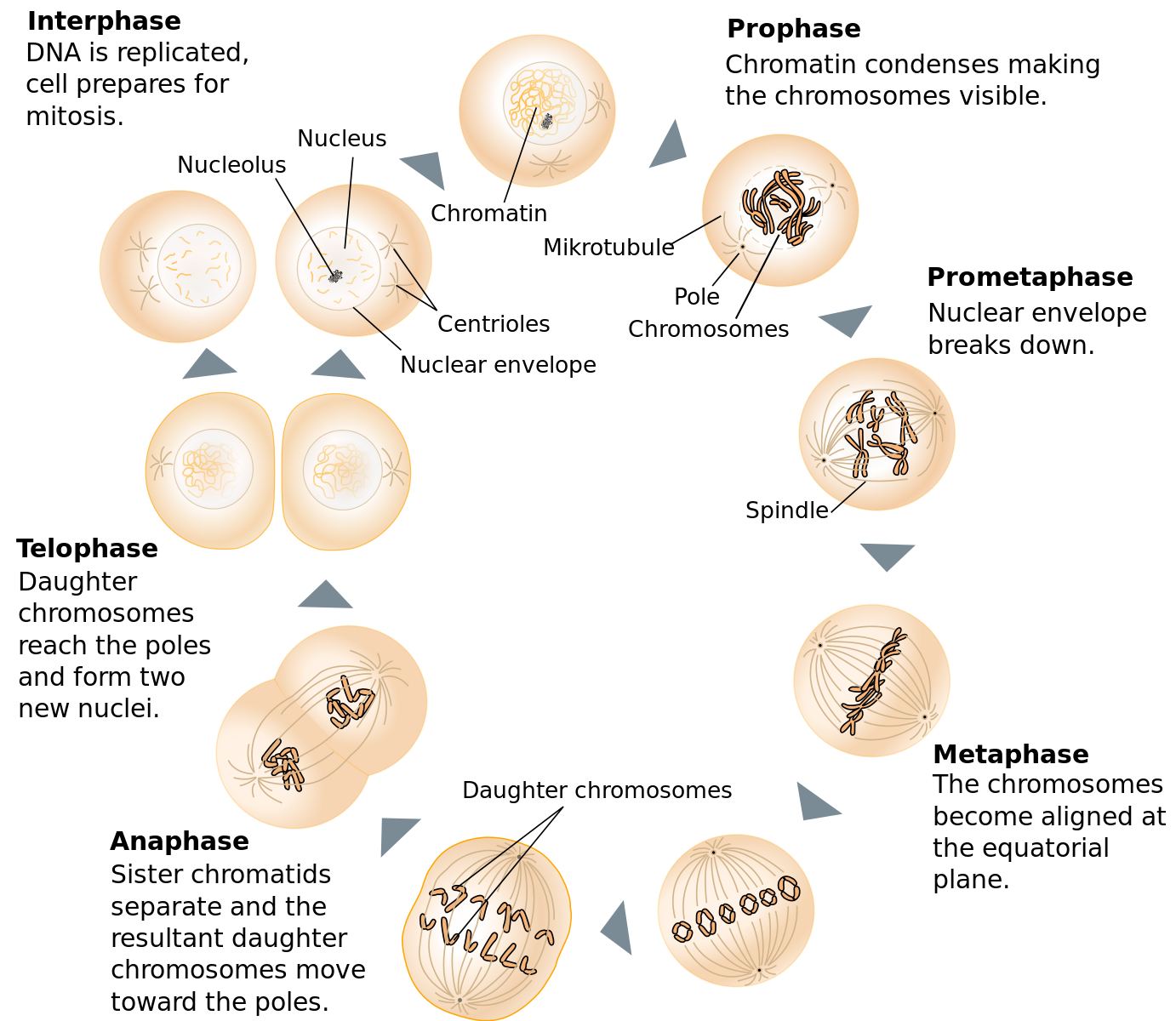
Image adapted from: Jpablo cad and Juliana osoriotranslation: MattDerivative work: M3.dahl, CC BY-SA 3.0
Image Source: Wikimedia Commons (2011). Mitosis_schematic_diagram-en, Licensed under a creative commons licence. Available for free at: https://commons.wikimedia.org/wiki/File:Mitosis_schematic_diagram-en.svg (Accessed: 21 December 2023)
Meiosis
Meiosis occurs within germ cells and produces haploid daughter cells. This form of cell division primarily aims to create gametes with half the total number of chromosomes than the parent cells.
It also allows genetic recombination during meiosis I as homologous chromosomes exchange genetic materials, allowing for unique genetic combinations in each germ cell.

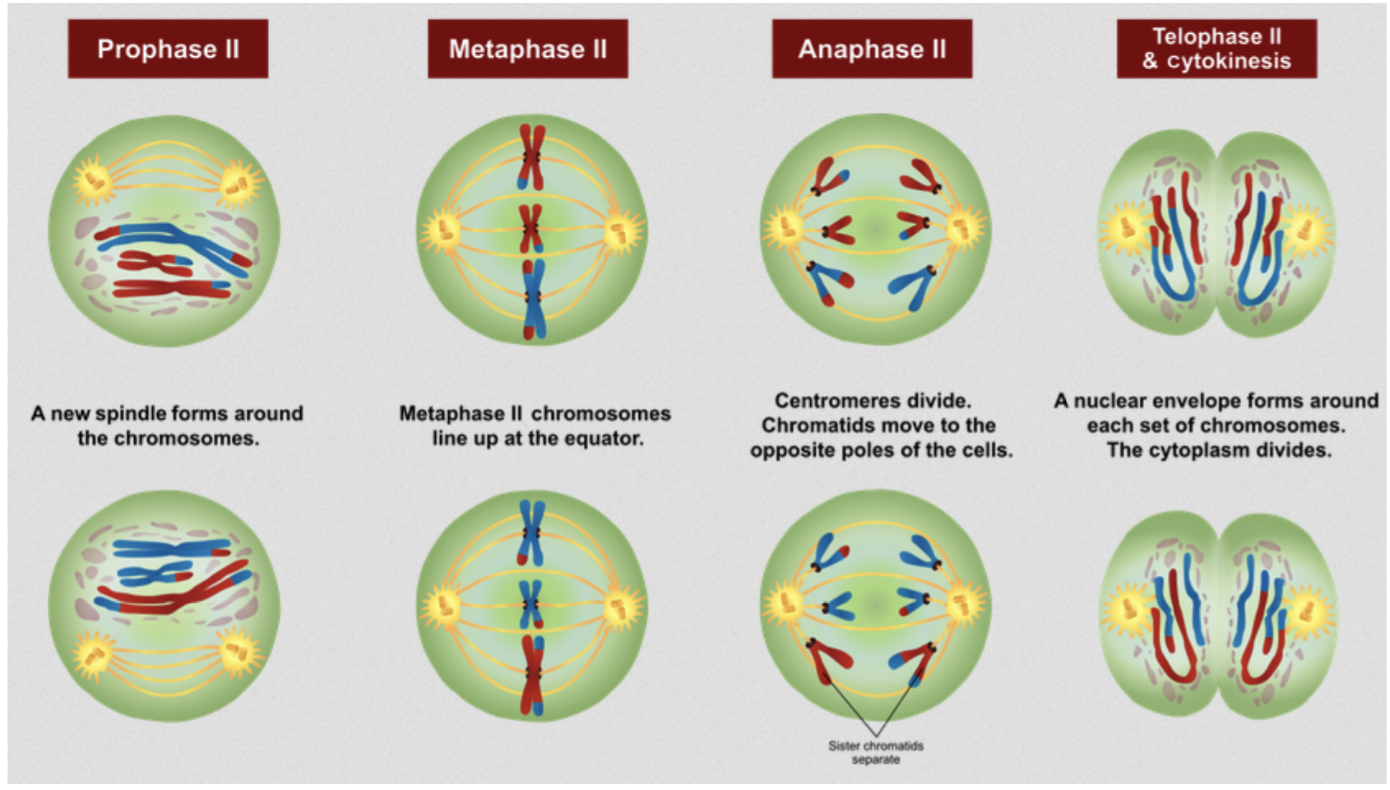
Originally adapted from Ali Zifan, CC BY-SA 4.0
Image Source: Wikimedia (2022). Meiosis Stages ku, Licensed under a creative commons license. Available for free at: https://commons.wikimedia.org/wiki/File:Meiosis_Stages_ku.svg (Accessed: 21 December 2023).
Clinical relevance
Medications used in the field of oncology often target the stages of mitosis to prevent further cell development. Several main classes of chemotherapy medications are often used :
- Antimetabolites – Medications that mimic DNA and RNA nucleotides to be incorporated into the DNA/RNA or by blocking enzymes required for DNA synthesis. Acts on the S-phase of the cell cycle.
- Alkylating agents – Forms covalent bonds between the DNA molecules, resulting in DNA strand breakage. This is cell-cycle independent.
- Anti-microtubule agents – Prevents microtubule formation or disassembly. This results in cell cycle arrest. This acts on the M-phase of the cell cycle.
- Topoisomerase inhibitors – Interfere with normal DNA replication by preventing normal DNA unwinding. It mainly acts on the S-phase of the cell cycle.
Reference
- Trent, R. J. (2012). Chapter 1 – Genes to Personalised Medicine. In R. J. Trent (Ed.), Molecular Medicine (Fourth Edition) (pp. 1–37). Boston/Waltham: Academic Press.
- Read, A., & Donnai, D. (2021). Chapter 2: How do genes work? In New Clinical Genetics: A guide to genomic medicine (4th ed.). United Kingdom: Scoin Publishing Limited.
- Strachan, T., & Read, A. P. (2019). Part 1: Basics of DNA, Chromosomes, Cells, Development, and Inheritance. In Human Molecular Genetics (5th ed.). United States: CRC Press.
- Jorde, L. B., Carey, J. C., & Bamshad, M. J. (2016). Chapter 1: Basic Cell Biology. In Medical Genetics (5th ed.). United States: Elsevier.
- Maitra, A., Kumar, V., Abbas, A. K., & Aster, J. C. (2013). Genetic and Paediatric Diseases. In Robbin’s Basic Pathology (9th ed.): Elsevier.
- Kelsell, D., Bryne, C., & Linton, K. (2012). Molecular cell biology and human genetics. In P. Kumar & M. Clark (Eds.), Kumar and Clark’s Clinical Medicine. Spain: Elsevier Saunders.
Complete Guide to Clinical Genetics ST3 Application and Recruitment (2027)
Written by Medibuddy. Last updated: October 2026. Clinical Genetics is

Complete Guide to Clinical Radiology ST3 Application and Recruitment (2027)
Recruitment paused: NHS England is not running Clinical Radiology ST3+ recru

Complete Guide to Paediatric Surgery ST3 Application and Recruitment in United Kingdom (2026)
Written by Medibuddy. Last updated: October 2026. If you’re planning


Take your subscriptions with you
Our mobile app allows you to access your interview and exam question banks wherever you are.

