


 Close
Close
 11th April 2024
Physiology of the menstrual cycle
Several hormones tightly regulate the mechanisms underpinning fertility and pregnancy. Gonadotrophin-releasing hormone (GnRH) from the hypothalamus stimulates the release of luteinising hormone (LH) and follicle-stimulating hormone (FSH) from the anterior pituitary. This begins the follicular phase, where a steady rise in FSH acts on granulosa cell receptors to cause the conversion of androgens into oestrogen and trigger oocyte development. Androgens are produced by theca cells in response to LH. FSH also promotes follicular development until mid-cycle, where a spike in LH causes ovulation. The residual follicle then becomes the corpus luteum, which produces primarily progesterone, oestrogen, and inhibin A.
Fertilisation of the ovum prevents regression of the corpus luteum. This is due to the production of β-hCG by the trophoblast cells that surround the embryo. β-hCG stimulates the corpus luteum to continue producing hormones which maintain the endometrial lining. However, involution of the corpus luteum occurs in the absence of fertilisation as high β-hCG levels are not sustained. The decrease in progesterone and oestrogen leads to endometrial shedding (menstruation), and the cycle resets with FSH increasing again to develop new follicles.
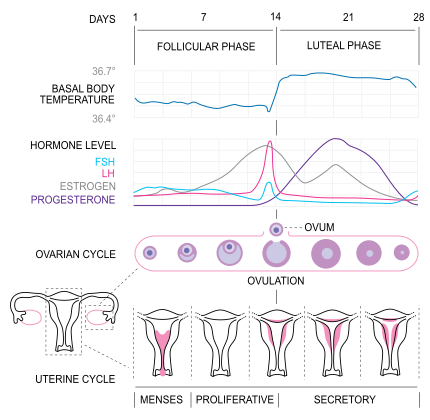
Image source: Wikimedia Commons (2010). MenstrualCycle2 en, Licensed under a Creative Commons licence. Available for free at: https://commons.wikimedia.org/wiki/File:MenstrualCycle2_en.svg (Accessed: 07 February 2024).
| Hormone | Produced where | Function |
|---|---|---|
| GnRH | Hypothalamus | Stimulates the release of FSH and LH |
| FSH | Anterior pituitary | Stimulates the development of a follicle |
| LH | Anterior pituitary | Spike causes ovulation
Development of the endometrium Negative feedback control of FSH and LH |
| Oestrogen | Corpus luteum
Placenta (>5 weeks) |
Stimulates growth of myometrium of the uterus
Mammary gland development |
| Progesterone | Corpus luteum
Placenta (>5 weeks) |
Prepares endometrium for implantation
Mammary gland development Maintains pregnancy and increases threshold for contractions |
| β-hCG | Placenta after implantation | Promotes maintenance of the corpus luteum |
| Prolactin | Anterior pituitary | Milk production and development of mammary glands |
| Inhibin A | Corpus luteum | Inhibits FSH |
Table 1 Overview of the main hormones involved in the menstrual cycle
References
The European Society of Human Reproduction and Embryology. POI Guideline Development Group.
Complete Guide to Clinical Genetics ST3 Application and Recruitment (2027)
Written by Medibuddy. Last updated: October 2026. Clinical Genetics is

Complete Guide to Clinical Radiology ST3 Application and Recruitment (2027)
Recruitment paused: NHS England is not running Clinical Radiology ST3+ recru

Complete Guide to Paediatric Surgery ST3 Application and Recruitment in United Kingdom (2026)
Written by Medibuddy. Last updated: October 2026. If you’re planning


Take your subscriptions with you
Our mobile app allows you to access your interview and exam question banks wherever you are.

