


 Close
Close
 6th February 2024
An Introduction to Metalloproteins
Metalloproteins
Metalloprotein is a broad term applied to any protein which contains a metal ion cofactor. A large number of proteins fall under this category. For example, around 1,000 out of 20,000 human proteins contain zinc-binding domains.
Many physiological processes rely on metalloproteins, such as insulin biosynthesis, respiration, and nerve transmission. A particularly important metalloprotein is haemoglobin, which contains iron.
Haem Synthesis
Haem synthesis takes place in the mitochondria of liver cells and bone marrow. It is a complex pathway, which is outlined below:
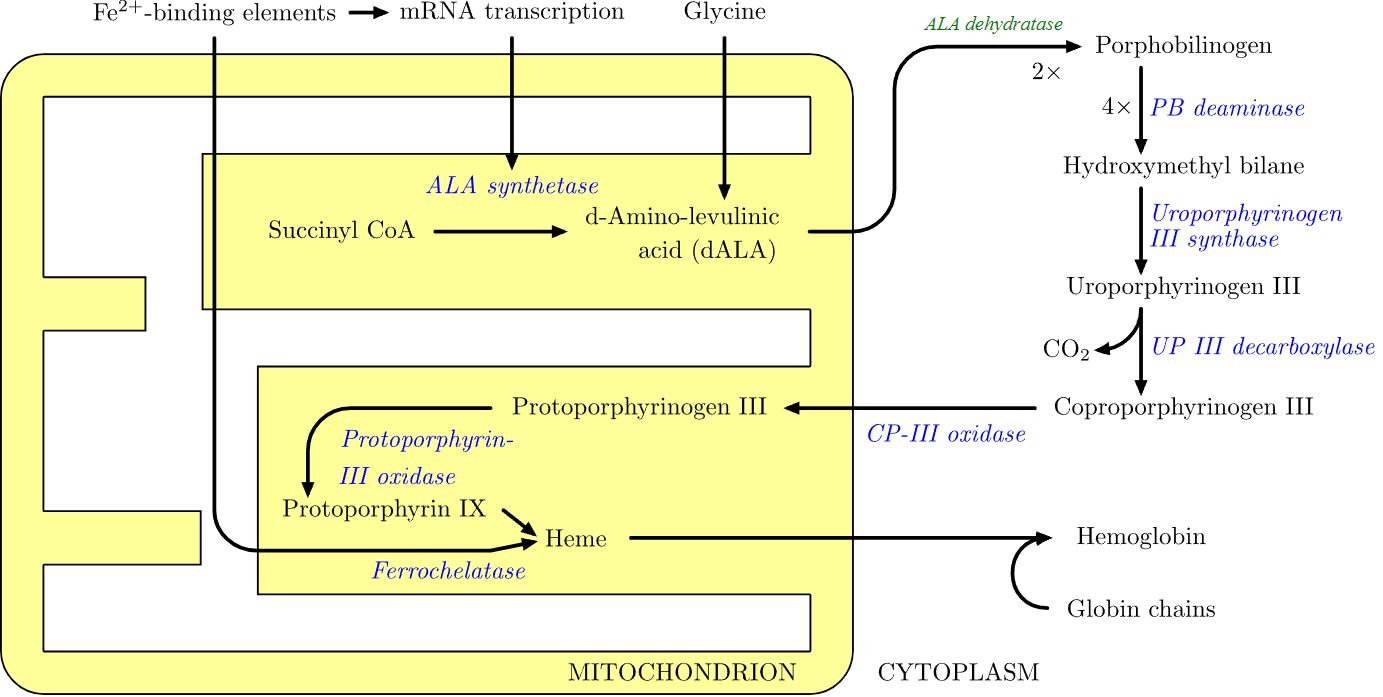
Image Source: Wikimedia Commons (2023). Heme synthesis, Licensed under a creative commons licence. Available for free at: https://upload.wikimedia.org/wikipedia/commons/a/a2/Heme_synthesis.svg (Accessed 4 January 2022).
Porphyria and Metalloproteins
As we have already mentioned, haemoglobin is a vital metalloprotein. Therefore, disorders relating to the synthesis of this protein can lead to clinical abnormalities. One prominent group of such disorders are termed porphyria. These are a group of inherited disorders of haem synthesis resulting in the accumulation of porphyrin and its precursors.
Depending on which enzyme involved in haem synthesis is deficient, there are seven main types of porphyria. This range of possible aetiologies leads to many clinical and biochemical features. The full list comprises
| Porphyria | Enzyme | Inheritance Pattern |
|---|---|---|
| Aminolaevulinic acid dehydratase porphyria (ADP) | Aminolaevulinic acid dehydratase | Autosomal recessive |
| Acute intermittent porphyria (AIP) | Porphobilinogen deaminase | Autosomal dominant |
| Congenital erythropoietic porphyria (CEP) | Uroporphyrinogen III synthase | Autosomal recessive |
| Porphyria cutanea tarda (PCT) | Uroporphyrinogen decarboxylase | Usually, autosomal dominant |
| Hereditary coproporphyria (HCP) | Coproporphyrinogen oxidase | Autosomal dominant |
| Variegate porphyria (VP) | Protoporphyrinogen oxidase | Autosomal dominant |
| Erythropoietic protoporphyria (EPP) | Ferrochelatase | Autosomal dominant |
There are numerous ways of classifying porphyria – most commonly by their clinical features:
- Acute porphyria featuring neuropsychiatric features: ADP and AIP.
- Cutaneous porphyria primarily affects the skin: PCT, EPP, and CEP.
- Mixed porphyria with features of both: VP and HCP.
However, we will focus on the three most clinically relevant porphyria: AIP, VP, and PCT.
References
- Fu, D., Finney, L. (2015). Metalloproteomics: challenges and prospective for clinical research applications. Expert Rey Proteomics, 11(1): 13–19. doi: 10.1586/14789450.2014.876365
- The BMJ (2023, Apr 5). Acute Intermittent Porphyria. https://bestpractice.bmj.com/topics/en-gb/235/treatment-algorithm#
- The BMJ (2023, Apr 5). Acute Porphyrias. https://bnf.nice.org.uk/treatment-summaries/acute-porphyrias/
Complete Guide to Clinical Genetics ST3 Application and Recruitment (2027)
Written by Medibuddy. Last updated: October 2026. Clinical Genetics is

Complete Guide to Clinical Radiology ST3 Application and Recruitment (2027)
Recruitment paused: NHS England is not running Clinical Radiology ST3+ recru

Complete Guide to Paediatric Surgery ST3 Application and Recruitment in United Kingdom (2026)
Written by Medibuddy. Last updated: October 2026. If you’re planning


Take your subscriptions with you
Our mobile app allows you to access your interview and exam question banks wherever you are.

