


 Close
Close
 12th April 2024
Pubertal development
Puberty begins when the hypothalamus starts releasing gonadotrophin-releasing hormone (GnRH) in pulses. GnRH travels into a network of capillaries called the hypophyseal portal system, which then stimulates cells known as gonadotrophs in the anterior pituitary gland to promote the production and release of gonadotrophins of luteinising hormone (LH) and follicle-stimulating hormone (FSH). LH and FSH stimulate the sex organs to produce sex hormones, which act via a negative feedback mechanism to inhibit the secretion of GnRH in the hypothalamus. This is known as the hypothalamus-pituitary-adrenal axis (HPA). Below is an image that illustrates the HPA axis.
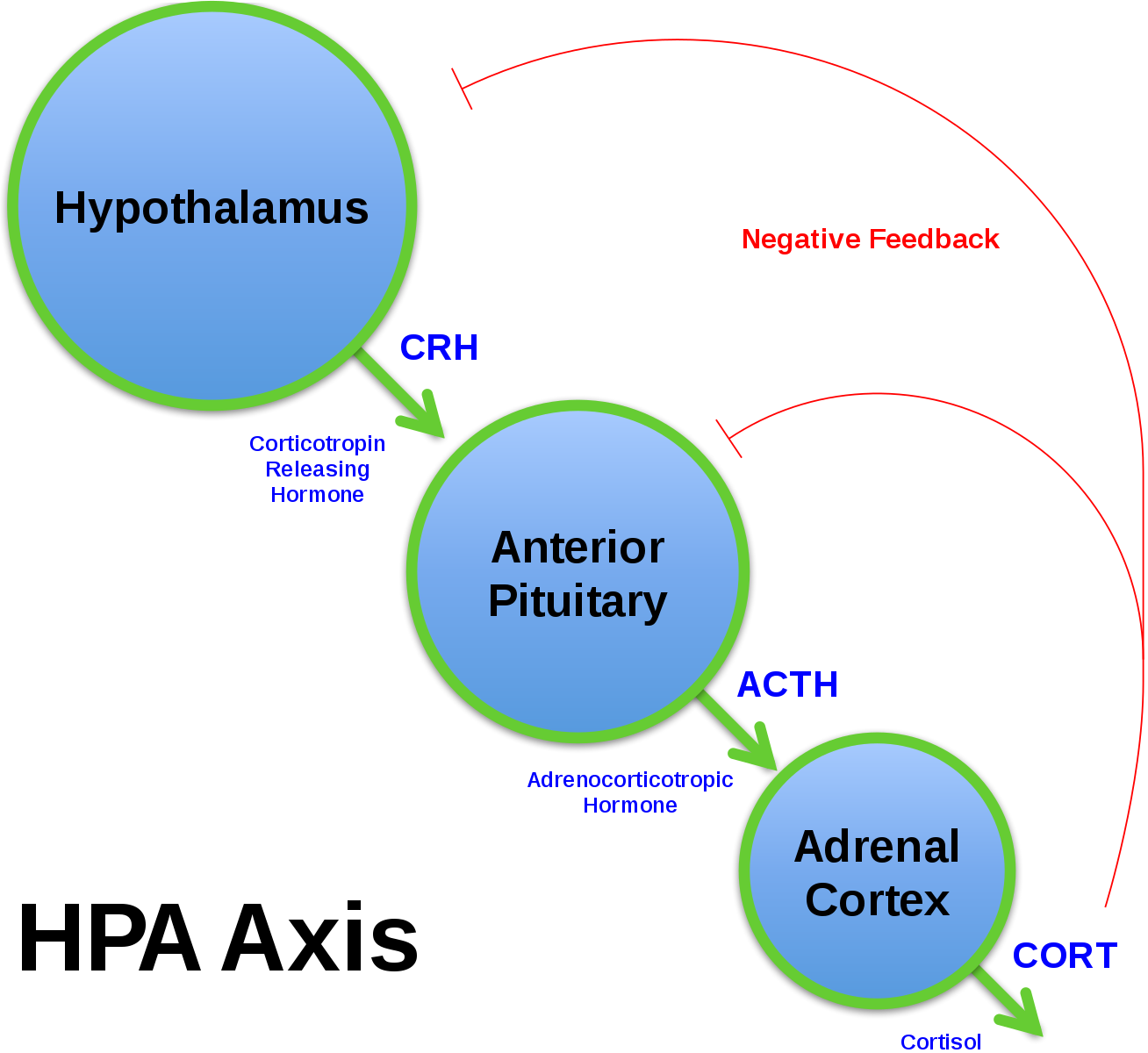
Image source: Wikimedia Commons (2016). HPA Axis Diagram (Brian M Sweis 2012), Licensed under a Creative Commons licence. Available for free at: https://commons.wikimedia.org/wiki/File:HPA_Axis_Diagram_(Brian_M_Sweis_2012).svg (Accessed: 06 February 2024).
In a male XY genotype, LH acts on Leydig cells in the interstitium of the testes to signal the conversion of cholesterol into testosterone. FSH act on the Sertoli cells in the seminiferous tubules of the testes to increase the production of sperm. Testosterone inhibits the production of GnRH and LH via a negative feedback mechanism, while the Sertoli cells produce inhibin to inhibit the production of FSH. Testosterone is important in promoting the development and growth of primary sexual characteristics.
In the female XX genotype, LH acts on the follicles of the ovaries to produce oestrogen and progesterone. The cells of the primary oocyte include theca cells and granulosa cells. Theca cells produce androstenedione in response to LH during puberty. Granulosa cells, in response to FSH, convert androstenedione into oestrogen and progesterone. Both oestrogen and progesterone work to regulate the monthly changes to ovary maturation and changes to the uterine wall, which is what causes the menstrual cycle. Oestrogen acts on the hypothalamus via a negative feedback mechanism to suppress further secretion of GnRH.
The stages and sequence in puberty are described by Tanner stages of puberty, which examines the development of secondary sexual characteristics. In males, the first sign of puberty is testicular enlargement >4mL. This is followed by pubic hair growth and usually takes place between 10 and 14 years. When the testicular enlargement reaches about 12 to 15mL, males often have rapid height growth. In comparison to females, the growth spurt occurs later and to a greater extent. In females, the first sign of puberty is the development of a breast disc, which usually happens in girls around ages 8 to 12. Height and pubic hair growth then follow rapidly. The menstrual cycle then begins approximately 2 years following the first sign of puberty. After the start of menarche, there is only 5cm left for height development.


Image source: Wikimedia Commons (2022). Tanner scale male intact, Licensed under a Creative Commons licence. Available for free at: https://commons.wikimedia.org/wiki/File:Tanner_scale_male_intact.svg (Accessed: 06 February 2024). Image source: Wikimedia Commons (2019). Tanner scale-female, Licensed under a Creative Commons licence. Available for free at: https://commons.wikimedia.org/wiki/File:Tanner_scale-female.svg (Accessed: 06 February 2024).
References
- Lissaue, Tom, Will Carroll, Keir Shiels, and Ranj Singh. Illustrated textbook of paediatrics. Amsterdam: Elservier, 2022
- Klatt, Edward C., and Vinay Kumar. Robbins and COTRAN Review of Pathology. London: Elsevier Health Sciences, 2015
Complete Guide to Clinical Genetics ST3 Application and Recruitment (2027)
Written by Medibuddy. Last updated: October 2026. Clinical Genetics is

Complete Guide to Clinical Radiology ST3 Application and Recruitment (2027)
Recruitment paused: NHS England is not running Clinical Radiology ST3+ recru

Complete Guide to Paediatric Surgery ST3 Application and Recruitment in United Kingdom (2026)
Written by Medibuddy. Last updated: October 2026. If you’re planning


Take your subscriptions with you
Our mobile app allows you to access your interview and exam question banks wherever you are.

