


 Close
Close
 18th March 2024
Drug Allergy and Intolerance
Adverse drug reactions
Overview
Adverse Drug Reactions (ADRs) can be defined as “an appreciably harmful or unpleasant reaction, resulting from an intervention related to use of the medicinal product, which predicts hazard from future administration and warrants prevention or specific treatment, or alteration of drug regime or withdrawal of the product.” Important aspects to consider when labelling a reaction as an ADR include a causal relationship between the medication and the effect (which can be difficult to establish, particularly in the context of polypharmacy) and that the effect observed resulted from a dose which is considered safe in humans.
The effects of ADRs are significant at both an individual and organisation level: 6-7% of hospital admissions are related to ADR. The term “pharmacovigilance” relates to the accountability of healthcare professionals to monitor the safety of medications; in the UK the Medicines and Healthcare products Regulatory Agency (MHRA) and the Commission on Human Medicines (CHM) is ultimately responsible. Clinicians should be familiar with the process for reporting concerns and ADRs, specifically via the Yellow Card Scheme.
Classification of adverse drug reactions
ADRs can be classified into six subtypes with the mnemonic:
- Augmented – dose-related: these result from an increased effect of the drug’s pharmacology when given at the usual dose
- Bizarre – non-dose-related: these cannot be predicted from the drug’s pharmacology
- Chronic – time-related and dose-related: the effect may persist for an extended period of time despite withdrawal of the drug
- Delayed – time-related: the observed effect presents a period of time after the administration of the drug (therefore, these reactions can be particularly difficult to relate to the initial drug)
- End of Use – withdrawal: these include withdrawal effect of the drug after discontinuation
- Failure – failure of therapy
Of the ADRs described above, the most common type is an augmented/dose-related; these constitute 80% of ADRs.
In this way, type A may be considered pharmacological and type B immunological:
Type A reactions: These may arise from pharmacokinetic or pharmacodynamic variations. At this point, we can review what is meant by these terms:

Examples of pharmacokinetic causes of ADRs include pharmacogenetic variations. Application of pharmacogenetics within clinical practice is rapidly increasing as genetic variations are identified which affect a particular drug’s pharmacokinetics within an individual: this allows individual assessment of a drug’s safety and efficacy and can advise dosing. A clinical example is checking a patient’s thiopurine S-methyltransferase (TPMT) prior to initiation of azathioprine therapy. Specific genetic variations within the TPMT gene affect the metabolism of azathioprine; patients with genetic mutations that confer a low TPMT activity may be unable to effectively metabolise azathioprine causing build-up and risk of myelosuppression. Conversely, patients with higher TMPT levels may metabolise azathioprine more effectively than others, necessitating a higher dose.
Pharmacodynamic-mediated ADRs may occur when multiple drugs taken in combination have similar, potentiating or competing, antagonistic effects on their specific target site, often at a receptor level. A different example is that of a cutaneous folliculitis associated with endothelial growth factor receptor (EGFR) antagonists. EGFR is a common target in a variety of cancer therapeutics, but its blockade is associated with a rash that is dose-dependent and can limit its use.
Type B reactions: These are non-dose dependent and considered to have an immunological basis. Here, we can consider Gell and Coombs’ classification of hypersensitivity reactions:
Gell and Coombs classification of drug reactions

In the context of drug reactions:
Type I: Drug-induced anaphylaxis is one of the most common causes of anaphylaxis, especially in inpatients and in older populations. Furthermore, when anaphylaxis is secondary to drugs it is associated with a worse prognosis. It can be related to any drug, however non-steroidal anti-inflammatory drugs (NSAIDs) and antibiotics (penicillins) are the most common culprits.
Type II: Reactions include heparin induced hypersensitivity. This occurs due to activation of IgG antibodies against heparin-platelet factor 4 complexes.
Type III: A Streptococcal throat infection leading to immune complex deposition in the kidney causing glomerulonephritis usually within 10 to 21 days.
Type IV: Examples of drug-induced delayed hypersensitivity reactions mediated by T cells include: DILI (drug-induced liver injury), DRESS (drug reaction with eosinophilia and systemic symptoms), TEN (toxic epidermal necrolysis), DIA (drug-induced agranulocytosis) and AGEP (acute generalised exanthematous pustulosis).
Severe Cutaneous Adverse Reactions (SCARs)
SCARs comprise of several distinct conditions with overlapping features. They are all T cell-mediated:
- Acute Generalised Exanethematous Pustulosis (AGEP) – a rare pustular drug eruption characterised by superficial pustules which usually develop within two days of exposure to the culprit medication. The rash usually starts on the face or in axillary folds and may be associated with a fever, however patients very rarely deteriorate in contrast to other SCARs
- Drug Reaction with Eosinophilia and Systemic Symptoms (DRESS) – a severe multi-organ drug reaction including pyrexia, morbilliform skin eruption, eosinophilia and hepatic injury. Lymphadenopathy is often a feature. It is particularly associated with anticonvulsant medication. DRESS is slower to develop than AGEP and is usually seen within two to eight weeks of starting the responsible medication. Immediate withdrawal of the culprit drug is warranted and systemic immunosuppression is often required. Many patients require intensive care and this condition is associated with significant morbidity and mortality.
- Toxic Epidermal Necrolysis (TEN) – a very rare adverse drug reaction more commonly seen in drugs with longer washout periods. Timing of presentation can be variable but is usually within four weeks of drug exposure. TEN is more common in patients with Human Immunodeficiency Virus. Appearance of a painful, erythematous, diffuse rash is often preceded by pyrexia and flu-like illness. Mucosal involvement can be extremely severe with ocular, gastrointestinal, genital, urinary and respiratory tract pathology. Shock and multiple organ failure can develop rapidly.
Important adverse drug reactions
| ACE inhibitors | Blurred vision, dry cough, hyperkalaemia, headache, syncope |
| Acetylcysteine | Abdominal pain and diarrhoea, hypersensitivity reactions, stomatitis, tinnitus |
| Amiodarone | Arrhythmias, cutaneous reactions, hepatic dysfunction, CYP inhibition (potentiating the effects of colchicine/fluconazole/warfarin), hepatotoxicity, prolonged washout period, thyrotoxicosis |
| Azathioprine (particularly those with TPMT deficiency) | Agranulocytosis, alopecia, anaemia, bone marrow suppression, hypersensitivity reactions, increased susceptibility to infections, leucopaenia, pancreatitis, severe cutaneous adverse reactions (SCARs), thrombocytopaenia |
| Beta blockers | Gastrointestinal disturbance, headache, insomnia, nausea, syncope, worsening of psoriasis |
| Bisphosphonates | Osteonecrosis of the jaw, GI erosions, hypocalcaemia |
| Carbamazepine | Aplastic anaemia, cutaneous reactions, DRESS, dry mouth, gastrointestinal disturbance, headache, hyponatraemia, lecuopaenia, movement disorders, visual disturbance, weight gain |
| Corticosteroids | Acne, insomnia, pancreatitis, psychosis, skin striae, weight gain (fluid retention and increased appetite), hyperglycaemia |
| Heparin | Bruising, haemorrhage, (epistaxis, haemoptysis, menorrhagia, haematuria) HIT (heparin-induced thrombocytopaenia) |
| Hydroxycarbamide | Alopecia, anaemia, cutaneous vasculitis, dermatomyositis, mucositis, neutropaenia, pancreatitis, photosensitivity, thrombocytopaenia |
| Leflunomide | Abdominal pain, alopecia, leucopaenia, peripheral neuropathy, teratogenicity |
| Lithium | Alopecia, angioedema, arrhythmias, atrioventricular block, cardiomyopathy, cerebellar syndrome, electrolyte derangement, encephalopathy, goitre, hyperglycaemia, hyperparathyroidism, idiopathic intracranial hypertension, memory loss, movement disorders nephropathy, peripheral neuropathy, QT prolongation, teratogenicity, thyrotoxicity, tremor, visual disturbance |
| Methotrexate | Anaemia, co-prescription of folate inhibitors risks significant myelosuppression, cutaneous reactions, pulmonary toxicity |
| Natalizumab | Alopecia, anaemia, hypersensitivity, increased susceptibility to infections, leucopaenia, myocardial infarction, progressive multifocal leucoencephalopathy |
| Platinum-based chemotherapy | Alopecia, anaemia, cardiotoxicity, hepatotoxicity, leucopaenia, neutropenia, nephrotoxicity, ototoxicity, pulmonary fibrosis, thrombocytopenia |
| St John’s Wort | Dry mouth, gastrointestinal disturbance, nausea, serotonin syndrome |
| Thiazolidinediones | Fluid retention and congestive heart failure, hepatotoxicity, macular oedema, ovarian hyperstimulation and teratogenicity, transitional cell carcinoma of the bladder |
References
- Edward IR, Aronson JK. Adverse drug reactions: definitions, diagnosis and management. Lancet 2000;356(9237):1255-1259
- National Institute for Clinical Excellence: Adverse Drug Reactions, last reviewed March 2017: https://cks.nice.org.uk/topics/adverse-drug-reactions/
- World Health Organisation. Collaborating Centre for International Drug Monitoring, Safety Monitoring of Medicinal Products, Guidelines for setting up and running a Pharmacovigilance Centre. Uppsala: World Health Organisation; 2000
- Böhm R, Proksch E, Schwarz T, Cascorbi I. Drug Hypersensitivity. Dtsch Arztebl Int. 2018 Jul 23;115(29-30):501-512
- Gauba V, Saldanha M, Vize C, Saleh GM. Thiopurine methyltransferase screening before azathioprine therapy. Br J Ophthalmol. 2006 Jul;90(7):923-4
Anaphylaxis
Anaphylaxis is a rapid-onset, severe, systemic hypersensitivity reaction characterised by airway or circulatory compromise often accompanied by cutaneous features. Approximately 1 in 1333 of the UK population experience anaphylaxes during their lifetime.
Anaphylaxis can result from a number of triggers, but the three largest common groups include food, drugs and venom. The significance of these varies from childhood to adulthood; food is particularly important in the paediatric population. Within food, nuts are the most common culprit but other significant groups include legumes and shellfish. Various classes of drugs are well-known to be associated with increased risk of anaphylaxis and these include antibiotics (notably penicillins and cephalosporins) and anaesthetic agents. Drug-induced anaphylaxis is associated with more rapid and severe reactions with higher mortality, especially when the medication is administered intravenously.
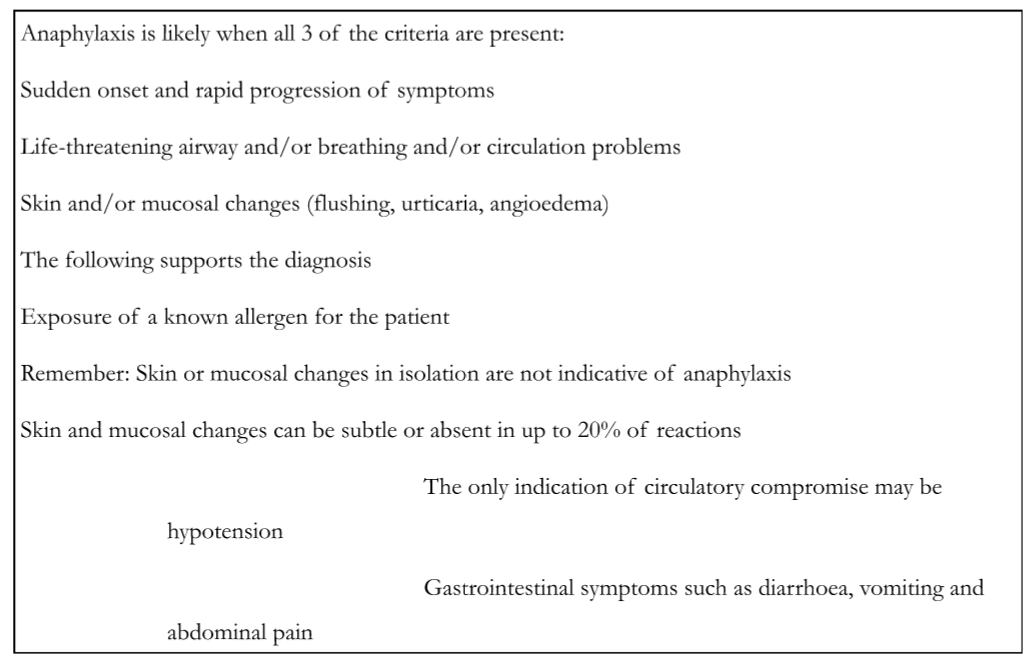
Adapted from: https://www.bsaci.org/wpcontent/uploads/2020/01/Emergencytreatmentofanaphylacticreactions2008.pdf
Pathophysiology of anaphylaxis
Symptoms of anaphylaxis are mediated by extensive release of histamine from mast cells and basophils. Degranulation of these cells is triggered by cross-linking of antigen-specific IgE binding to high affinity receptors expressed on the surface of the mast cells and basophils. Histamine released causes systemic symptoms, including vasodilation, tissue oedema and bronchoconstriction, resulting in hypotension, intravascular volume depletion and airway constriction. The cumulation of these features causes hypoxia, hypotension and shock with loss of organ perfusion.
It is important to note that a significant proportion of reactions result from mast cell and basophil activation independent from IgE; these reactions are termed anaphylactoid. Common causes include non-steroidal anti-inflammatories and contrast media. Vancomycin is a well-known cause of anaphylactoid reaction and is sometimes termed “Red Man Syndrome”. Presentation of anaphylactoid reactions and, therefore, their management is identical to that of anaphylaxis.
Treatment of anaphylaxis
Prompt recognition of symptoms is essential. Removal of the trigger is especially important, particularly in the context of medications, for example, disconnecting intravenous medications. Adrenaline and fluid replacement are central to the management of anaphylaxis. Acute management is defined by the emergency treatment of anaphylaxis guidelines produced by the UK Resuscitation Council. This was updated in 2021 and significant changes to previous guidance include:
- Emphasis on prompt administration of IM adrenaline with dose repeated at 5 minutes if symptoms persist
- Advice to avoid sudden postural changes and maintain a supine position
- Treatment of refractory anaphylaxis and early involvement of definitive airway support if appropriate
- Corticosteroids are no longer recommended in the management of emergency anaphylaxis
- Antihistamines are considered third-line agents and do not form part of the initial management
- Guidance relating to monitoring of patients following stabilisation and safe discharge
- Consideration of fast-track discharge following a two hour observation period may be appropriate in the context of: a good response to a single dose of adrenaline with complete resolution of symptoms in a patient in possession of unused auto-injectors, trained in their use with adequate supervision following discharge
Drug Induced Anaphylaxis (DIA)
Incidence of DIA is increasing with development of new medications and increased awareness and reporting of cases. As discussed above, medications are common causes of anaphylaxis and are associated with higher mortality than reactions caused by venom or food; drug-induced cases represent up to 58% of fatal anaphylaxis. Non-steroidal anti-inflammatory drugs are the most common culprits of DIA followed by beta-lactam antibiotics, particularly amoxicillin. Modern radiocontrast media is less frequently associated with DIA due to non-ionic, low osmolar agents. Proton pump inhibitors are increasingly frequently linked to DIA, most commonly lansoprazole. Additionally, it is important to recognise the risk of topical agents including chlorhexidine and latex. Excipients in vaccines such as egg lecithin and recently polyethylene glycols in COVID vaccines, as well as a variety of medications including proton pump inhibitors and laxatives, have been identified as anaphylaxis culprits.
Risk factors for increased severity of reactions include increasing age and intravenous administration. Co-factors are also known to influence DIA risks, such as co-morbidities (including asthma), alcohol, menstruation and psychological stress.
Immunologic anaphylaxis can result from both IgE dependent and IgE independent pathways. Certain drugs are more commonly associated with one pathway rather than the other (such as penicillin associated with IgE) and some, such as contrast media, can be associated with both. IgE dependent anaphylaxis requires sensitisation during which T helper cells are activated (in this case by the medication) and induce IgE production specific to the antigen. The IgE independent pathway is orchestrated by IgG or complement; the mechanism is not yet fully described in humans. Finally, as described above, an anaphylaxis reaction can result from direct activation of mast cells and basophils. The sensitisation process is not required in anaphylactoid reactions.
Latex-fruit syndrome
There is a significant crossover observed between allergic reactions to certain foods and latex. Up to 40% of patients with latex allergy demonstrate reactions to one or more fruits including strawberry, kiwi, banana and tomato. This is hypothesised to be due to structurally similar proteins on the surface of latex and specific foods. Although the term “latex fruit syndrome” is used, the phenomenon is not limited to fruit and is observed with a variety of vegetables, too. This syndrome demonstrates the importance of a careful allergy history as well as an awareness of cross-sensitivity.
Investigations for DIA
As in all allergic diseases, a careful and chronological history is essential. The temporal relationship between drug administration and symptoms is important, as in true anaphylaxis, the reaction is rapid (within minutes). In the acute setting, serial serum mast cell tryptase measurements may be useful to confirm mast cell activation and anaphylaxis. Levels may not rise until 30 minutes after the onset of symptoms and peak at 1-2 hours. Tryptase has a short half-life and timing of measurements must be carefully documented as levels may have normalised within 6 hours. It is important to remember that a normal tryptase level does not exclude anaphylaxis.
Despite thorough history-taking, identification of the causative medication can be difficult and, particularly in the case of polypharmacy, further investigations may be helpful. Skin prick testing (SPT) may be less informative than in the investigation of food and venom-induced anaphylaxis and is poorly validated except in specific examples. Intradermal testing can be used in the context of negative SPT using increasing concentrations of diluted medication and observing for symptoms. Similarly, specific IgE testing in the context of medications can be of limited use; therefore, often, direct oral challenge is required. While sometimes it is feasible to avoid certain medications for some patients, there are examples when it is important to definitively prove or disprove hypersensitivity. Examples of this may include concerns of antibiotic-induced anaphylaxis in patients requiring long-term or prophylactic antibiotics such as bronchiectasis or in patients requiring procedures under general anaesthetic.
References
- Resuscitation Council UK. Emergency treatment of anaphylaxis: guidelines for healthcare providers. May 2021 https://www.resus.org.uk/sites/default/files/202105/Emergency%20Treatment%20of%20Anaphylaxis%20May%202021_0.pdf
- Montañez MI, Mayorga C, Bogas G et al. Epidemiology, mechanisms, and diagnosis of drug-induced anaphylaxis. Front Immunol 2017;8:614
Complete Guide to Clinical Genetics ST3 Application and Recruitment (2027)
Written by Medibuddy. Last updated: October 2026. Clinical Genetics is

Complete Guide to Clinical Radiology ST3 Application and Recruitment (2027)
Recruitment paused: NHS England is not running Clinical Radiology ST3+ recru

Complete Guide to Paediatric Surgery ST3 Application and Recruitment in United Kingdom (2026)
Written by Medibuddy. Last updated: October 2026. If you’re planning


Take your subscriptions with you
Our mobile app allows you to access your interview and exam question banks wherever you are.

