


 Close
Close
 30th August 2024
Main classes of drugs and their adverse effects
An adverse drug reaction is a harmful, unintended consequence of taking medication. Drug reactions are classified into five groups which are summarised in the table below.
| Type | Description | Example |
|---|---|---|
| A | Dose-dependent and predictable reactions based on the pharmacological action of the drug. | Hypoglycaemia from insulin |
| B | Idiosyncratic, unpredictable reactions not related to the pharmacological action of the drug. | Anaphylaxis from penicillin |
| C | Reactions associated with long-term use of a drug and involve a cumulative dose. | Osteoporosis from corticosteroids |
| D | Delayed reactions that become apparent sometime after use of the drug. | Carcinogenesis from chemotherapy |
| E | Withdrawal reactions that occur when a drug is stopped abruptly. | Rebound hypertension from clonidine |
Anticoagulants
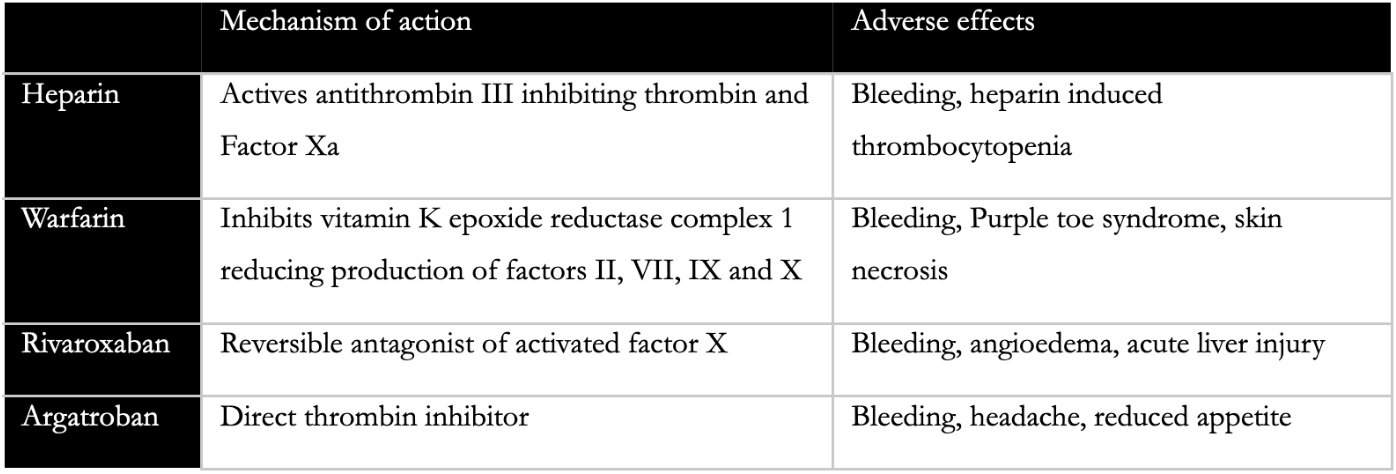
Anticoagulants are used for the prevention or treatment of thromboembolic events. The different types of anticoagulants are low molecular weight heparins, vitamin K antagonists (e.g., warfarin), direct oral anticoagulants (e.g., rivaroxaban), and direct thrombin inhibitors (e.g., argatroban). Their mechanisms of action are depicted in the image below.
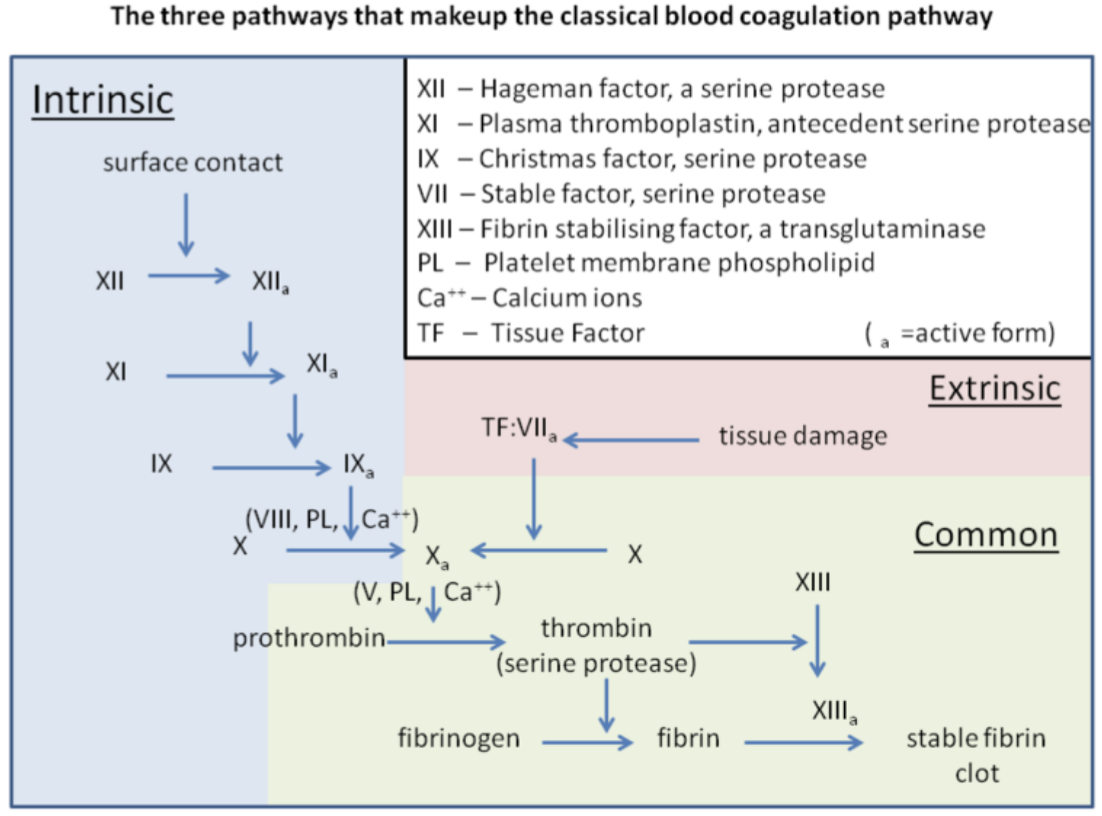
Image Source: mage Source: Wikimedia Commons (2012). Classical blood coagulation, Licensed under a creative commons licence. Available for free at: https://commons.wikimedia.org/wiki/File:Classical_blood_coagulation_pathway.png (Accessed 29 August 2024)
Heparin induced thrombocytopaenia
Heparin-induced thrombocytopenia (HIT) is classified into two types: HIT type 1 and HIT type 2. HIT type 1 is a non-immune condition where heparin directly causes platelet aggregation and is less severe than HIT type 2.
HIT type 1 occurs in about 10% of patients within 72 hours of starting heparin treatment. It involves a modest drop in platelet count, rarely below 100 (normal 150-400 *109/L) and is not linked to an increased risk of thrombosis. Symptoms improve once heparin is discontinued.
HIT type 2 is an immune-mediated reaction occurring within 10 days of starting heparin. Platelet factor 4 (PF4) forms immune complexes with heparin, accumulating on platelets and activating them. This triggers the release of more PF4, creating a positive feedback loop. Procoagulant microparticles are then released, leading to excessive thrombin formation, consumptive thrombocytopenia, and a high risk of thrombosis. These characteristics make HIT type 2 a significant clinical concern.
Opioids
Opioids, including natural opiates like morphine and synthetic analogues such as oxycodone, act on opioid receptors in the central nervous system to provide rapid relief for acute severe pain or chronic pain in palliative care. They can cause respiratory depression, nausea, vomiting, pinpoint pupils, constipation, and itching. Prolonged use can lead to physical dependence, necessitating careful management to avoid withdrawal symptoms like sweating, tremors, anxiety, and cravings. Oxycodone is contraindicated in patients with acute hepatic failure.
Immunosuppressants
Immunosuppressant medications are essential for treating chronic inflammatory diseases, autoimmune disorders, and preventing organ rejection post-transplantation. Examples include azathioprine and mercaptopurine, ciclosporin, methotrexate, mycophenolate and tacrolimus. However, their use increases susceptibility to infections by suppressing the innate, cellular and humoral immune response.
Azathioprine
Azathioprine is converted to its active form, 6-mercaptopurine, which disrupts nucleic acid production as a purine analogue. Adverse effects include bone marrow suppression, nausea, vomiting, and pancreatitis. Testing for thiopurine methyltransferase (TPMT) activity before treatment is recommended, as individuals with low enzyme activity are at greater risk of developing myelosuppression from thiopurine therapy.
Ciclosporin
Ciclosporin, an immunosuppressive drug, works by inhibiting T-cell activation. A key step in this process is the influx of calcium into T-cells, which activates the enzyme calcineurin. Calcineurin then dephosphorylates transcription factors like NF-AT, which triggers the production of interleukin-2 (IL-2) and other cytokines that regulate T-helper cells and inflammation. Ciclosporin binds to cyclophilin, forming a complex that blocks calcineurin activity. This inhibition reduces IL-2 synthesis, thereby suppressing the immune response.
Ciclosporin use is associated with numerous side effects, including gingival hyperplasia, hirsutism, convulsions, hypertension, immunosuppression, gastrointestinal disturbances, liver and kidney problems, hyperkalaemia and peripheral neuropathy. Of particular concern is the increased risk of skin cancers due to its immunosuppressive effects.
Methotrexate
Methotrexate, classified as an antimetabolite, acts distinctly in neoplastic and inflammatory conditions. In neoplasms, it functions as a potent inhibitor of dihydrofolate reductase, crucial for converting dihydrofolate to tetrahydrofolate—a cofactor essential for nucleotide synthesis. This inhibition halts DNA and RNA synthesis, effectively suppressing the proliferation of cancer cells.
In inflammatory disorders, it inhibits DNA and RNA synthesis, suppresses immunoglobulins crucial for immune responses, reduces B lymphocytes, and dampens cytokine production. These mechanisms collectively modulate inflammation.
Methotrexate therapy carries a range of potential adverse effects, such as macrocytic anaemia from folate deficiency, immunosuppression, mucositis, leukopenia, gastrointestinal disturbances, and possible impacts on renal and hepatic function. Additionally, it is teratogenic, increasing the risk of birth defects and additional neoplasms. Pulmonary fibrosis is also a significant concern associated with its use.
Mycophenolate
Mycophenolic acid, also known as mycophenolate, is a compound of fungal origin that exerts its pharmacological effects as a prodrug. Central to its mechanism of action is the inhibition of inosine monophosphate dehydrogenase (IMPDH), an enzyme critical to the de novo synthesis of purines. Given that purines can be acquired through two distinct pathways – de novo synthesis and the salvage pathway – and that leukocytes predominantly rely on de novo synthesis for their purine requisites, the inhibition of IMPDH by mycophenolic acid effectively impairs purine biosynthesis, resulting in the downregulation of inflammatory cells, particularly T and B lymphocytes, through the inhibition of DNA synthesis.
Despite its therapeutic benefits, the use of mycophenolic acid requires careful monitoring due to potential adverse effects. Common side effects include gastrointestinal disturbances, nausea, anaemia, agranulocytosis, metabolic acidosis and immunosuppression, which has led to the association with progressive multifocal leukoencephalopathy.
Tacrolimus
Tacrolimus is a potent immunosuppressant that targets T-cells by interacting with the protein FKBP12 to form a complex that blocks calcineurin activity. This blockade prevents T-cell activation and interleukin-2 (IL-2) Tacrolimus is a crucial immunosuppressant in post-transplant care. It presents with a spectrum of potential adverse effects across various physiological systems. Cardiovascular effects, notably hypertension and arrhythmias, are critical concerns post-transplant. Central nervous system impacts such as headaches and tremors can significantly affect daily functioning. Dermatologically, tacrolimus may induce acne and pruritus. Endocrine and metabolic effects include the development of new-onset diabetes mellitus after transplantation (NODAT) and electrolyte imbalances like hyperkalaemia and hypomagnesemia, necessitating meticulous management. Gastrointestinal side effects such as nausea and diarrhoea can lead to dehydration and exacerbate electrolyte disturbances if not properly controlled. Tacrolimus also heightens susceptibility to infections, including urinary tract infections and opportunistic infections, requiring vigilant monitoring. Renal function is particularly vulnerable to tacrolimus-associated nephrotoxicity, necessitating continuous assessment and careful dosage adjustment.
Corticosteroids
Corticosteroids exert their therapeutic effects by activating cytoplasmic receptors, which then translocate to the nucleus to modify transcription. This process leads to the downregulation of pro-inflammatory molecules and the upregulation of anti-inflammatory proteins. One notable complication is oral candidiasis, resulting from immunosuppression that predisposes the oral mucosa to fungal colonisation. Prolonged corticosteroid use can also suppress the Hypothalamic-Pituitary-Adrenal (HPA) axis, reducing endogenous cortisol production and requiring careful tapering to avoid adrenal crisis.
Long-term use may also compromise skeletal integrity, increasing the risk of osteoporosis and avascular necrosis. The pathogenesis involves decreased bone formation and enhanced resorption, with avascular necrosis particularly affecting the femoral head. Metabolic derangements, such as glucose intolerance, heighten the risk of iatrogenic diabetes mellitus. Psychiatric manifestations, ranging from mood alterations to psychosis, necessitate thorough psychiatric assessment in predisposed individuals. Gastrointestinal complications, notably peptic ulceration, are exacerbated by concurrent NSAID use. Additionally, the immunosuppressive effects increase susceptibility to fungal, mycobacterial, and viral infections.
Statins
Statins play a pivotal role in atherosclerosis management by inhibiting the 3-hydroxy-3-methyl-glutaryl coenzyme A (HMG CoA) reductase enzyme, crucial in cholesterol biosynthesis. This inhibition leads to reduced hepatic cholesterol production and increased clearance of low-density lipoprotein (LDL) cholesterol from the blood. While effective in lowering cardiovascular risk, statins are associated with adverse effects such as myopathy and the more severe rhabdomyolysis, characterised by significant muscle damage and potential renal impairment. Other common side effects include headaches and gastrointestinal disturbances, including dyspepsia and diarrhoea. Despite these potential drawbacks, the benefits of statins in cardiovascular disease prevention are significant, necessitating careful monitoring and management of these adverse effects to ensure continued patient compliance and therapeutic efficacy.
References
- British National Formulary. Heparin (unfractionated). In: BNF [Internet]. London: BMJ Group and Pharmaceutical Press; [cited 2024 May 15]. Available from: https://bnf.nice.org.uk/drugs/heparin-unfractionated/#side-effects
- British National Formulary. Warfarin sodium. In: BNF [Internet]. London: BMJ Group and Pharmaceutical Press; [cited 2024 May 15]. Available from: https://bnf.nice.org.uk/drugs/warfarin-sodium/#side-effects
- British National Formulary. Rivaroxaban. In: BNF [Internet]. London: BMJ Group and Pharmaceutical Press; [cited 2024 May 15]. Available from: https://bnf.nice.org.uk/drugs/rivaroxaban/#side-effects
- British National Formulary. Argatroban monohydrate. In: BNF [Internet]. London: BMJ Group and Pharmaceutical Press; [cited 2024 May 15]. Available from: https://bnf.nice.org.uk/drugs/argatroban-monohydrate/#side-effects
- Thomson AW, Bonham CA, Zeevi A. Mode of action of tacrolimus (FK506): molecular and cellular mechanisms. Ther Drug Monit. 1995 Dec;17(6):584-91. doi: 10.1097/00007691-199512000-00007. PMID: 8588225
- Sharma H, Wadhwa R. Mercaptopurine. [Updated 2023 May 22]. In: StatPearls [Internet]. Treasure Island (FL): StatPearls Publishing; 2024 Jan-. Available from: https://www.ncbi.nlm.nih.gov/books/NBK557620
- Allison AC. Mechanisms of action of mycophenolate mofetil. Lupus. 2005;14 Suppl 1:s2-8. doi: 10.1191/0961203305lu2109oa. PMID: 15803924
- Cronstein, B.N., Aune, T.M. Methotrexate and its mechanisms of action in inflammatory arthritis. Nat Rev Rheumatol 16, 145–154 (2020). https://doi.org/10.1038/s41584-020-0373-9
- Hitchings A, Lonsdale D, Burrage D, Baker E. The top 100 drugs. Clinical pharmacology and practical prescribing. Churchill Livingstone Elsevier 2015
Complete Guide to Clinical Genetics ST3 Application and Recruitment (2027)
Written by Medibuddy. Last updated: October 2026. Clinical Genetics is

Complete Guide to Clinical Radiology ST3 Application and Recruitment (2027)
Recruitment paused: NHS England is not running Clinical Radiology ST3+ recru

Complete Guide to Paediatric Surgery ST3 Application and Recruitment in United Kingdom (2026)
Written by Medibuddy. Last updated: October 2026. If you’re planning


Take your subscriptions with you
Our mobile app allows you to access your interview and exam question banks wherever you are.

